Navixy 4: your business model, your data model, your telematics platform
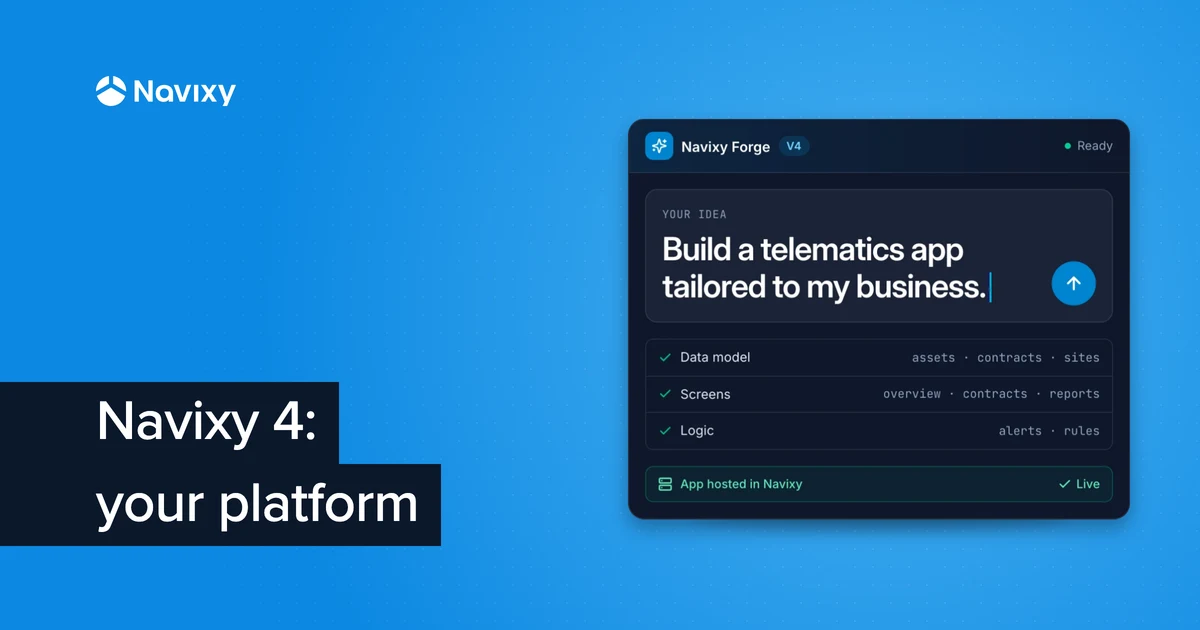
Imagine a telematics platform that doesn't limit you to a predefined set of features. Instead of navigating multiple menus to find the right report, you simply ask an AI assistant. Instead of hiring developers to build a custom app, you describe the application your business needs, and AI builds it and deploys it directly within the platform. And instead of adapting your processes to the software, you create a data model that reflects how your business actually operates.
This is the vision behind Navixy 4 — a new generation of telematics platform we're building for companies that develop and use solutions powered by connected devices and data.
Today's business needs go far beyond basic GPS tracking. Logistics companies need to manage not just vehicles, but also shipments, orders, and contracts. Construction businesses need to connect equipment data with projects, job sites, and operational workflows. And telematics service providers want to offer specialized services that solve industry-specific challenges.
Yet many telematics systems are still built around predefined objects, interfaces, and workflows. The further a company's operations move beyond these defaults, the more integrations, manual work, and custom development are needed.
With Navixy 4, we're taking a different approach: the platform should adapt to your business model.
Talk to your platform in natural language
Working with telematics data often means knowing your way around multiple interfaces. To answer an operational question, users may need to switch between maps, reports, trip histories, and other tools.
But what if you could simply ask?
- "Which vehicles deviated from their routes today?"
- "Show me construction equipment that's been idle for more than three days."
- "Compare fuel consumption across our business units over the past month."
With Navixy 4, we're developing a new way to interact with the platform through an AI assistant or agent. Users will be able to ask questions in natural language, while the system retrieves relevant data, analyzes it, and presents the results in a useful format.
And the response won't be limited to text. Depending on the task, it could be a map, a table, an analytical summary, or another visualization that helps users understand what's happening.
This changes the traditional way people interact with software. Instead of learning where every feature is located, users can start with the problem they want to solve.
That doesn't mean traditional interfaces are going away. Dispatchers will still need live maps to monitor vehicles. Managers will still want dashboards showing key performance indicators. Security teams will still need tools for investigating incidents.
The difference is that interacting with the platform will no longer be limited to predefined screens and reports.
We're moving toward a model where users can choose how they work: through a familiar interface, an AI conversation, or their own purpose-built application.
Build your own applications around your business needs
Two companies may use exactly the same GPS trackers while running completely different operations.
A logistics operator needs to monitor shipments and order fulfillment. A construction company needs to track equipment utilization across job sites and connect that information to projects. A vehicle rental business needs to manage vehicles, customers, contracts, and return dates.
A standard telematics system may provide data for all these scenarios. But that doesn't mean its built-in interfaces can support every workflow.
With Navixy 4, we want to change how telematics applications are built.
One of the key capabilities we're developing is based on the concept of vibe coding. You describe the application you want in plain language, explain what it should do, and specify the details that matter to your business. AI turns those requirements into a fully functional application using the platform's data and capabilities.
Imagine a telematics service provider working with a construction equipment rental company. The customer needs an application where managers can see available equipment, its location, active contracts, rental periods, and actual utilization.
Instead of hiring developers to build it, the provider simply describes the requirements in the Navixy chat: which data to display, what the interface should look like, and what actions users should be able to perform.
Navixy Forge will generate the application and host it directly within the Navixy platform. There's no need to find servers, configure infrastructure, or arrange external hosting.
And this goes beyond building an interface with attractive charts. The application will be able to work with live platform data, perform calculations, monitor events, send notifications, and use existing business logic.
Once created, the application can be shared with colleagues or partners, with access controlled by their roles. If the solution could benefit other businesses, it can also be published in the Navixy marketplace.
For telematics service providers and system integrators, this opens up new business opportunities. Instead of offering every customer the same set of tools, they will be able to build industry-specific products faster, adapt them to individual requirements, and turn their expertise into new services.
Navixy 4 will enable businesses to move beyond off-the-shelf telematics software and create their own AI-powered applications — without having to develop and host every solution from scratch.
Manage business assets, not just devices
Building applications around real business processes requires more than collecting GPS coordinates and sensor readings. Businesses operate with a much more complex data structure.
Behind every truck is an entire network of connected entities: a driver, a shipment, a route, a customer, and a contract. Behind every piece of construction equipment are job sites, projects, operators, usage history, and maintenance schedules.
Together, these entities and the relationships between them provide a complete picture of business operations. Yet they aren't always represented in the standard data model of a telematics platform.
With Navixy 4, we're developing an approach that will allow companies to define their own business entities, their attributes, and the relationships between them.
These might include vehicles and equipment, shipments and containers, customers and contracts, job sites, or any other entities relevant to a particular industry.
For example, a logistics company will be able to connect information about a truck, trailer, shipment, and order within a single data model. Vehicle location, sensor readings, shipment details, and customer obligations will become part of the same operational context.
This foundation will support analytics, custom applications, and automated workflows that take into account not only device data but also real business relationships.
Instead of forcing businesses to describe their operations as a collection of GPS devices, Navixy 4 will connect telemetry with the assets, entities, and processes they actually manage.
Turn data into insights and automated actions
Connected devices generate large volumes of information every day: location, speed, engine parameters, temperature, equipment status, and countless other signals.
But the value of this data isn't determined by how much you collect. It depends on how effectively you can use it to understand what's happening and take action.
That's why analytics and automation are essential parts of the Navixy architecture.
Two tools are already available today, giving companies greater flexibility in how they work with telematics data.
IoT Query provides access to data for analytical queries and makes it possible to use that data in custom reports, dashboards, and BI tools. Rather than relying only on predefined reports, companies can create and analyze the metrics that matter to their operations.
IoT Logic enables teams to build their own data processing and automation workflows. They can define conditions, process events, and trigger actions, from sending notifications to interacting with external systems.
Consider a logistics company transporting perishable goods. Simply knowing a vehicle's location and the temperature inside its refrigerated trailer isn't enough.
The company needs to detect deviations early, understand which shipments and orders may be affected, and trigger the appropriate response.
Analytics helps identify patterns and evaluate operational performance. Automation makes it possible to respond to events without constant manual monitoring.
In Navixy 4, we're bringing together customizable business data models and AI-powered interaction.
This will make it easier to build more precise workflows in which device information, business entities, and processing rules work together.
Our goal is to help companies move from simply monitoring connected assets to actively managing operations through data.
Scale your business without adding complexity
Building custom applications and services is only one part of a flexible telematics platform.
Just as important is how easily you can manage that environment as your business grows.
For a telematics service provider, every new customer brings more devices, users, configurations, access permissions, and commercial requirements. And when a provider offers multiple products across different industries, the complexity can grow even faster.
Large enterprises face similar challenges when managing multiple branches, regions, or business units.
Navixy 4 is being designed with this complexity in mind.
At the center of platform administration will be Navixy Console — a unified environment for managing organizations, workspaces, products, users, access permissions, and billing.
Instead of relying on disconnected administration tools, teams will be able to manage different aspects of the platform in one place.
For example, a telematics service provider will be able to organize multiple customer environments, enable the products each customer needs, and assign appropriate access permissions to different users. A large enterprise will be able to separate operations across departments while maintaining centralized control.
Another important direction for Navixy 4 is a flexible, usage-based pricing model.
This approach will allow companies to select the platform capabilities they need and scale their usage as their business evolves.
For telematics providers, it creates a foundation for more flexible commercial offerings. For enterprises, it offers a way to better align technology spending with actual business needs.
The idea is simple: growing your business shouldn't mean a proportional increase in the complexity of managing your technology platform.
One platform, different business opportunities
The flexibility of Navixy 4 isn't just a technical advantage. It creates new opportunities for different players in the telematics market.
Telematics service providers (TSPs) will be able to develop their own services, build specialized solutions for different industries, and offer customers more than standard GPS tracking. The platform will help providers turn their industry expertise into new products and potential revenue streams.
System integrators and developers will gain a foundation for building applications that combine connected device data, business systems, analytics, and automation. Rather than developing the entire infrastructure from scratch, they'll be able to focus on solving each customer's specific challenges.
Enterprises and operations teams will be able to build digital workflows around their own processes, from managing fleets and equipment to analyzing performance and automating operations.
In every case, the foundation remains the same: data, business entities, automation, analytics, access management, and the ability to build custom applications.
What changes is what each business chooses to build on top of it.
Navixy 4: a foundation for the next generation of telematics solutions
Telematics is evolving beyond traditional vehicle tracking.
Connected devices are becoming data sources for business applications, AI assistants, analytics systems, and automated workflows. And as these technologies become more capable, the flexibility of the underlying platform matters more than ever.
That's why we're building Navixy 4 as a composable telematics platform — a foundation that enables companies to create their own solutions using shared data, tools, and services.
We envision a future where businesses no longer have to choose between the limitations of off-the-shelf telematics software and the cost of developing entirely separate applications.
They'll be able to work with data through AI, create specialized applications, model their own business processes, and bring everything together within one technology environment.
We'll continue introducing new capabilities and demonstrating how they can help telematics service providers, system integrators, and enterprises build solutions that go far beyond traditional GPS tracking.
We're now opening early access to Navixy 4 for telematics service providers, system integrators, and businesses looking to build solutions around their own operational processes.
Want to be among the first to explore what the new platform can do? Sign up for Navixy Console and start building telematics solutions tailored to your business needs.
On this page
- Talk to your platform in natural language
- Build your own applications around your business needs
- Manage business assets, not just devices
- Turn data into insights and automated actions
- Scale your business without adding complexity
- One platform, different business opportunities
- Navixy 4: a foundation for the next generation of telematics solutions