Building reusable asset tracking services with Navixy

AuthorBenjamin Hayes
Tracking tools, equipment, returnable containers, and other temporary assets with permanently installed devices often makes little operational or financial sense. Many have no permanent power source, while others only need tracking during a rental, shipment, project, or another part of their lifecycle.
With the Queclink GL30MEU now integrated with Navixy, TSPs and solution integrators have another hardware option for these deployments. Read on to see how portable tracking hardware can work with Navixy geofences, IoT Logic, Geo Links, and analytics to build reusable asset tracking solutions around different customer requirements.
Reusable asset tracking for temporary and unpowered assets
Before we go further, let's agree on what we mean by reusable asset tracking here. We're talking about a portable tracker that is assigned to an asset for as long as tracking is needed, then returned, recharged, and used for another assignment. The same hardware can serve multiple assets over time.
You probably know the type of project. A rental company wants to track generators or equipment while they are with customers. A construction business moves tool kits between sites. Returnable containers circulate between warehouses and customer facilities. A logistics provider needs additional visibility for a particular high-value shipment, but has no reason to keep the tracker attached after delivery.
The interesting part for a TSP is that the number of trackers does not necessarily have to match the total number of assets. Let's say a rental operation has 200 pieces of equipment, but only 40 are typically away from the depot at any given time. A pool of portable trackers can follow the equipment currently in circulation and be reassigned as it returns.
Battery life and reporting for reusable deployments
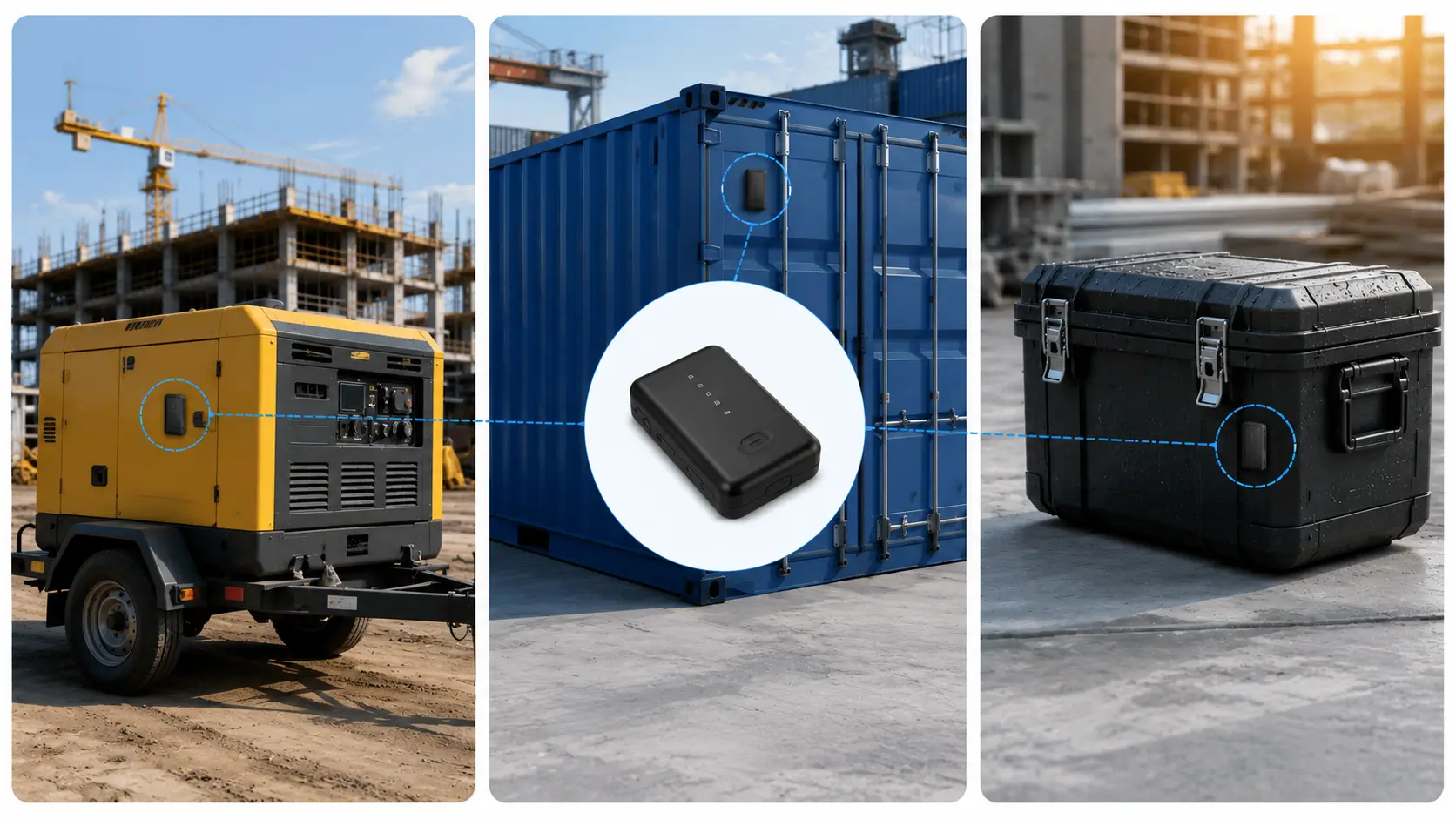
The newly integrated Queclink GL30MEU is a compact rechargeable tracker with multi-constellation GNSS, Wi-Fi scanning, BLE 5.2, a three-axis accelerometer, and IP67 protection. For reusable deployments, two characteristics are particularly relevant: how long it can stay in the field and how easily it can be prepared for the next assignment.
Queclink estimates around five days of operation with five-minute reporting, eight days with ten-minute reporting, 16 days with hourly reporting, and up to 190 days with one report per day under the manufacturer's specified test conditions. A TSP can set reporting according to the assignment, with frequent updates for a short high-value shipment or longer operating time for equipment expected to stay away for weeks.
When devices return, Queclink's 10-in-1 magnetic charging kit allows multiple GL30-series trackers to be charged together before they go back into circulation.
That covers the hardware side. Once the tracker leaves with an asset, the question becomes what you can do with its data in Navixy.
You might also want to explore all devices integrated with Navixy
Set the boundaries and handle the exceptions
Let's keep following the rental equipment example. The tracker has left the depot with a generator and is reporting its location. The moments worth paying attention to are its arrival at the customer site, movement outside the agreed operating area, an unexpected departure, and eventually its return.
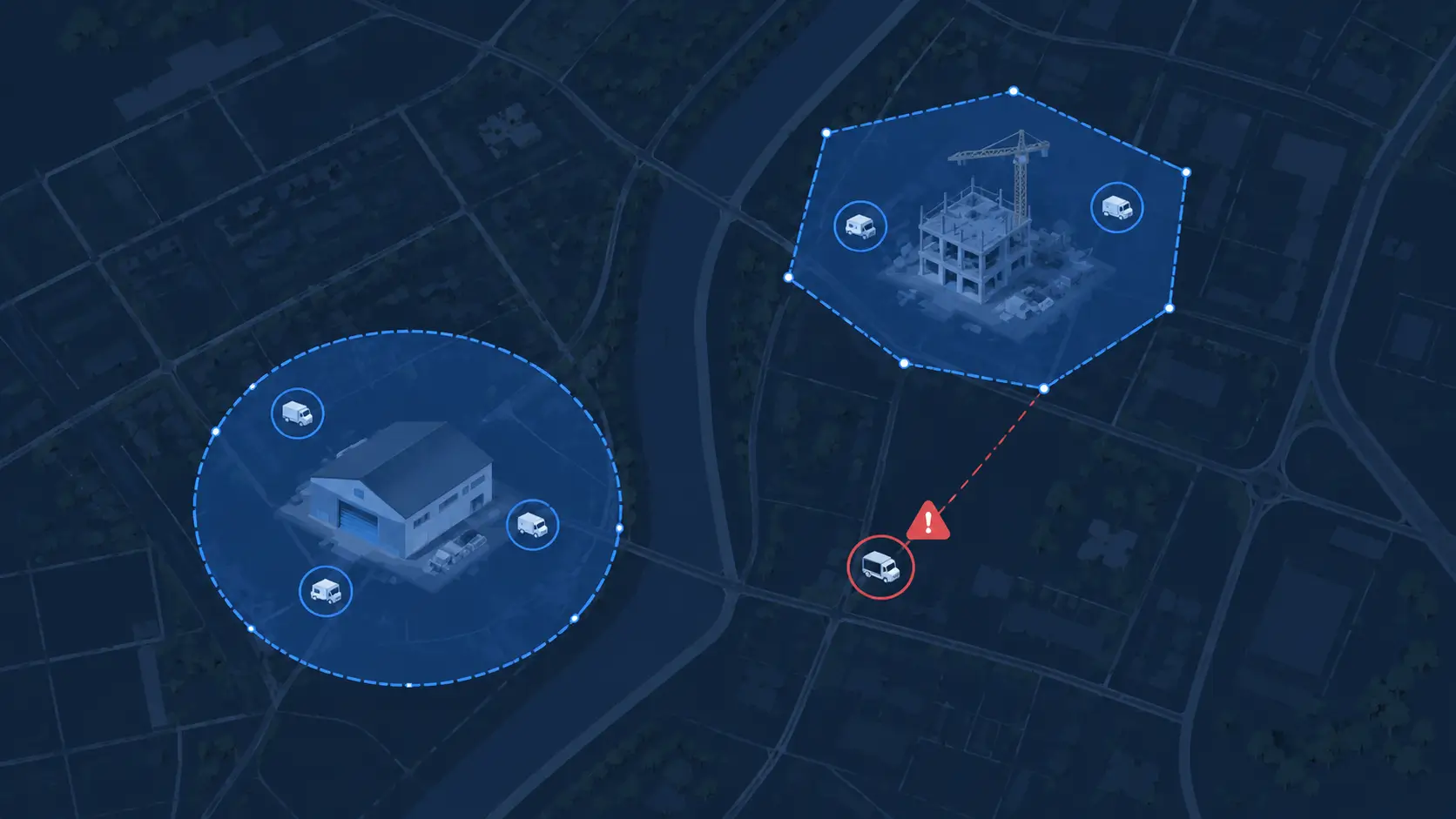
Navixy geofences provide the location context for those events. Depots, customer facilities, construction sites, permitted operating areas, and routes can be represented as circular, polygonal, or corridor zones. Instead of treating every new coordinate equally, the service can work with entries, exits, and visits to places that matter to the operation.
Change the assignment and the geography changes with it. For returnable containers, the important locations might be a distribution center and a network of customer sites. For construction equipment, it could be the current project boundary. For a temporary shipment, it might be the origin, destination, and expected route. The same tracker can go out again with a monitoring setup that reflects the new job.
Add the conditions that matter to the customer
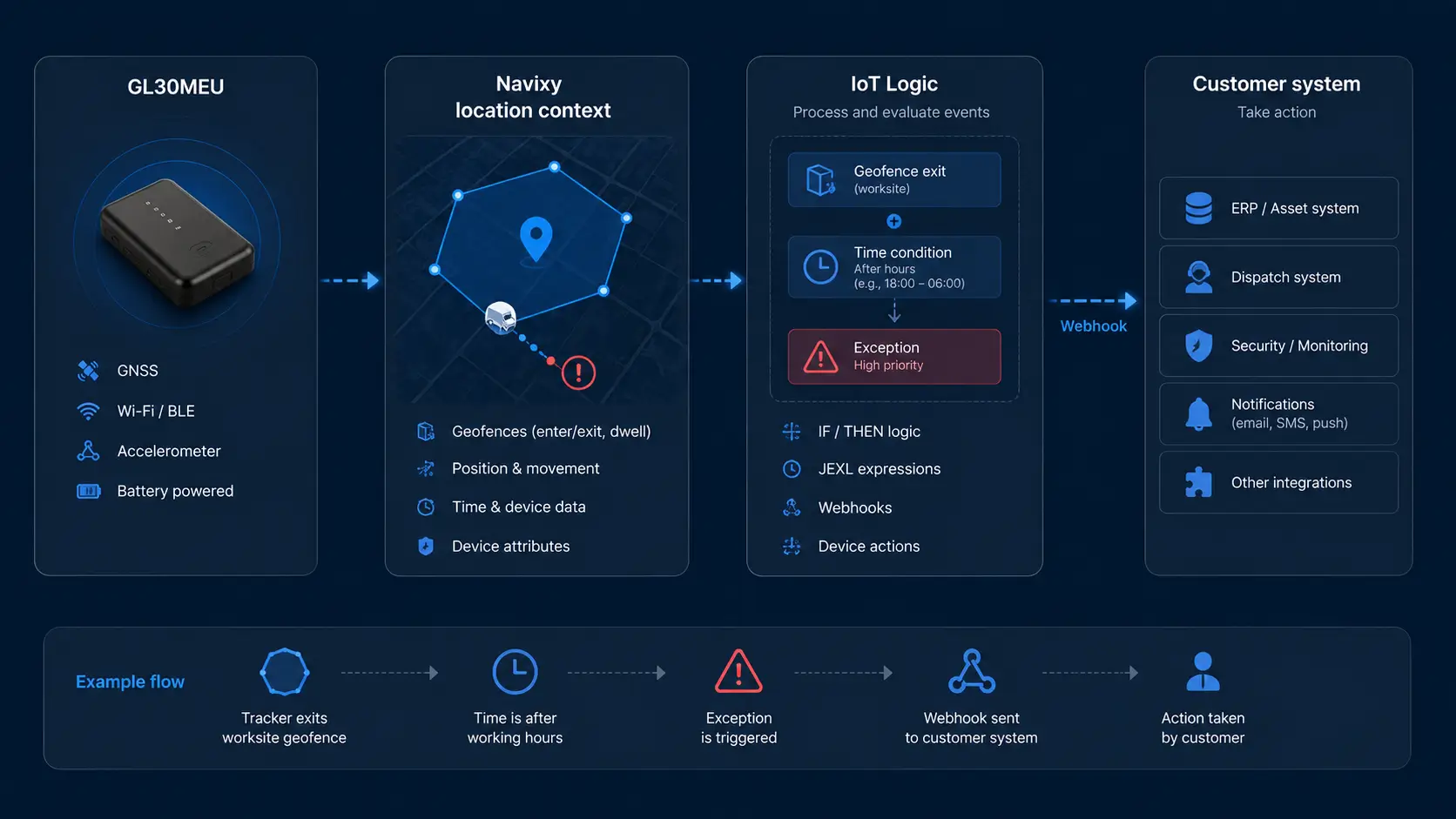
Suppose that generator leaves the customer site. At 2 p.m., that could simply mean the rental is over. At 2 a.m., the same geofence exit deserves a closer look.
IoT Logic lets an integrator evaluate that event in context. IF/THEN logic can check the relevant conditions, JEXL expressions can calculate or transform attributes when needed, and webhooks can pass the result to an ERP, dispatch application, security system, or another service the customer already uses.
For the rental company, an after-hours geofence exit could become an exception in its security or dispatch workflow. A returnable-container operation could use arrival at a customer site as an input to another business process. With the required timing and business data available, the same approach can be used to flag excessive dwell.
The tracking event does not have to end as an alert inside Navixy. It can become an input to the process the customer already uses to deal with the situation.
The specific device attributes used in a flow should match the model-level data available through the GL30MEU integration. This is worth checking during solution design whenever a workflow depends on something beyond basic location data and events.
Share the asset, not the platform
Our generator has reached the customer. They may need to see where the equipment is, but that does not necessarily call for a permanent account in the telematics platform.
Geo Links let Navixy users share selected tracking information for a limited period. A rental customer can receive access while the equipment is in their custody. A shipment recipient can follow an asset until delivery. A contractor can see the equipment relevant to a particular project.
In a reusable tracking service, access can follow the assignment. The tracker goes out with the asset, the relevant party gets visibility for the period they need it, and the link can expire when the assignment ends.
Use the history to understand asset circulation
Eventually the generator comes back. After a few months of similar assignments, our hypothetical rental company also has a record of how equipment moves through its customer network.
Perhaps one site routinely keeps equipment several days longer than others. Some assets may spend considerably more time away from the depot than expected. In a returnable-container operation, the same history could reveal locations where containers regularly accumulate or return cycles consistently run long.
IoT Query gives solution developers SQL access to Navixy telematics and business data for this kind of analysis. Geofence visit data can provide entry and exit times and visit duration, while other available telemetry and business data can be brought into customer-specific analysis.
A rental business could compare dwell by location or customer. A container operator could look for sites associated with long return cycles. Equipment tracking projects could use the same data to examine utilization or recurring location exceptions. The questions change with the operation, but the history is already being collected as part of the tracking service.
Reusable hardware can support more than one service
The next time our GL30MEU leaves the depot, it may not be attached to a generator at all. The customer may have different assets, locations, reporting requirements, and operating rules.
For a TSP, a pool of portable trackers can therefore support different types of asset tracking projects. The same hardware may spend one assignment monitoring rental equipment, another following a returnable container, and the next providing additional visibility for a temporary shipment. What the service does around that tracker can be configured for the customer and the job.
This makes the GL30MEU a useful addition to the Navixy device portfolio for reusable asset tracking. It gives TSPs and solution integrators another portable hardware option for a range of customer projects, with Navixy available to build the monitoring and workflow around each one.
If you're considering reusable asset tracking for your own business or working on a customer scenario with similar requirements, contact us to discuss what you could build with Navixy.
Frequently asked questions
What is reusable asset tracking?
Reusable asset tracking uses portable tracking hardware across multiple assets or assignments. A tracker can accompany equipment, a container, a shipment, or another asset while visibility is required, then return for charging and reassignment.
What assets are a good fit for reusable GPS tracking?
Typical scenarios include rental and construction equipment, tool kits, returnable containers, temporary cargo, and other assets that lack permanent power or only need tracking for part of their lifecycle. The setup can be configured around assignment duration, reporting frequency, operating environment, and the customer's monitoring requirements.
How does the Queclink GL30MEU work with Navixy?
The GL30MEU provides the portable tracking hardware and location data. Navixy provides the platform capabilities around that data, including geofences and location monitoring, IoT Logic for event processing and integrations, Geo Links for controlled external visibility, and IoT Query for working with historical telematics data.