How raw tracker data protects your reports, audits, and analytics

AuthorRoman S, Product owner, Navixy IoT Logic and Integrations
Every telematics service provider has been here. A customer doubts last month's fuel report and wants to see what the fuel level sensor actually sent. If the original readings were kept, the conversation is short and to the point. You show what the sensor reported, check the calculation, and recalculate the report if needed. That's why Navixy Data Gateway passes GPS tracker data on exactly as it arrived.
Why keep raw data when the reports are already there
Liters, engine hours, battery levels, and every report built on them are calculated from tracker readings using formulas and settings. People configure those settings, so mistakes happen. In practice, three situations come up most often.
- The formula is wrong. Say battery level is converted from voltage with the wrong formula, and the screen shows 10% instead of the real 60%. If the original voltage was kept, you fix the formula and recalculate the history.
- The parameter isn't configured yet. The tracker already sends temperature readings, but the platform has no sensor or report set up for them. When the report is needed, the past weeks of history are already there.
- The tracker changed its data format. After a firmware update, the tracker starts reporting temperature in tenths of a degree, and the report shows 215 °C instead of 21.5 °C. Since the raw values were kept, we adjust the formula and recalculate the history.
In all three cases, the original data works as insurance. Any calculation can be checked and rerun as long as you still have what the tracker sent.
Want to see how it works? Open the Navixy console and explore how the platform handles original tracker data.
How Navixy Data Gateway receives telematics data
In the updated Navixy platform, Data Gateway is the telematics gateway that serves as the single entry point for device data. Its main job is to bring data from trackers of different manufacturers into one data model, so readings from different brands can be compared with each other. Devices connect to the gateway over TCP, UDP, HTTP, or MQTT, and vehicles with factory telematics come in through OEM activation, with no extra hardware.
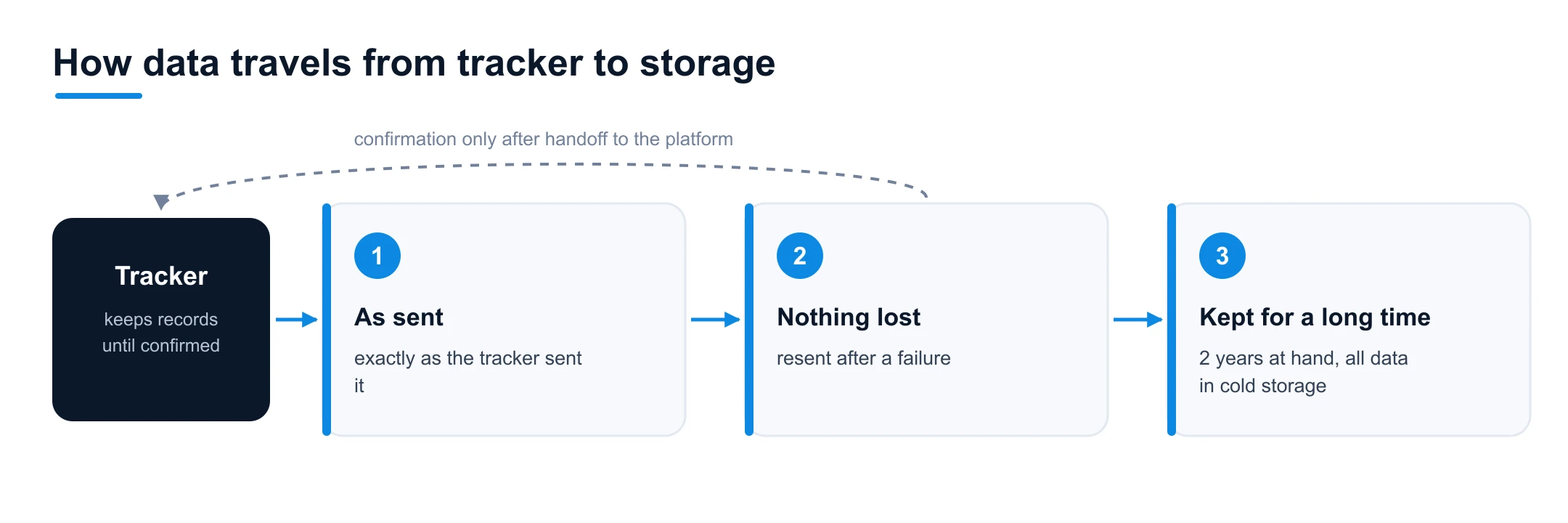
Values stay exactly as the tracker sent them
Protocol parsing is handled by IoT Protocol Decoder. Together with it, the gateway converts data to the unified Navixy format, where fields that mean the same thing have the same name across all devices. The values themselves, however, are not recalculated. Serial number 007312 arrives with its leading zeros, voltage stays voltage, and the input list contains everything the tracker actually sent.
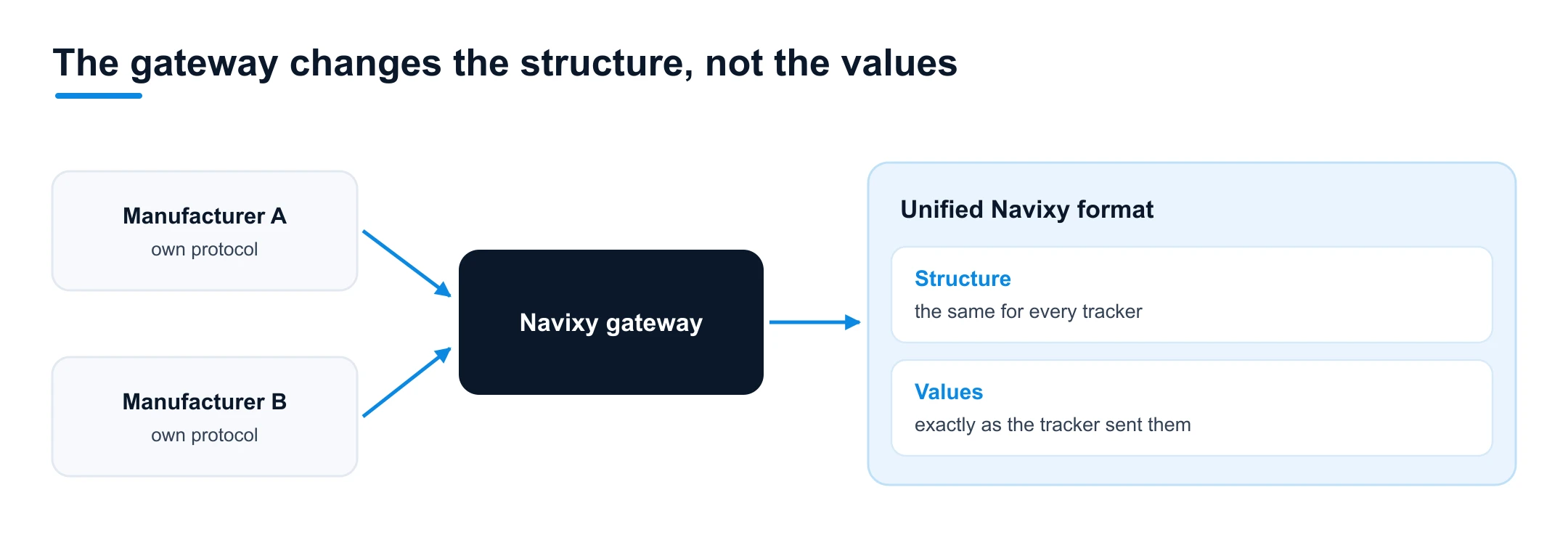
How the gateway guards against missing records
A tracker keeps records in memory until the server confirms receipt. The gateway sends that confirmation only after the record has been passed on to the platform. If something breaks along the way, the tracker never gets the confirmation and sends the records again, and duplicates are filtered out where needed. As a result, a temporary failure on the server side usually means a delay rather than a hole in the history. This holds as long as the tracker has enough memory and power to keep its records.
History is kept for a long time
Storage is handled by IoT Data Storage. Two years of history are available right away, and all data also goes to cold storage, including data the platform can't work with yet. You can put it to use later.
What this gives you and your customers
A disputed report can be checked and corrected. Back to the customer with the fuel report. Your team compares the fuel level sensor's original readings with the calculated liters and finds an error in the formula. The formula gets fixed, the report is recalculated from the same saved readings, and the customer receives a corrected report along with an explanation of what went wrong. Nobody has to collect data from the vehicles again.
You come to any review with data. An auditor or insurer can see separately what the tracker sent and what the platform calculated from it. We should say up front that raw data alone doesn't guarantee acceptance as evidence, and Navixy doesn't certify it. The reviewer will also look at sensor calibration, timestamps, and regulatory requirements. But with the original records in hand, the conversation goes noticeably smoother. We covered why a thermometer isn't a cold-chain record in a separate article.
A new report without new hardware. If a customer asks for temperature history in their refrigerated trailers or engine hours from the CAN bus, and the trackers already send those values, the report is built from what the fleet is already sending.
Developers and analysts don't need their own parser. Telematics data from every tracker model arrives in one format with the original values intact. Analysts can reuse the saved history instead of collecting data from devices again.
To unlock the full potential of this data, there's Navixy IoT Logic. In the visual editor, via API, or with the AI Assistant, you build processing flows: calculate new parameters with formulas, set conditions, and send the results to your own systems.
You can recalculate anything, except what was lost
Formulas get fixed, calibrations get updated, and customers come with requests nobody had in mind a year ago. All of this is possible as long as you still have what the tracker sent. So think of raw data not as an archive, but as a safety margin for everything you build on the platform.
Want to see how Navixy Data Gateway would handle data from your trackers? Get in touch, and we'll walk you through it.