Driver verification to reduce risks and costs in public transportation

AuthorRoman S, Product owner, Navixy integrations
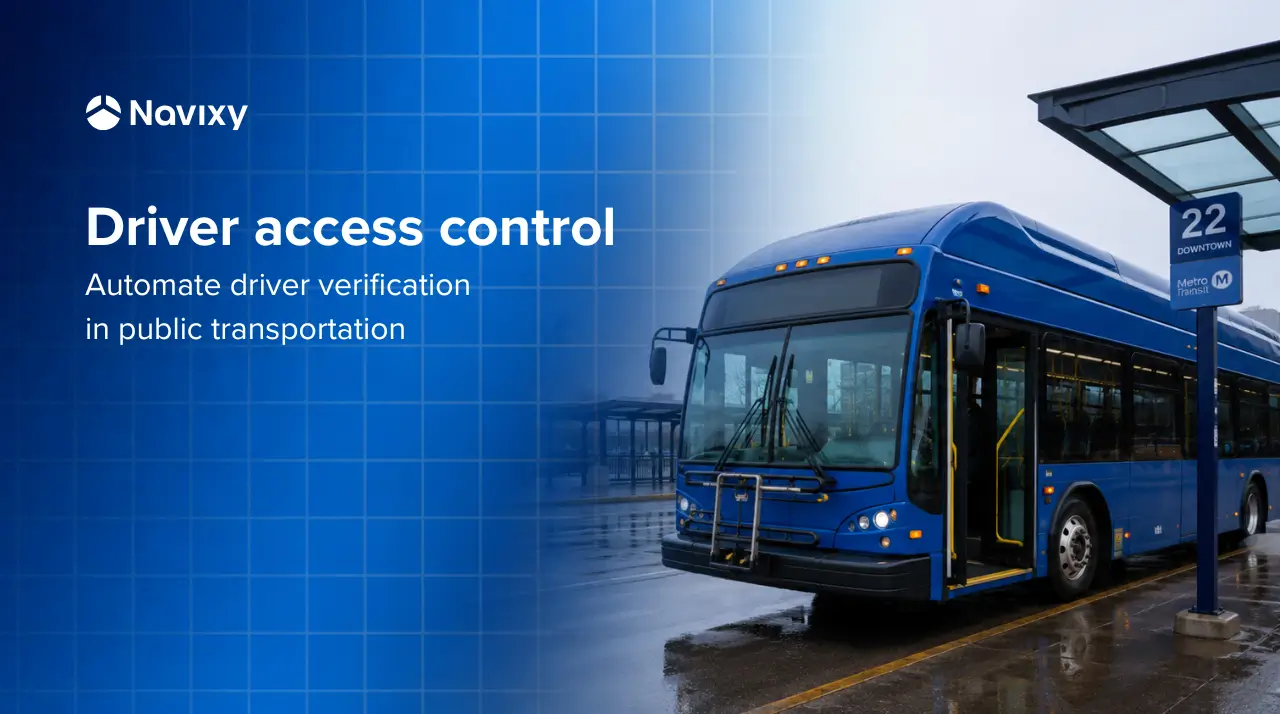
Unauthorized vehicle usage in public transportation can lead to fuel losses, vehicle downtime, compliance issues, and costly incident investigations. In many fleets, shared physical keys make it difficult to verify who actually started and used the vehicle. Turns out someone probably had the key is not a particularly strong audit trail.
Automated driver verification solves this by linking every ignition event to an identifiable driver and enforcing access policies automatically before the vehicle even starts.
In this article, we’are looking at how a public transportation company can use this approach to improve fleet accountability and reduce risk across its operations.
TL;DR
- Lack of driver accountability increases operational and financial risks across fleet operations.
- Automated driver verification links every ignition event to an identifiable driver.
- Unauthorized access attempts can automatically trigger alerts or immobilization workflows.
- The result is stronger accountability, better policy enforcement, and fewer “who took the bus?” situations.
Vehicle access control challenges in public transportation fleets
A regional public transportation company operates dozens of buses across several depots. Drivers rotate between shifts, supervisors exchange keys during busy hours, and vehicles remain active almost around the clock.
And, honestly, most days, everything works normally. Until something happens.
That might be a vehicle appearing outside its assigned route. A sudden spike in fuel consumption. A bus leaving the depot after operational hours. A minor incident with nobody being able to clearly confirm who actually started the vehicle.
And suddenly, a very simple operational question becomes surprisingly difficult to answer:
Who had access to the vehicle?
This is one of the biggest accountability challenges in public transportation fleets. When vehicle usage cannot be reliably linked to specific drivers, unauthorized trips, policy violations, and misuse become much harder to detect and investigate.
The consequences go far beyond security alone:
- incident investigations become slower
- compliance issues become harder to resolve
- operational misuse may go unnoticed
- insurance exposure increases
- fleet visibility deteriorates over time
And in large transit environments with rotating shifts, subcontractors, and shared vehicles, manual oversight alone rarely scales well enough to maintain consistent accountability.
Want to know exactly who started every vehicle in your fleet? Talk to our team about automating driver verification.
Traditional vehicle access control limits accountability
Traditionally, public transportation fleets have relied on physical keys, depot supervision, paper logs, and shift schedules to control vehicle access.
These methods are familiar, relatively inexpensive, and operationally simple. But they also depend heavily on human oversight. And humans, unfortunately, continue to behave like humans.
Keys might get shared between shifts, vehicles get accessed outside assigned hours, or supervisors become busy and logs might become incomplete. Policies exist, but enforcement becomes inconsistent across large fleets operating 24/7.
As a result, fleet operators often struggle to answer basic operational questions:
- Who started the vehicle?
- Was the driver authorized?
- Did the ignition happen during an assigned shift?
- Was the vehicle used according to company policy?
When incidents occur, reconstructing events may require manually reviewing schedules, comparing records across systems, and speaking with supervisors or drivers after the fact. Doesn’t feel efficient.
Automated driver verification as a more controlled approach to vehicle access
A different approach is automated driver verification, which connects vehicle access directly to driver identity. As a result, fleet operators gain a clearer view of vehicle usage and a more reliable foundation for incident investigations, policy enforcement, and compliance management.
Fleet teams can identify policy violations more quickly, spend less time reconstructing events after incidents, and maintain more consistent oversight across multiple depots, shifts, and vehicles.
For organizations operating large public transportation fleets, automated driver verification can also improve operational visibility without increasing administrative effort.
Let's look at a practical example.
Case study: Vehicle access control in a multi-depot bus fleet
A regional public transportation company operates a fleet of buses across multiple depots and rotating driver shifts.
Like many transit operators, the organization relies on physical vehicle keys distributed between drivers and supervisors. While operationally simple, this approach provides limited visibility into who actually starts and uses vehicles throughout the day.
To improve vehicle access control and driver accountability, the company implements an automated driver verification workflow using IoT Logic and RFID-based driver identification.
When a driver turns the ignition on, the workflow automatically:
- checks whether the detected RFID key belongs to an authorized driver
- verifies the ignition event
- allows normal vehicle operation for approved drivers
- triggers alerts and immobilization procedures for unauthorized access attempts
Because every ignition event becomes linked to a specific driver identity, dispatchers and fleet managers gain a clear audit trail across the fleet without relying on manual logs or depot supervision.
The workflow also continues forwarding telemetry data even after unauthorized ignition attempts, allowing operators to monitor vehicle location and activity in real time.
The workflow shown in this example is available as a ready-to-use driver verification template in IoT Logic. Rather than building the logic from scratch, organizations can use the template as a starting point and adapt it to their own vehicle access policies, authorization rules, and operational processes.
Request a demo to learn more about templates in IoT logic
Let's break it down.
How the vehicle access control workflow works
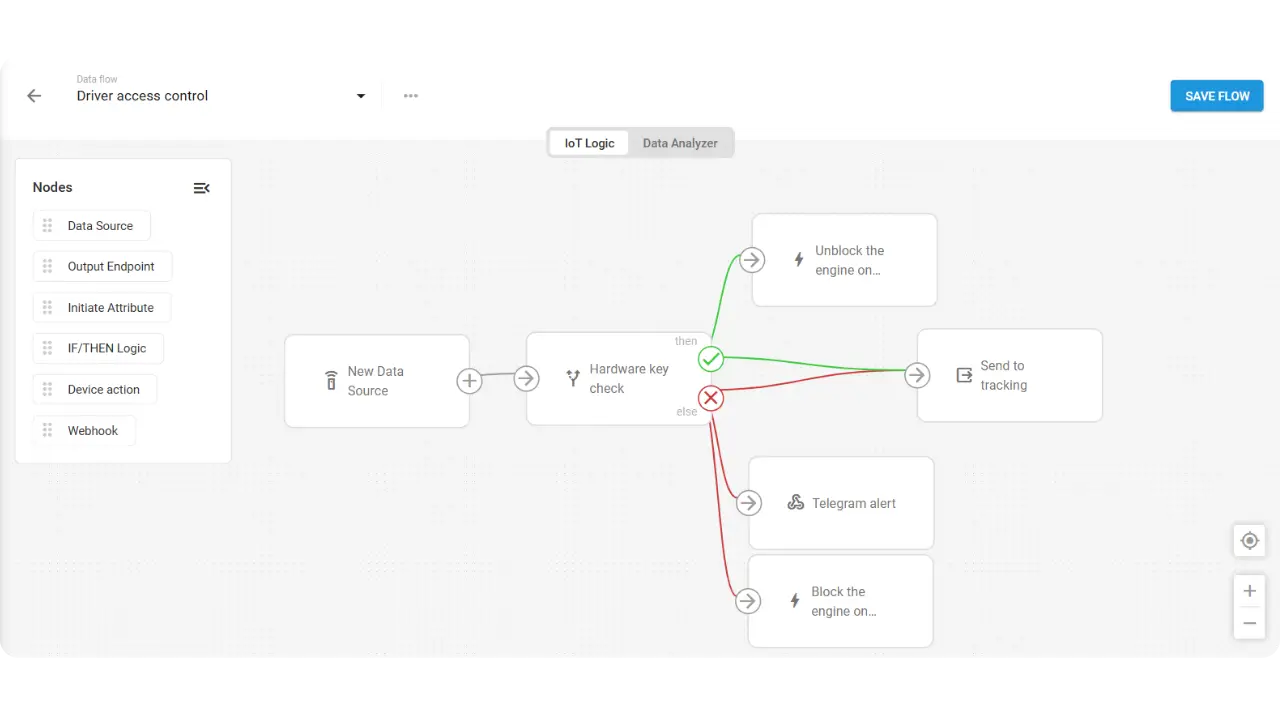
The workflow begins when a vehicle sends telemetry data to the IoT Logic environment. At the moment the ignition is activated, the system evaluates the event together with the driver identification data received from the authentication device.
The verification logic checks whether the ignition event is valid and whether the detected driver identifier belongs to an approved driver. If both conditions are met, vehicle operation continues normally and telemetry data keeps flowing as usual.
If the system detects an unauthorized driver, it can immediately trigger a Telegram alert and send an engine block command. At the same time, telemetry remains active, allowing fleet operators to continue monitoring the vehicle's location and activity.
One important detail is that authorization is validated during the ignition event rather than continuously throughout the trip. This approach reduces unnecessary processing while enforcing access control at the moment when it matters most, before vehicle operation begins.
Building on the workflow
Although this workflow focuses on driver verification and vehicle access control, the same logic can be extended into broader operational automation scenarios.
Public transportation companies can customize the workflow to support:
- shift-based authorization
- depot geofencing
- contractor-specific access rules
- multi-channel alerts
- dispatch system integrations
- certification validation
- escalation procedures for unauthorized usage attempts
For example, a fleet operator could allow ignition only during scheduled shifts or only within approved depot locations. Another variation could automatically notify dispatch teams or supervisors whenever unauthorized ignition attempts occur outside operational hours.
Because the workflow is built around configurable automation logic, organizations can adapt it to their own operational policies and compliance requirements.
Driver verification as a risk management tool
The biggest benefit of automated driver verification is not simply knowing who started the vehicle. It is creating a reliable chain of accountability behind every operational event that follows.
When ignition events are linked to verified drivers, fleet operators gain confidence in the accuracy of incident investigations, compliance records, fuel analysis, maintenance histories, and operational reporting. Instead of relying on assumptions, supervisors can make decisions based on verified data.
As public transportation organizations continue adopting connected fleet technologies, the quality of operational data becomes increasingly important. Vehicle location, fuel consumption, route performance, and safety metrics all become more valuable when they can be tied to a confirmed driver identity.
In that sense, driver verification is not only an access control mechanism. It is a foundation for more transparent, accountable, and data-driven fleet operations.
Ready to replace assumptions with verifiable driver accountability? Book a demo and explore automated vehicle access control with Navixy.