Fleet Routing & Scheduling app: reclaim hours and cut fuel costs

AuthorNatalia A., Customer Success Manager
According to McKinsey & Company, last-mile delivery represents 53% of total shipping costs, and route inefficiency is one of the few controllable levers fleet operators can pull today. For last-mile delivery fleets especially, where every stop matters, the planning layer is where the day is won or lost.
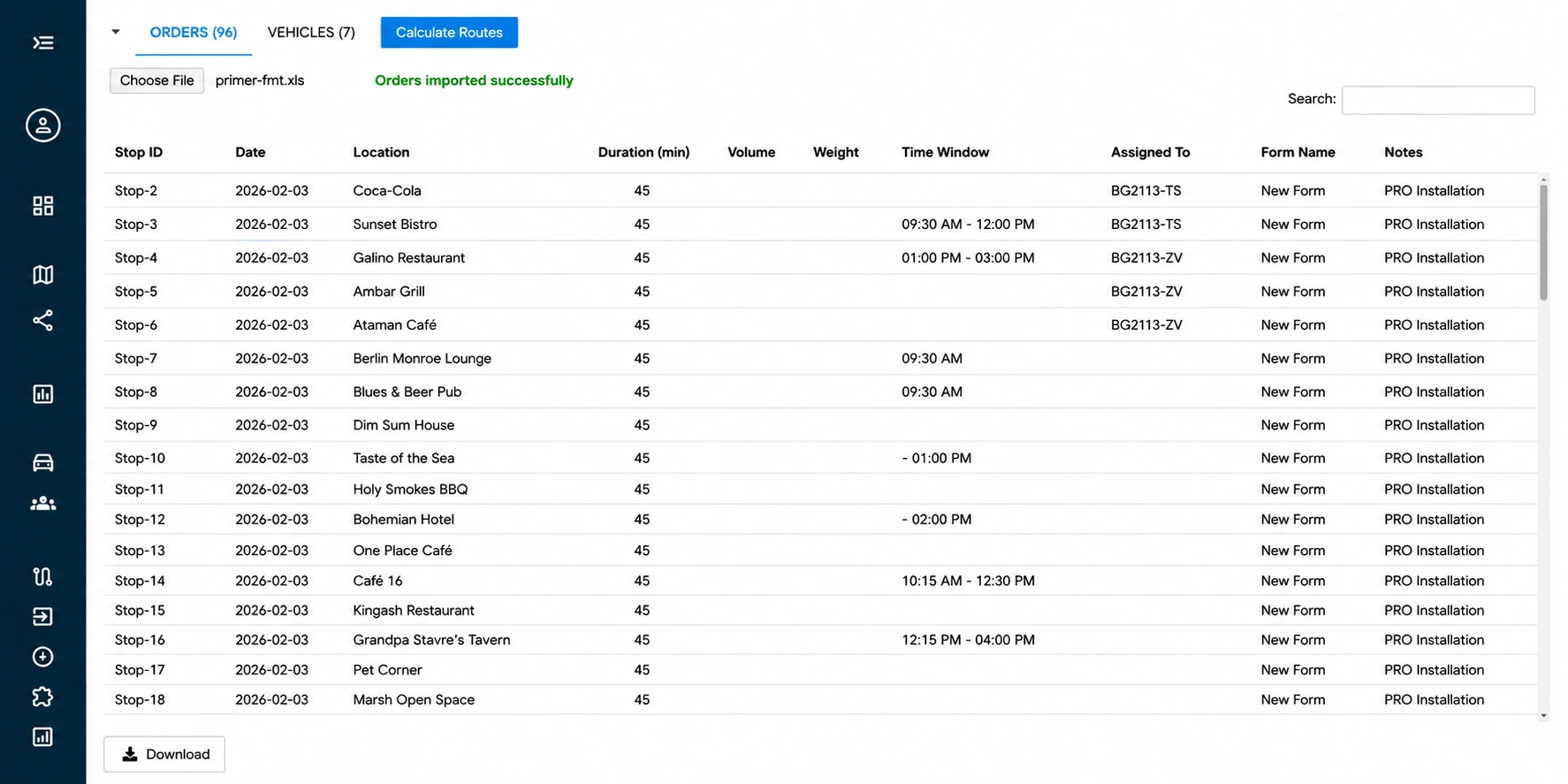
In practice, that inefficiency lives in the gap between what a dispatcher can calculate and what is mathematically possible. A fleet of 7 vehicles and 96 orders has a combination space too large for any human to fully evaluate. Manual routing by experienced dispatchers typically runs 15–25% longer than an optimized solution, not from error, but from the limits of what is humanly calculable. That deviation is the difference between a profitable day and a losing one.
The Fleet Routing & Scheduling application, built on the Navixy telematics platform, applies dynamic route optimization to treat route planning as a constraint satisfaction problem, not a scheduling task.
The result is a set of routes that respect every constraint simultaneously: time windows, vehicle loads, driver hours, start and end locations. The dispatcher still owns the judgment calls, from handling loyal customers who need special attention to applying shortcuts only a local driver knows. The optimizer handles the combinations; the dispatcher handles the context.
How fleet route optimization works in practice
A well-designed route optimization workflow consists of four steps:
1. Import orders from Excel or API. A real fleet doesn't want to re-enter data. Orders come from ERPs, CRMs, or a dispatcher's spreadsheet. The system ingests them with all relevant fields: location, duration, time window, priority, assigned vehicle (if pre-assigned), and notes. In a 96-order run, this takes seconds, not an hour.
2. Configure the vehicle fleet. Each vehicle gets its real constraints: cargo capacity by volume and weight, driver working hours (e.g., 8 a.m. to 4 p.m.), start and end depot. The solver uses these to eliminate infeasible assignments before it even starts exploring sequences.
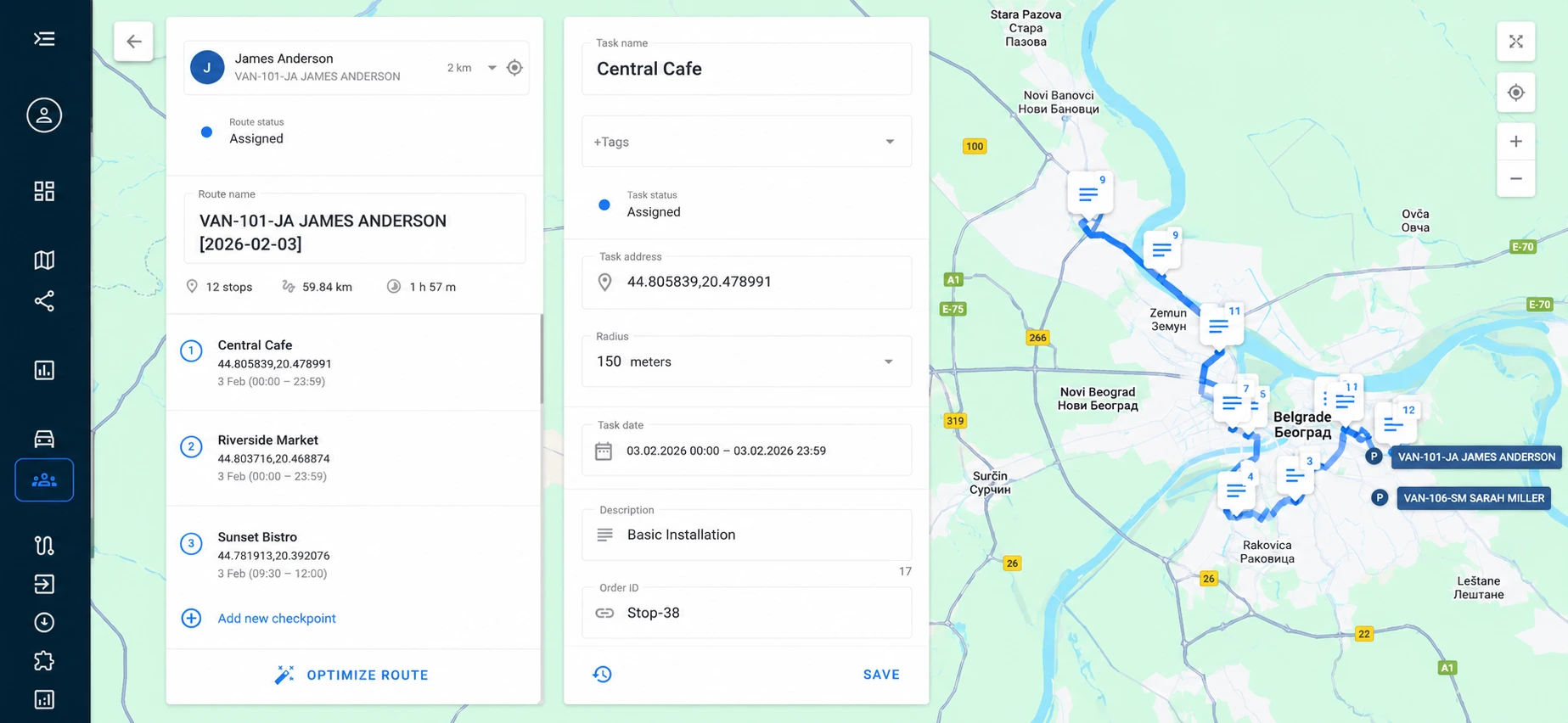
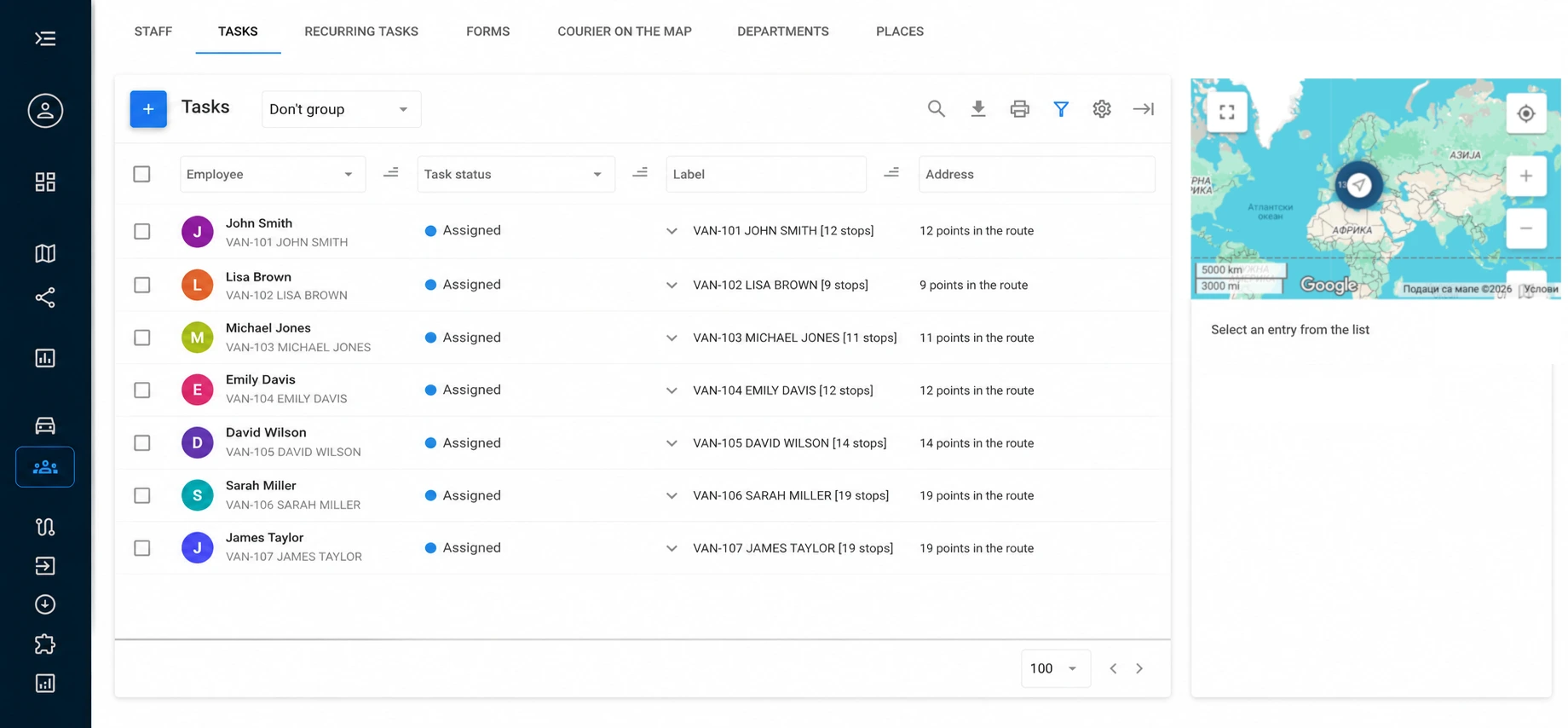
3. Run the optimizer. The solver returns a set of routes, one per vehicle, with per-stop arrival times, travel distances, and total route metrics. A real 7-vehicle, 96-order run produces 458 km of combined fleet routes across 6 hours 50 minutes. A 20% efficiency gain on that baseline means roughly 90 km less driving per day, directly off the fuel bill.
4. Export to the field, directly to drivers. Routes don't stay in a spreadsheet. They get pushed to drivers' devices, where the execution platform tracks live progress and lets drivers and dispatchers adapt if reality diverges from the plan. Navixy's route optimization API is available for teams building custom integrations, but most fleet operators want this handled at the application layer, not in code.
How fleet route optimization app works with Navixy
Fleet Management Team DOO, a Navixy partner, built Fleet Routing & Scheduling to close the loop between planning and execution on the Navixy platform.
Orders are imported from Excel or via API. The optimizer runs against the fleet's real constraints. The output routes are exported directly to Navixy's X-GPS Tracker app, a mobile app for field teams to receive assigned routes, navigate to each stop, and confirm task completions in real time. Each driver's route becomes a live task sequence with checkpoints, stop details, and progress tracking. Dispatchers see the fleet executing the plan in real time; drivers get their tasks on the mobile app without a separate briefing call.
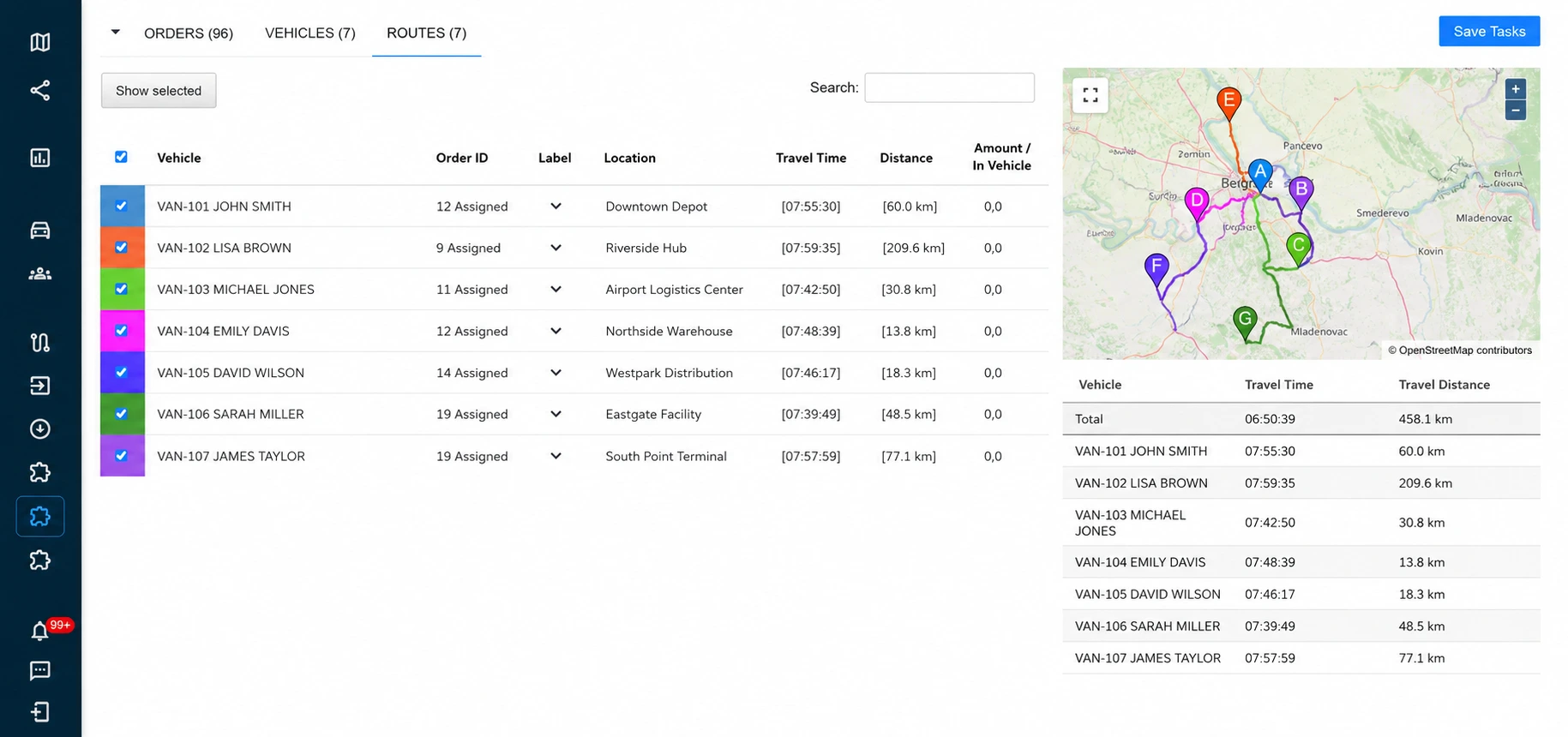
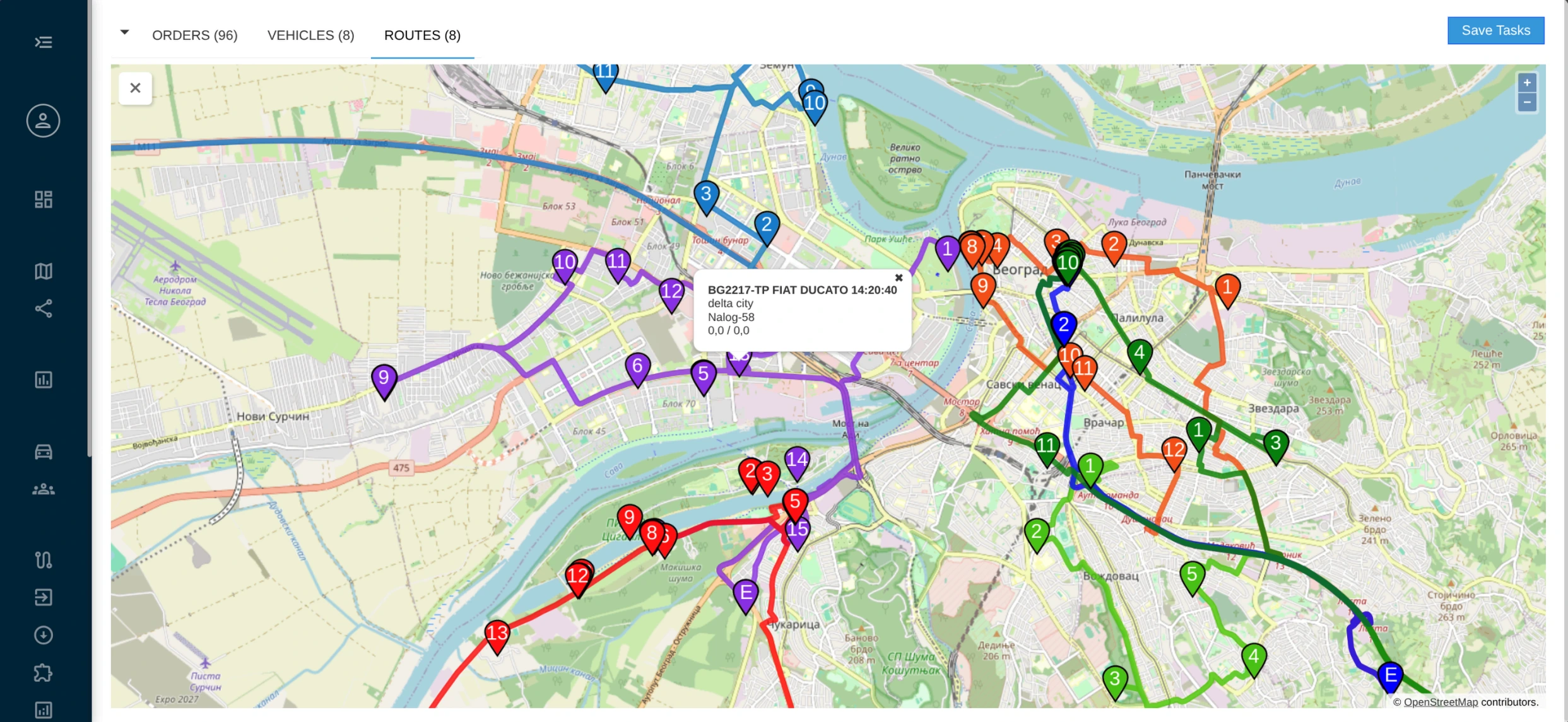
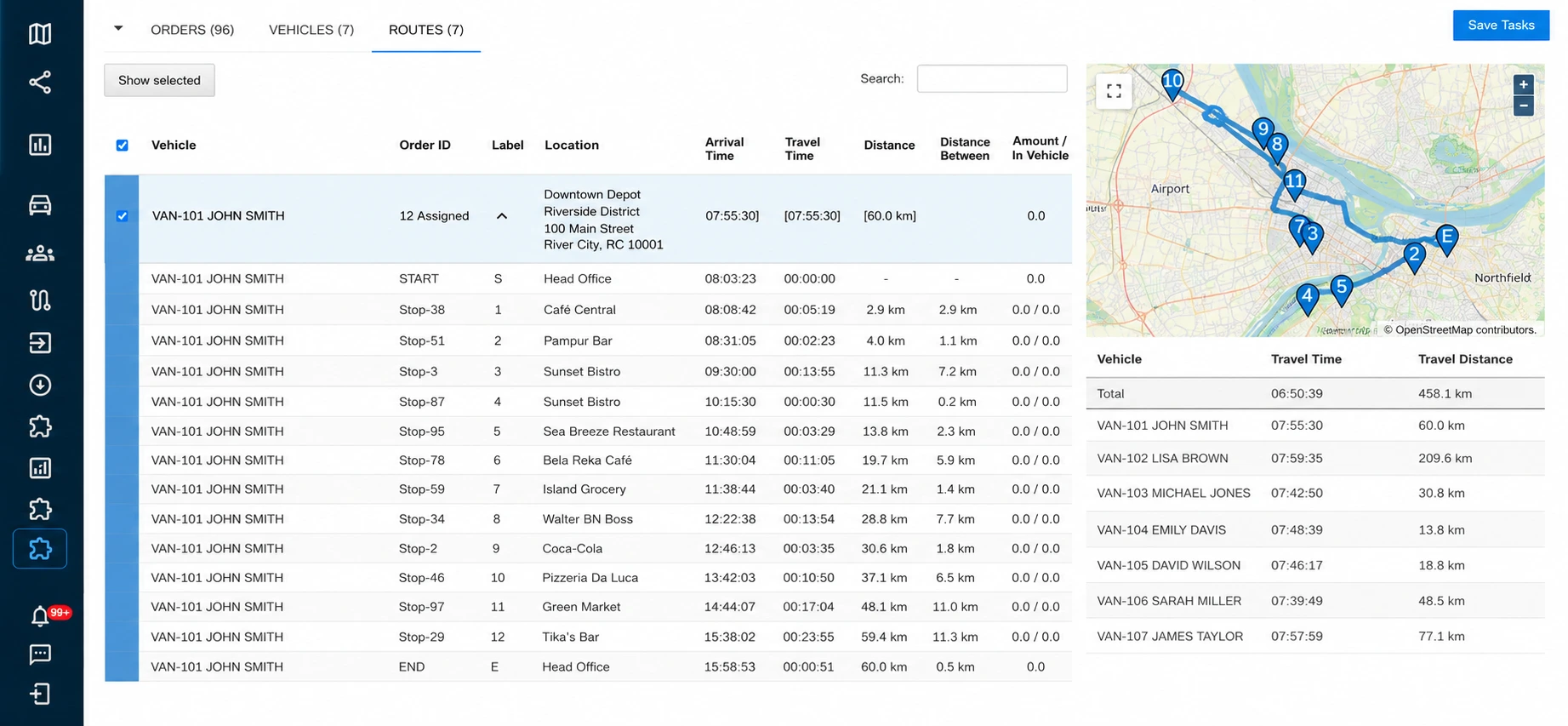
In deployments reported by Fleet Management Team DOO, fleets have achieved up to 20–30% reduction in fuel costs and a 15–25% improvement in delivery efficiency, attributed to reduced unnecessary detours and more accurate time-window planning. Results vary with fleet size, order density, and geographic constraints.
Once the optimizer has produced the routes, the Navixy platform ensures the plan is followed, deviations are visible, and completed stops are recorded. Planning and execution become one workflow rather than two disconnected systems.
What to check before you optimize
Fleet route optimization software is only as good as the inputs. Before running the solver on your fleet, verify:
- Order data is complete. Every stop needs a geocoded address, a realistic service duration, and a time window if one exists. Missing or wrong time windows are the most common reason optimized routes fail in the field.
- Vehicle constraints are accurate. Capacity figures in the system must match what vehicles actually carry. An optimizer that doesn't know a vehicle is at 80% capacity will overfill it.
- Depot start/end logic is configured. If drivers start from home or from different depots, this needs to be set per vehicle, not assumed to be a single central depot.
- A process exists for day-of changes. The optimizer produces the best plan for the information it has. When reality changes, there needs to be a clear handoff: who updates the route, who notifies the driver, how the dispatcher sees the deviation.
Getting these four things right turns route optimization from a planning tool into an operational one.
The shift worth making
As order volumes grow, vehicle fleets expand, and customer expectations for time windows tighten, the gap between what a dispatcher can calculate and what an optimizer can calculate widens. The cost of that gap lands directly on the fuel bill and the delivery success rate.
Fleet route optimization software doesn't require replacing your dispatcher or rebuilding your operations. It requires feeding the optimizer clean data, respecting its output as a starting point rather than a final answer, and connecting the plan to live execution.
The Fleet Routing & Scheduling app, built on the Navixy platform, is available for fleets looking to close that gap.
Reach out to your Navixy manager to understand its capabilities and how it fits for your operation.