The cold chain has a floor: the freeze risk monitoring can miss
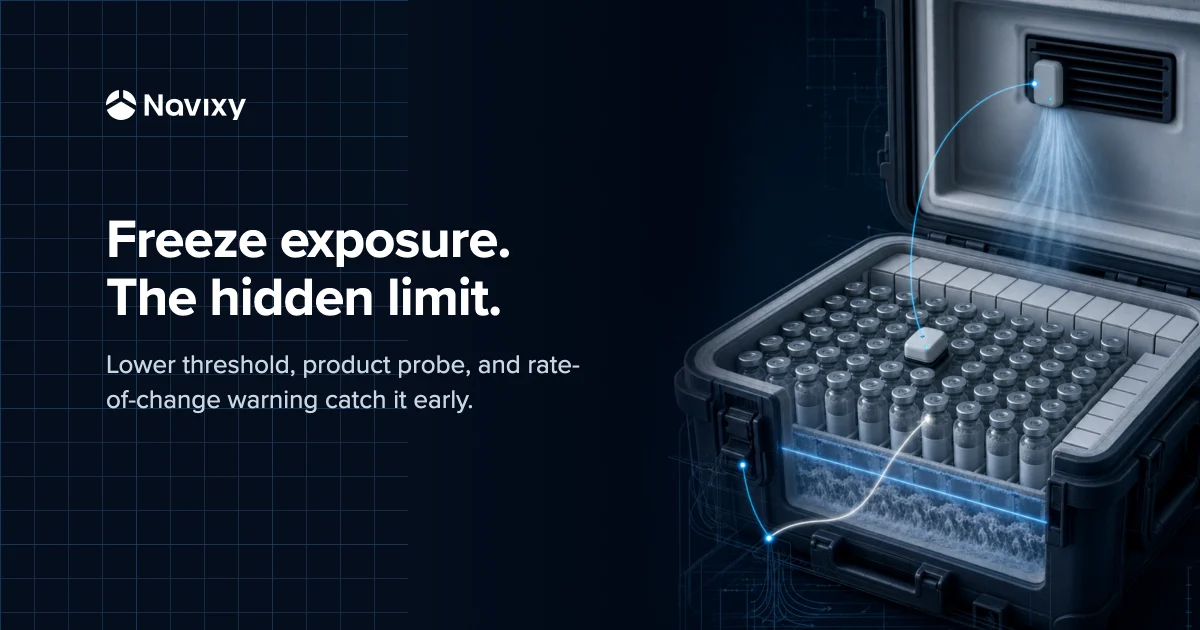
Cold-chain monitoring is usually ready for heat. The quieter risk sits at the other end of the range: a freeze-sensitive vaccine can be damaged when the product drops below its lower temperature limit, even while the refrigerator's own log looks normal.
Monitor that risk with a lower-threshold rule, a probe placed with the product, and a rate-of-change warning that flags a fast fall toward the lower limit for investigation. Together they form the freezing floor: a lower bound the operation can enforce and a continuous record the quality team can investigate.
Cold-chain monitoring can prioritize heat
Every temperature-sensitive drug or vaccine ships inside a validated corridor with two edges — a ceiling and a floor. Yet lower-limit monitoring is still easy to omit.
PATH found freeze exposure in 14–35% of the refrigerators and shipments it examined. In studies that followed every distribution segment, 75–100% of shipments encountered at least one freeze event (Matthias et al., Vaccine, 2007). PATH's review puts the pattern plainly: efforts to protect vaccines from heat came "often at the risk of exposure to freezing temperatures," leaving freeze damage largely overlooked.
Why appearance cannot rule out freeze damage
That blind spot compounds because freeze damage may not be visible. For adsorbed, freeze-sensitive vaccines, the PAHO/WHO shake test detects freeze damage, but it is run only after freezing is already suspected, well after any chance to prevent it (PAHO/WHO, How to perform the "Shake Test").
Without monitoring that watches the freeze side specifically, the first signal is a failed potency assay or a technician's shake test, arriving days or weeks after the damaging exposure. By then, the team is investigating a loss instead of preventing one.
The freezing floor: three guards for the blind spot
The freezing floor consists of three controls that a heat-only rule cannot provide.
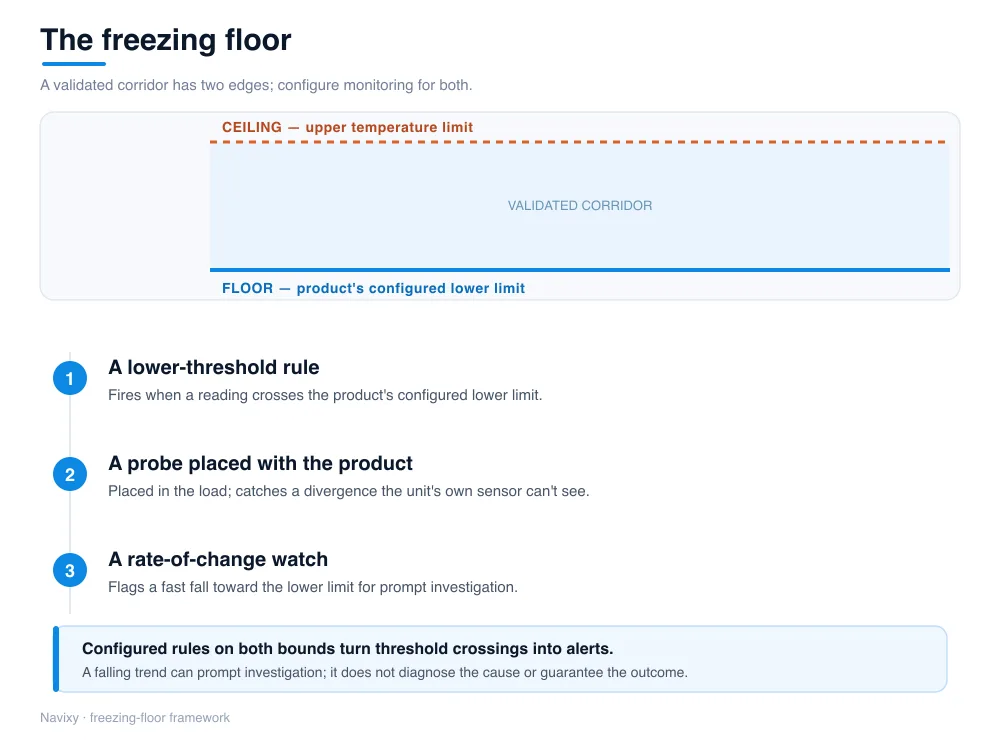
- A lower-threshold rule. It fires when a reading crosses 0 °C, or the product's own lower limit, just as an upper-threshold rule fires on heat. This rule can be omitted when monitoring centers on the upper limit.
- A probe in the product, not just the unit's own air sensor. A fridge or a reefer reports its own air; product against the cold wall, the evaporator, or an ice pack can freeze while the unit's average reads fine. Canada's vaccine storage guidance names two placement risks directly: door shelves and crisper bins, where temperatures can fluctuate (Public Health Agency of Canada, Canadian Immunization Guide). The same logic scales to a distribution freezer or a reefer: the reading at the product matters, and that may not be where the standard sensor sits.
- A rate-of-change watch ahead of the limit. A reading falling fast toward the product's configured lower limit is the condition for prompt investigation. It can indicate abnormal cooling or local cold exposure. The trend supports investigation; determining the cause and outcome requires the operator's investigation and response.
Why the floor is also an audit finding
In Canada this isn't only an operational risk — it's a Good Manufacturing Practices question. Health Canada's guidance on environmental control of drugs (GUI-0069) requires storage refrigerators and freezers to carry sensors for continuous monitoring wherever temperature is most likely to deviate. For transport, it requires temperature mapping and monitoring when an actively temperature-controlled vehicle or container provides the primary environmental control. For a qualified passive package, GUI-0069 allows documented, risk-based qualification and alternatives; mapping or ongoing monitoring is not one universal rule for every transport mode.
Health Canada allows an excursion to be accepted, provided it comes with documented scientific justification. That assessment depends on captured excursion data; when monitoring does not capture the event, the quality team lacks that evidence for investigation and disposition.
Unlike the EU, Canada doesn't split this into a separate "Good Distribution Practice" regime. Distributors and wholesalers answer to the same GMP framework as manufacturers (Health Canada, GMP/establishment-licensing enforcement policy), so a gap found at a depot or a courier is a GMP-relevant finding in its own right.
The record an auditor actually wants starts with time-out-of-range and, where applicable, mean kinetic temperature (MKT), the same evidence behind a defensible cold-chain record. USP General Chapter <1079.2> defines MKT as a single calculated, isothermal temperature that simulates cumulative degradation from nonisothermal storage-temperature variation. Derived from the Arrhenius equation, it is not a simple arithmetic mean; USP considers it acceptable for storage and says it may be considered for transit excursions.
Health Canada GUI-0069 adds an important product-level limit: MKT may not be appropriate for refrigerated products or biologics. MKT does not replace evaluation of a refrigeration or freezing excursion. Use it only where product-specific stability data and the applicable pharmacopoeial or quality procedure support it. The resulting record combines time-out-of-range and, where applicable, MKT; a min/max alone can't support the same disposition work.
A quick self-audit for your cold chain
- Does your monitoring have a floor alert, or only a ceiling — would a reading of −0.5 °C fire anything at all?
- Is at least one probe in the product — a carton, a tray, a vial rack — or only on the unit's own air sensor?
- Would a fast rate-of-change toward the product's configured lower limit get flagged before the lower limit is crossed, or only after?
- For active temperature-controlled transport, could you produce the vehicle or container mapping and monitoring evidence? For a qualified passive package, could you produce the documented risk-based qualification and evidence for the chosen alternative?
- Is your exportable record time-out-of-range and, where applicable, MKT, or a daily average that can hide a brief but real excursion?
For each uncertain answer, assign an owner and a test date while the monitoring configuration is still in hand.
How Navixy applies the three controls
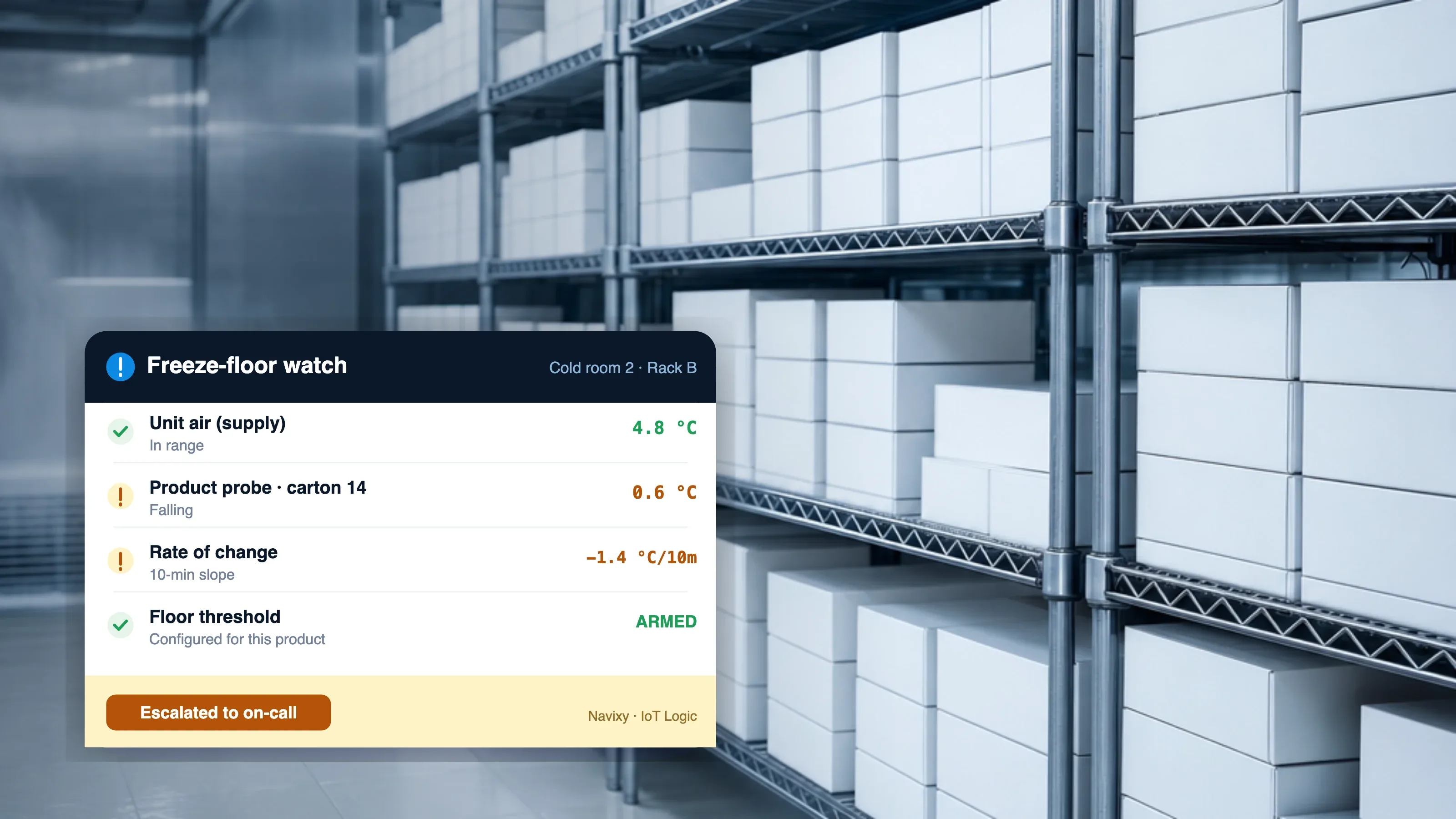
The three controls work with any sensor brand that is calibrated and placed correctly. In Navixy, a lower-bound IoT Logic rule runs alongside the upper-bound rule and evaluates the probe placed in the load or rack, rather than relying only on the unit's return-air sensor.
The same flow watches the slope. A rate-of-change rule flags a reading falling fast toward the product's configured lower limit for prompt investigation. The trend can indicate abnormal cooling or local cold exposure. Determining the cause and outcome requires the operator's investigation and response.
IoT Query calculates time-out-of-range and, where applicable, configured MKT from the continuous series per shipment or storage unit, then exports those outputs through an open API into a quality system. The operator's quality system decides whether MKT applies to that product and excursion.
Navixy captures and exports the configured continuous temperature series, time-out-of-range and, where applicable, MKT; it does not certify GMP compliance. The operator's quality system determines whether the resulting record satisfies applicable Health Canada and GMP obligations — the platform's job is making sure the data those roles need was actually captured, floor included.
Your next step
Check whether your monitoring has a floor as well as a ceiling: configure a lower-bound rule, place a probe with the product, and route a fast fall toward the lower limit for prompt investigation. Test each control against the product's validated range and document the result.