How Navixy ingests Ford Telematics — and what changes for another OEM
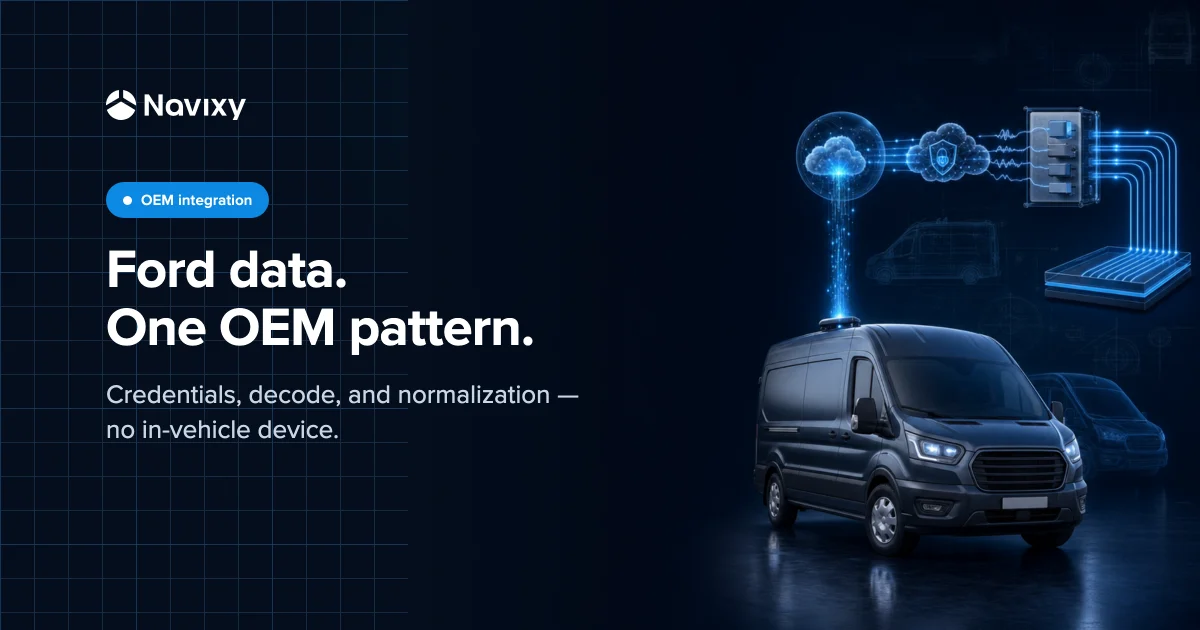
One row in the event table further down this page reads Impact → Crash alarm. It looks like a footnote. It is a compact view of the architecture.
When a vehicle's crash sensors register an impact, Ford's cloud emits the "Impact" event. Navixy maps that source event to the native "Crash alarm" event used for installed trackers. Rules and alerts can therefore use the same event without a Ford-specific branch, even though no hardware tracker or wired accelerometer was installed in the vehicle.
That mapping shows how the integration works. Navixy authenticates the cloud feed, decodes Ford fields and events, maps them to native platform semantics, and normalizes the result to one protocol. Ford-specific handling ends at the ingestion boundary; supported downstream tools work with the common model.
Step by step, that sequence is credentials → cloud feed → decode → normalize → done. It is the OEM ingestion pattern. For an eligible connected fleet, onboarding uses cloud authorization and does not include a workshop installation.
Ford provides a supported cloud data path
This integration exists because Ford built the path for it. Ford Pro Data Services frames commercial data around what Ford Commercial Solutions calls "the power of choice" — manufacturer-grade vehicle data available through the telematics provider a business chooses, rather than only Ford's own app. Most Ford commercial vehicles from the 2020 model year onward ship with the FordPass Connect modem already installed; some 2018–2019 vehicles qualify too. Availability currently spans North America and Europe.
Two authorizations do different jobs. A Ford service account provides an OAuth client ID and secret that authenticate the technical connection between Ford's platform and Navixy. Those credentials alone do not grant access to a fleet's vehicles. Ford starts transmitting a fleet's data only after the fleet owner authorizes sharing with the chosen provider.
Once both authorizations are in place, an eligible connected vehicle needs no installer visit. Credentials, not a truck roll.
The OAuth subscription keeps the feed live
For a fleet already operating connected Fords, onboarding consists of authorizing data sharing while Navixy configures the service-account connection. The vehicles then appear in Navixy alongside installed devices and join the same normalization layer.
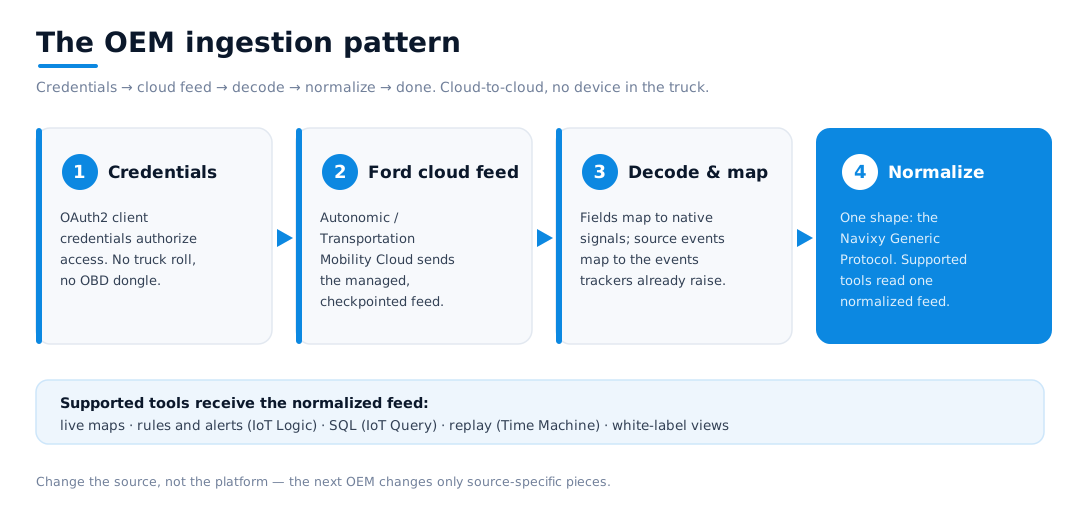
Under the hood, Navixy subscribes to Ford's managed feed through Autonomic — the platform behind Ford's Transportation Mobility Cloud — using OAuth2 client credentials. The subscription records checkpoints so processing can resume from the saved position after an interruption, and it runs in a cluster-aware configuration for reliability. The fleet owner authorizes data sharing, after which Navixy operates the technical subscription.
What the Ford feed actually carries
The Ford feed carries more than location. It includes telemetry a fleet would otherwise install a device to collect:
| Domain | What the feed exposes |
|---|---|
| Position & motion | position, speed, heading, acceleration |
| Powertrain | engine status, RPM, coolant and oil temperature, engine hours, fuel level, odometer |
| Electric vehicles | battery state of charge, time to full charge, charger current |
| Body & safety state | doors, hood, parking brake, seatbelt, ABS, gear/PTO |
| Environment | outside air temperature |
| Identity | VIN |
Position and motion support daily operations. Maintenance and safety rules draw on powertrain and body-state signals, with outside-air temperature adding operating context. VIN has a different role: it ties each record to the correct vehicle.
On electric Fords, battery state of charge and time-to-charge arrive from the factory system, giving a mixed fleet the inputs it needs to plan charging.
Ford events become native Navixy events
The signal table describes continuous values. Ford also sends discrete behavior and safety events, which arrive under the native Navixy event names below:
| Ford / Autonomic event | Navixy native event |
|---|---|
| Impact | Crash alarm |
| Forward-collision warning | Forward-collision warning |
| Harsh acceleration / braking / cornering | Harsh driving |
| Excessive idling (start / stop) | Idle start / end |
| Seatbelt unbuckled | Seatbelt unbuckled |
| Ignition on / off | Ignition on / off |
| Vehicle movement (start / stop) | Movement start / end |
| Low battery charge | Main power low |
Taken together, these mappings cover incident response, driver coaching, and vehicle-state workflows. Operators continue using Navixy's existing event vocabulary for these Ford events.
One normalized model serves factory and installed data
Navixy represents each Ford vehicle as a tracker and normalizes its feed to the Navixy Generic Protocol. Supported downstream tools receive the same source shape for factory data and installed hardware.
In IoT Logic, rules and alerts can use the Ford events they are mapped to. Supported map, query, and replay tools read the normalized feed through their existing interfaces.
How to evaluate the next OEM
Ford turns the generalization into two concrete questions: does the manufacturer expose the required signals and events through a supported feed, and can they be mapped to Navixy's native model? If both answers are yes, Navixy can implement that OEM as another supported source.
For another manufacturer, the credentials and decoder are source-specific, but the normalization layer and supported interfaces remain in place. Change the source, not the platform.
What reaches the fleet still depends on the manufacturer. Navixy decodes and normalizes the signals Ford's cloud exposes, while cadence, eligibility, regions, and subscription tier are set on Ford's side.
The manufacturer's own data terms still apply. An eligible factory-connected vehicle does not need an aftermarket tracker or its installation, while the data service keeps its own commercial terms. A batched cloud feed suits utilization, compliance, and behavior, while sub-second control still calls for a wired device.
Put the OEM ingestion pattern to work
Ford is the production example. The practical next step depends on whether you operate the vehicles or build the service around them:
- If you run connected Fords: you can bring that data into one operational picture without installing anything — see the full Ford Pro telematics integration guide or book a technical walkthrough.
- If you build or resell telematics: the ingestion pattern lets you offer OEM data under your own brand without rebuilding the platform around each manufacturer.
On this page