Fleet data management: how to unify mixed vehicle operations

AuthorDenis Demianikov
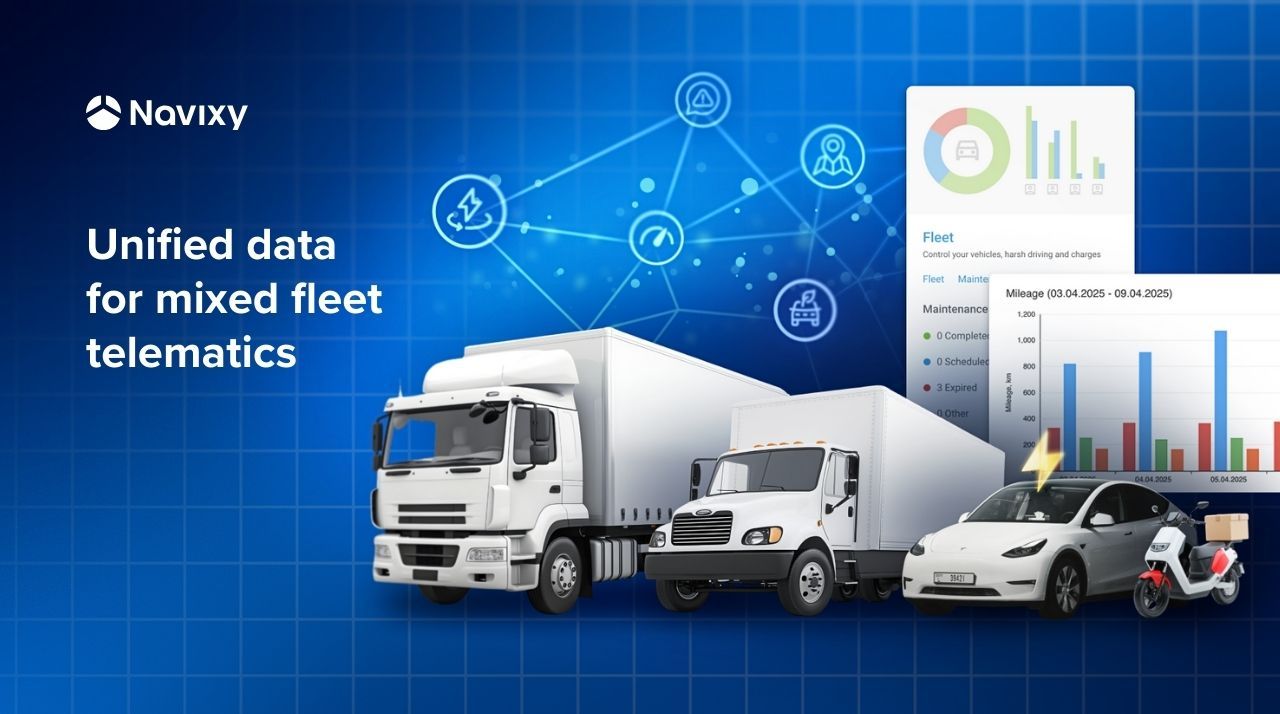
Fleet operations have reached a level of complexity few anticipated. What began as simple GPS tracking has evolved into a sprawling ecosystem of technologies: OEM telematics, aftermarket GPS trackers for ICE vehicles, cameras and MDVRs, sensors attached to trailers, generators, and heavy machinery. Each asset type brings valuable telemetry — but each system speaks its own language.
Effective fleet data management becomes nearly impossible when every signal stream lives in its own silo. For companies now operating a mix of EVs, hybrids, ICE vehicles, equipment, and trailers, that fragmentation has become more than an inconvenience: it is an operational barrier with real financial consequences.
This is why mixed fleet telematics is emerging as one of the most important strategic capabilities in modern fleet management.
The fleet data silo problem
Ask any operations manager how many systems they use daily, and the answer is rarely a small number. One portal provides battery and charging data. Another shows GPS locations. A separate interface reports camera events. Equipment hours and safety metrics come from somewhere else entirely. And what about fleet analytics? Often rebuilt manually in spreadsheets. No single source reveals the whole story.
This patchwork forces teams to react instead of anticipate. Important trends stay buried. Leadership struggles to quantify utilization, energy usage, or the true cost of mixed-asset operations. And as electrification accelerates, the data environment becomes even more scattered.
When the real challenge becomes managing systems rather than vehicles, you know the infrastructure is out of step with the fleet's needs.
Fleet data integration strategies
Electrification didn't just add new vehicles — it added new categories of data that require new operational thinking. Range, state of charge, battery cycles, charging windows, thermal thresholds: these metrics influence dispatching, maintenance, planning, and cost modeling in ways ICE vehicles never did.
But EV insights remain locked in OEM portals. Equipment and trailers are stuck in separate dashboards. Camera events require yet another interface.
Effective fleet data integration means more than connecting systems — it means normalizing them into a consistent operational model. A fleet cannot operate cohesively when its data is split across disconnected systems. What is missing is a shared data foundation that harmonizes every signal into a single operational truth.
This is the gap Navixy set out to solve.
One telematics layer for every vehicle and system
Navixy's mixed fleet telematics platform is built to unify OEM telematics feeds, aftermarket telematics hardware, and EV telematics data — without forcing fleets to replace existing systems. Instead of requiring hardware swaps or migrations, Navixy integrates directly with the systems fleets already use and brings all telemetry into a consistent, AI-ready data model.
At the core are two components that together handle the full fleet data management lifecycle — from raw signal normalization to historical analysis and reporting.
IoT Logic — fleet data harmonization engine
A no-code/low-code tool that normalizes telematics data from OEM feeds, GPS trackers, cameras, sensors, EV systems, and third-party platforms. It transforms fragmented signals into one coherent stream: consistent, structured, and ready for flexible automation.
IoT Query — the analytics layer for unified fleet data
A SQL-native lakehouse designed specifically for telematics and time-series data. It provides historical context, unified schemas, and the ability to run advanced analytics — from utilization and fuel modeling to EV performance forecasting and cost-per-job calculations.
Together, IoT Logic and IoT Query give fleets something they have never truly had: a single operational view of every asset, in real time and across time.
EV vans appear alongside diesel trucks. Trailers, equipment, and sensors share the same rules and events. Workflows trigger across multiple asset types — not just within one platform. This is what it means to move from fragmented tools to unified operations.
Clarity, control, and measurable ROI for mixed fleets
Leadership teams no longer ask whether telematics is useful — they ask whether it delivers financial clarity. A unified telematics data layer answers these questions in ways siloed systems cannot.
Organizations using Navixy report improved planning accuracy, stronger real-time visibility into mixed-fleet performance, and faster decision cycles. And because the platform works with existing hardware and systems, fleets avoid the cost and disruption of replacement projects.
This isn't about collecting more data. It's about finally making fleet data useful.
The future of fleet operations is unified
Mixed fleets are no longer the exception — they are the new normal. Electrification, operational diversification, and the growing number of connected devices mean the complexity will only rise.
Fleets that embrace a unified telematics foundation will adapt faster, operate smarter, and maintain a competitive edge. Those that stay locked in fragmented systems will continue to lose time, insight, and opportunities.
For organizations ready to modernize their operations without disrupting them, Navixy offers a clear path forward: one platform, one model, one truth — for every asset in the fleet.
Want to see what unified fleet data management looks like in practice? Explore Navixy IoT Query — the analytics and reporting layer that turns raw telematics into decisions. Or book a demo to see it with your own fleet data.