The cold you load is the cold you keep: the pre-cool gate
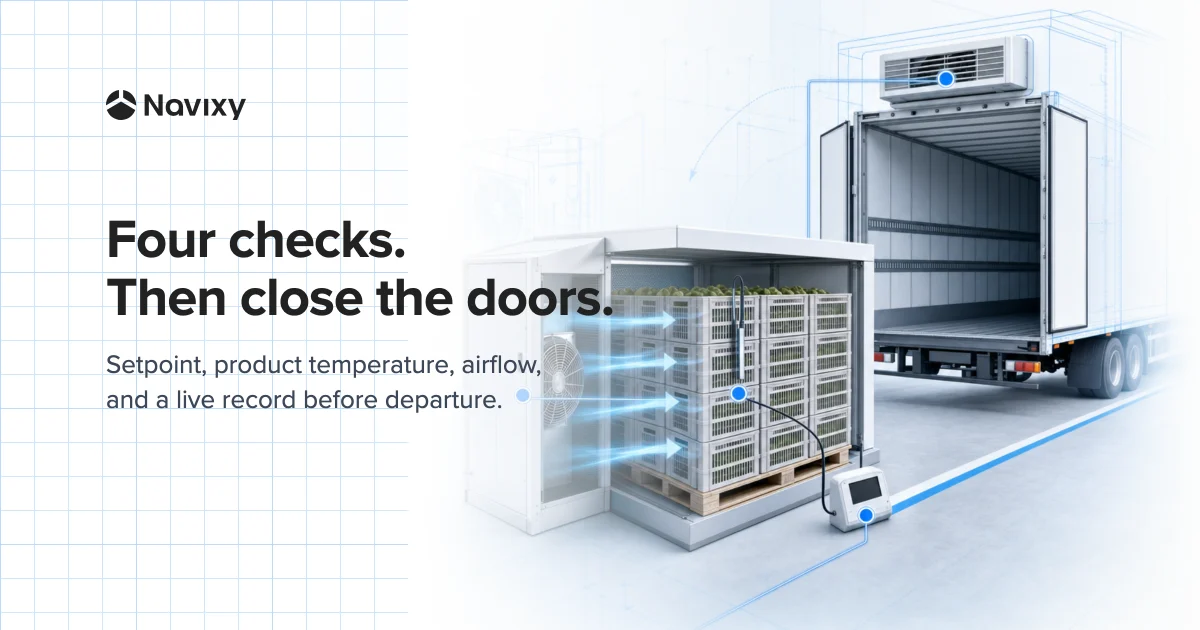
A load-out card clipped to the dock rail at a British Columbia packhouse has four lines. Three are already checked off: unit holding setpoint, load plan cleared for airflow, temperature recorder armed and running. The fourth line — pulp — is blank. The reefer has been running for twenty minutes, and the display already reads a clean 2 °C.
That blank line is the whole argument. Hold the load until all four lines clear — that's the direct answer. A supply-air reading of 2 °C says the unit is doing its job; it does not confirm whether the fruit in a warm pallet core has reached that temperature. Release on three checks and a good-looking display, and the load leaves the dock with its starting pulp temperature unverified.
A transport reefer primarily maintains a pre-cooled load against heat entering through the walls. With a warm pallet core, the surrounding air may reach setpoint well before the product reaches its required carrying temperature. The blank line on the card is the measurement the display cannot supply.
The display measures the box; the fruit needs its own reading
Fresh produce keeps working once it's picked. The fruit continues respiring after harvest — burning stored sugars, giving off heat — and the rate climbs steeply with temperature: USDA's Agriculture Handbook 66 puts the deterioration rate at roughly double for every 10 °C, the commonly cited Q10 approximation. It's a rule of thumb, not a promise for any single lot, but it explains why a few warm hours at the dock cost more than the same hours in transit.
Pre-cooling is the step that removes that field heat before the trailer gets involved. Forced-air, hydro-cooling, and cold-room methods differ in endpoint and cooling time according to the commodity and load, as UC Davis and USDA postharvest research have documented for decades.
That division of labor matters at release. Purpose-built pre-cooling removes field heat before loading; the transport unit then maintains the condition it receives. A warm core may not reach its required carrying temperature during transit even while the supply air holds setpoint.
The supply-air sensor reads the air coming off the coil, which cools fast. Product temperature changes more slowly and unevenly from the outside of the pallet in. Fresh produce is alive in the box in exactly this sense: a pulp probe provides the direct reading from a warm core that may remain several degrees above the surrounding air.
The pre-cool gate: four checks before the doors close
Load-out deserves a named checkpoint: the pre-cool gate, four conditions, and only one of them lives on the reefer's display. The trailer is ready to leave when all four are confirmed.
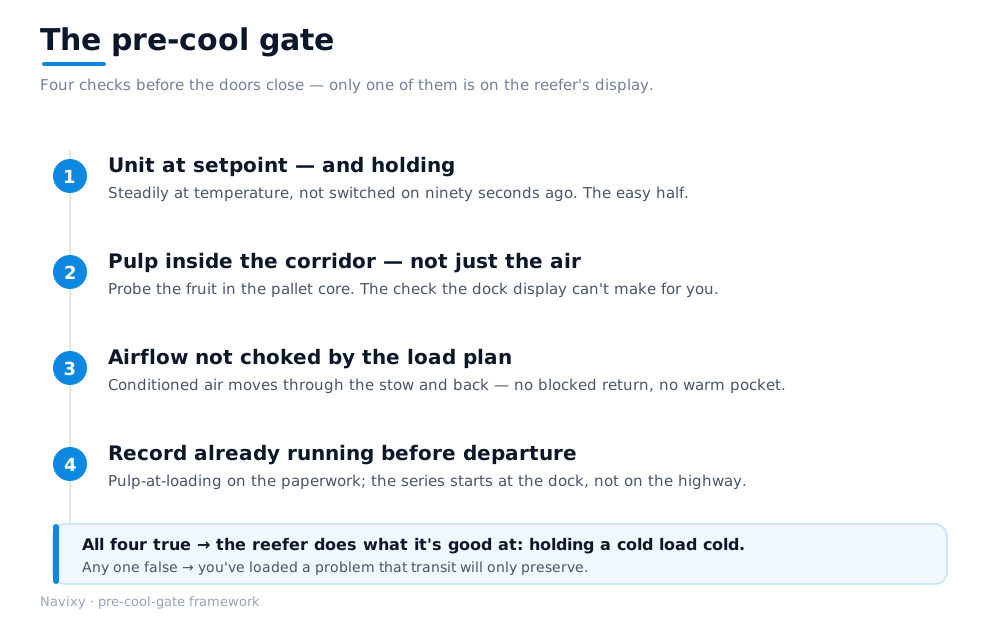
- The unit is at setpoint and holding. A brief touch at the target has not passed the stability check; release requires a steady reading.
- The pulp is inside the corridor. Probe the fruit at the pallet core and compare it to the commodity's target; this reading sits outside the dock display's scope and completes the release decision.
- The load plan preserves airflow. Conditioned air has to move through the stow and back — a blocked return or an overloaded nose turns a working unit into a warm pocket.
- The record is already running before departure. The Fresh Produce Transportation working group's own best-practice guidance is explicit that a Bill of Lading should carry pulp temperature at loading plus the locations and serial numbers of the recorders on the load — evidence that starts at the dock, before the trailer ever reaches the highway.
The fourth condition carries the dock evidence into any later dispute.
What a DRC claim asks the record to prove
In Canada, a good-delivery dispute between DRC members can go before the Fruit and Vegetable Dispute Resolution Corporation (DRC) in Ottawa. For a truck shipment within that member jurisdiction, the receiver's request for a destination inspection is due within eight working hours after notice of arrival and access to the load, with Sundays and holidays excluded. That inspection still produces one snapshot at the end of the trip.
The continuous story from load-out to arrival helps establish the temperature part of responsibility: was pulp temperature inside the corridor when the doors closed, did it remain there, and when in the journey did it leave? A pulp-at-loading reading plus the record establishes the product's starting condition; a supply-air trace alone leaves that question open.
Temperature evidence is one part of a dispute; the DRC also weighs the contract, condition defects, inspection findings, loading pattern, reefer data, and disposition. Separately, Canada's Safe Food for Canadians Regulations require records that identify the food and support one-step-back and one-step-forward traceability. The CFIA can require those records on request. That regime is distinct from a DRC dispute, but each decision context depends on records that begin at the event under review.
A quick self-audit for your next load-out
- Where in the pallet do you probe pulp, and where is each reading recorded?
- How long must the unit be holding setpoint before release?
- Who checks the load plan and confirms the supply and return airflow paths?
- When does the temperature record start, and which pulp reading anchors it?
- Could you produce a continuous series from load-out in minutes if a receiver opened a claim tomorrow?
A soft answer identifies a condition to correct before the doors close.
How Navixy turns the gate into a departure rule
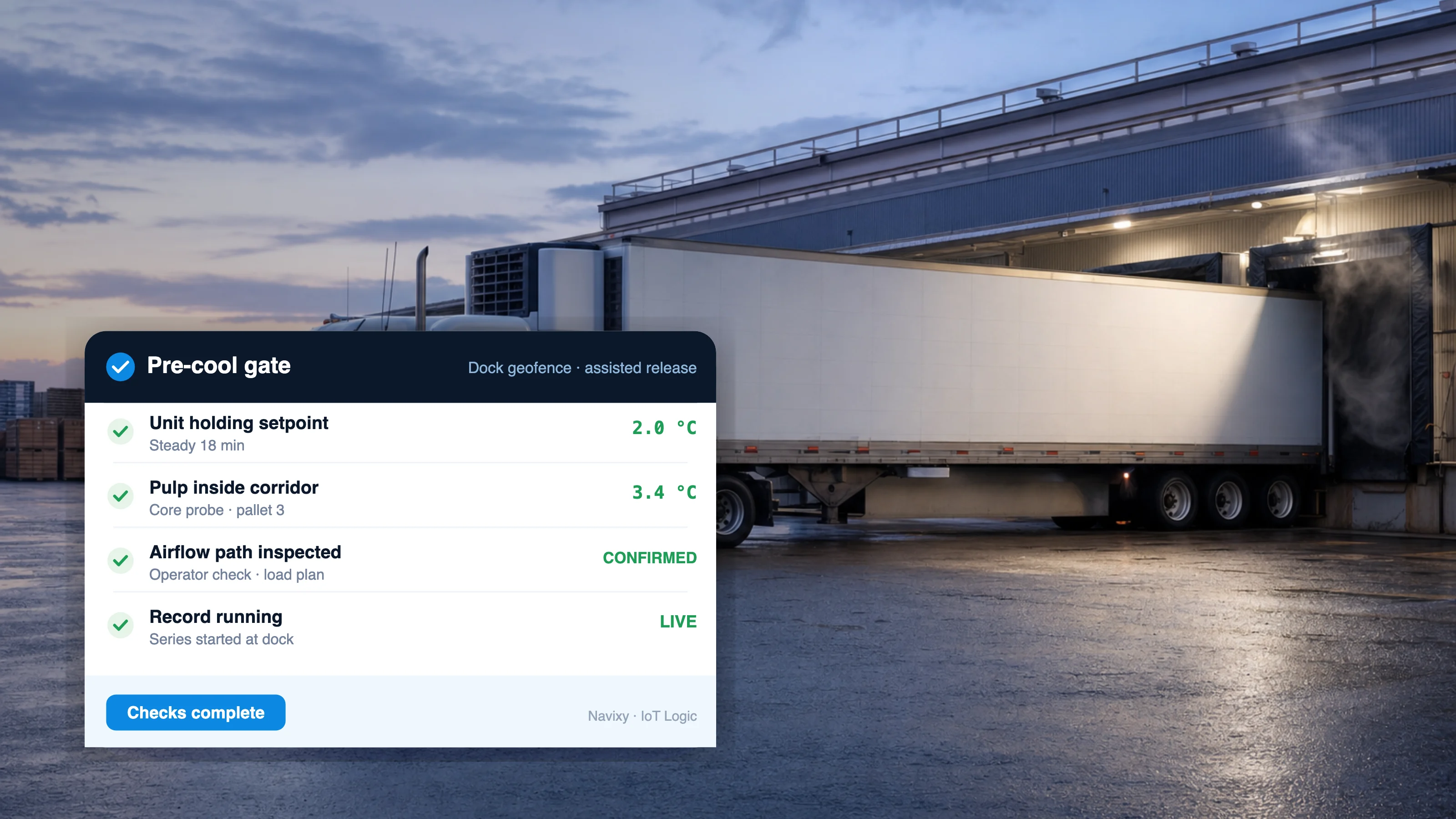
The gate itself is a discipline any operation can run without a particular vendor. IoT Logic automates its sensor-driven portion: it ingests the reefer's telemetry alongside a BLE or wired pulp probe and evaluates unit stability and product temperature in the dock geofence. Airflow remains a physical load-plan inspection on the dock card. Recorder status supplies the fourth release line, so the departure decision still requires all four checks.
On the road, the rule can watch the gap between supply-air temperature and pulp temperature and flag a sharp change as a possible door opening, airflow restriction, or other operating issue. IoT Query then assembles the continuous series — pulp and air from load-out to arrival, time-out-of-range, mean kinetic temperature — and exports it through an API into the operation's evidence file.
Navixy produces the record for operations; it does not certify phytosanitary, food-safety, contractual, or good-delivery compliance.
Your next step
Run the pre-cool gate on the next load and hold it until the product-temperature line on the card is complete. The reefer confirms the air; the probe confirms the fruit.