Building telematics solutions that scale, regardless of the hardware

AuthorBenjamin Hayes
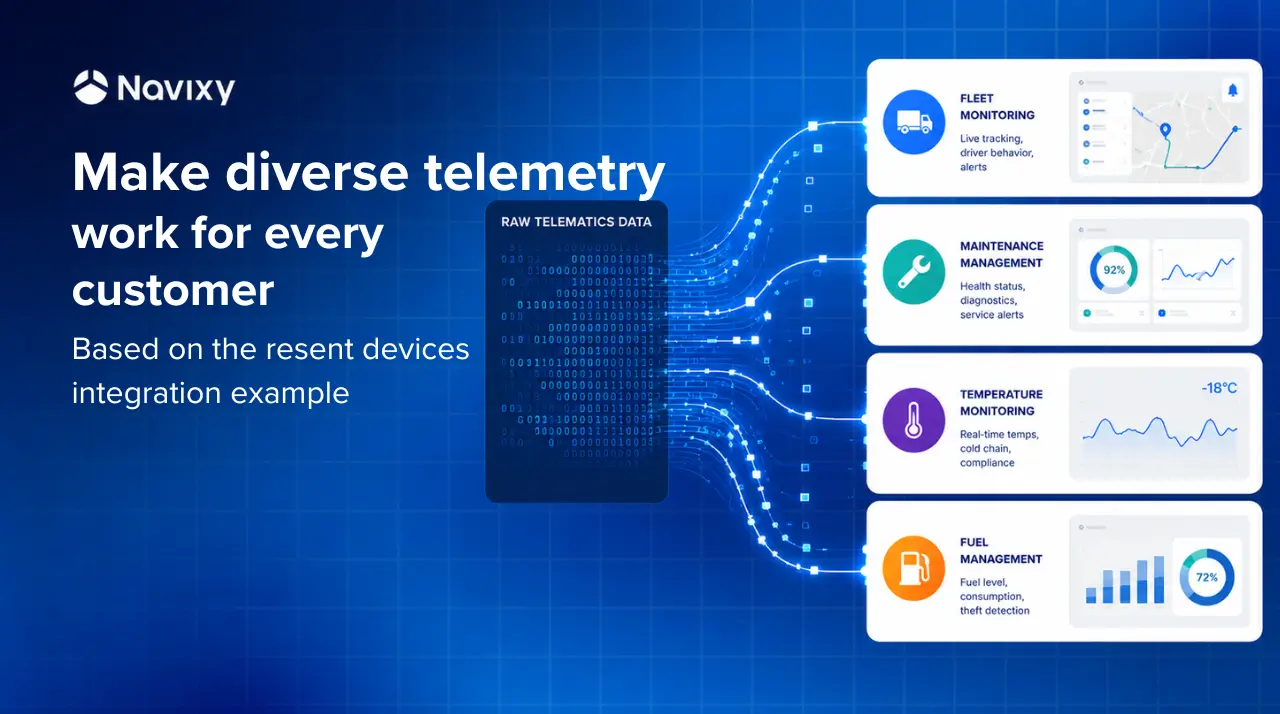
If you build telematics solutions, support enterprise fleets, or integrate fleet management technologies, you know that homogeneous fleets are mostly a myth. Every customer brings a different mix of vehicles, assets, business priorities, and tracking hardware. Supporting that diversity isn't simply about connecting more devices. It's about making data work for the business.
Recently, Navixy integrated ATrack AK300, X3Tech XT40, Virtueyes NT40, and Shenzhen Qianfeng J16. These devices were added for different customers, different projects, and different use cases. Taken together, though, they illustrate something much more interesting: how a modern telematics platform turns diverse telemetry into solutions that scale.
Different customers need different answers
Ask five customers what they need from a telematics solution, and you'll probably get five different answers. One wants to monitor equipment utilization. Another needs proof of service. Someone else is looking for fuel savings or cold chain compliance. That's why choosing a tracking device is rarely the first decision in a project. The first step is understanding what the customer is trying to achieve. Only then does it become clear what data is needed and which hardware is best suited to collect it.
Those priorities directly influence the type and depth of telemetry required. Some deployments only need reliable location tracking and trip history. Others depend on engine hours, fuel level, CAN bus parameters, temperature sensors, BLE beacons, or digital inputs to provide the operational visibility the customer expects. The wider your customer portfolio becomes, the more likely you are to support all of these scenarios at once.
That's why hardware diversity isn't the exception in telematics. It's simply the result of solving different customer problems. The challenge for telematics service providers and system integrators is not supporting another device. It's consolidating data coming from different devices, manufacturers, and protocols into a single operational view, then turning that data into solutions that match each customer's priorities.
Collecting telemetry is only the first step
Raw data rarely answers business questions on its own. Customers don't think in terms of protocols or sensor values. They don't ask whether a device supports a particular CAN parameter or how often it reports temperature. They ask why fuel costs are increasing, whether maintenance can be scheduled before equipment fails, which deliveries violated cold chain requirements, or whether expensive assets are actually being used.
Bridging that gap is where a telematics platform creates value. The first step is collecting telemetry. The second is turning that telemetry into something the customer can actually use.
The four devices recently integrated into Navixy are a good example of how different kinds of telemetry can support very different business objectives.
Four recent integrations, four different customer needs
Each was introduced for a different type of project, serves a different industry, and collects a different set of operational data. Together, they reflect the diversity telematics service providers and system integrators work with every day, where supporting one customer may require basic vehicle tracking, while another depends on engine telemetry, environmental sensors, or richer vehicle data.
Rather than comparing hardware specifications, let's look at the operational challenges these devices are best suited to address and how the data they collect can be transformed into practical fleet management solutions.
ATrack AK300. Construction and industrial fleets
For construction companies and industrial fleets, knowing where equipment is located is only part of the picture. The bigger challenge is understanding how it's being used. Is an excavator working or idling? Is maintenance due? Is equipment operating where and when it should?
The ATrack AK300 is a natural fit for these environments, supporting deployments that require richer operational telemetry than basic location tracking.
Within Navixy, that telemetry becomes much more than a stream of sensor values. Engine-hour data can feed maintenance schedules based on actual equipment usage, helping reduce unplanned downtime. Geofences verify activity at construction sites or restricted areas, while reports reveal utilization trends across assets and projects. Combined with configurable alerts, these insights help operations teams identify idle equipment, unauthorized usage, and maintenance issues before they affect productivity.
For construction and industrial fleets, the result is better asset utilization, more predictable maintenance, and greater control over operating costs.
X3Tech XT40. Commercial fleet operations
Logistics, field service, and regional delivery fleets often don't need complex vehicle diagnostics. Their priority is maintaining reliable day-to-day visibility into fleet operations while keeping deployments straightforward and cost-effective.
The X3Tech XT40 provides the core telemetry required for these scenarios. Once connected to Navixy, its data supports trip history, route verification, geofence notifications, Eco Driving analysis, and scheduled reports that help dispatchers and fleet managers monitor daily performance without increasing operational complexity.
Instead of simply tracking vehicles, operators gain a clearer understanding of route execution, driving behavior, and operational exceptions, helping improve service quality and fleet efficiency.
Virtueyes NT40. Distributed assets and infrastructure
Organizations managing mobile equipment, utilities, or distributed infrastructure need continuous visibility across assets that aren't always part of a traditional vehicle fleet. The challenge is maintaining consistent monitoring while integrating asset data into everyday operational processes.
The Virtueyes NT40 expands the range of supported hardware for these deployments. Inside Navixy, its telemetry feeds the same reports, dashboards, alerts, and APIs used across the platform. With IoT Logic, solution providers can also build customer-specific workflows that automatically react to incoming events, whether that's notifying operators, updating external systems, or triggering follow-up actions.
This allows vehicles, equipment, and other mobile assets to be managed through a single platform while adapting workflows to each customer's operational requirements.
Shenzhen Qianfeng J16. Cost-effective fleet visibility
Not every fleet needs extensive telemetry. Rental businesses, motorcycle fleets, small commercial operators, and security-focused deployments often prioritize dependable tracking, compact hardware, and affordability.
The Shenzhen Qianfeng J16 addresses those requirements while benefiting from the same platform capabilities as more advanced devices. Within Navixy, its telemetry supports live tracking, trip history, geofence alerts, scheduled reports, and automated workflows that help detect unauthorized movement, improve asset visibility, and streamline day-to-day fleet management.
The hardware may be simpler, but the business outcome remains the same: turning operational data into practical, repeatable workflows that solve the customer's problem.
Building scalable telematics solutions across diverse hardware and telemetry
At this point, having raw data devices stream is absolutely not enough. Customers care about the information that helps them run their business. Can maintenance be planned before a machine breaks down? Was refrigerated cargo transported within the required temperature range? Which assets spend more time idling than working? Which deliveries failed to meet the agreed SLA?
That’s the challenge that starts once the devices begin sending data. Here’s why.
Different hardware. Different protocols
Each hardware manufacturer has its own communication protocol, its own parameter names, and often its own way of reporting the same event. Two trackers may both report engine hours, but structure the data differently. One device may expose temperature as a dedicated sensor, while another reports it as a generic analog input. Even something as simple as a digital input can appear under different identifiers depending on the device family.
If every report, rule, dashboard, or API integration had to understand every supported protocol individually, scaling a telematics platform would quickly become impossible.
This is why the first thing Navixy does isn't generating reports or triggering alerts. It starts by decoding incoming device packets and translating them into a consistent set of platform resources that the rest of the system can understand. The documentation refers to this as parsed raw data. Device-specific packets are decoded with full awareness of the protocol and hardware model, making GPS information, sensor readings, input states, and other telemetry available in a common platform context. At the same time, the original decoded telemetry remains accessible through the Raw IoT Data API for integrations and investigations that require device-level detail.
A common data model isn't the final product
Having a common data surface solves an important technical problem, but it doesn't solve the customer's problem.
Fleet operators don't work with parsed telemetry. They work with maintenance schedules, fuel reports, temperature compliance, driver performance, utilization metrics, and dozens of other operational indicators. Those don't exist in the incoming device packets. They have to be built from the available telemetry.
That's where the next layer of the platform comes in.
Instead of treating incoming values as the final result, Navixy allows solution providers to combine, evaluate, and extend them using platform services such as IoT Logic, rules, reports, maintenance, Eco Driving, APIs, and analytics. Each serves a different purpose, but together they transform decoded telemetry into information that's meaningful for a particular customer.
IoT Logic is a good example. Rather than simply forwarding incoming events, it lets solution providers process telemetry in real time using configurable flows. Incoming data can be evaluated against conditions, combined with other values, enriched with calculated attributes, and routed to different actions, including notifications, webhooks, MQTT endpoints, or other platform services. Calculated attributes created in IoT Logic can also be exposed back to the platform as virtual sensors, making them available to reports, dashboards, and other Navixy features just like native device parameters.
This is an important distinction. The platform isn't inventing information that doesn't exist. It builds new operational metrics from telemetry the device already provides.
An engine-hour counter becomes a maintenance schedule because the platform compares accumulated operating hours with a predefined service interval. Temperature readings become a cold chain compliance workflow because incoming values are continuously evaluated against customer-defined thresholds. Location updates become proof of service when they're correlated with geofences and business rules. The same GPS event that confirms a technician's arrival at a customer site can also trigger an API call, update an external work order system, and generate a customer notification, all without requiring custom software for each deployment.
Building customer logic instead of device logic
This same principle applies across the platform.
| Incoming telemetry | Platform capability | Business output |
|---|---|---|
| Engine hours | Maintenance + reports | Service schedules based on actual equipment usage |
| Temperature readings | Rules + measuring sensor reports | Cold chain alerts and compliance history |
| GPS location | Geofences + rules + API | Proof of service, route verification, automated workflows |
| Fuel level | Fuel analytics | Consumption reports, refill and drain detection |
| Driver events | Eco Driving | Driver performance scoring and safety reports |
Notice what's happening here.
The device never reports "maintenance due", "cold chain violation", or "proof of service." It reports engine hours, temperature values, and location updates. Everything else is created by combining telemetry with business logic.
For telematics service providers, that's an important distinction. Building customer solutions no longer means writing device-specific logic for every project. Instead, the focus shifts to defining the customer's operational rules while letting the platform handle telemetry processing underneath.
Scaling solutions instead of integrations
This architecture becomes increasingly valuable as customer portfolios grow. A telematics service provider may support a construction company using ATrack devices, a refrigerated carrier equipped with another hardware vendor, and a regional delivery fleet using an entirely different tracker family. The telemetry varies, the protocols vary, and the operational priorities certainly vary. Yet the platform layer remains the same.
That's ultimately the value of broad hardware support. Every new integration expands the range of customer scenarios Navixy partners can address. The platform takes care of decoding device-specific telemetry, exposing it through a common operational model, and providing the tools needed to turn that data into reports, automation, integrations, and workflows that reflect how each customer's business actually operates.
Conclusion
Homogeneous fleets are unlikely to become the norm anytime soon. As businesses expand, modernize, acquire new assets, or enter new markets, hardware diversity naturally follows. For telematics service providers and system integrators, adapting to that diversity has become part of everyday work.
The recent integration of ATrack AK300, X3Tech XT40, Virtueyes NT40, and Shenzhen Qianfeng J16 is a good reminder that supporting more devices isn't an end goal in itself. Every new integration simply expands the range of customer scenarios that can be addressed through the same platform.
The real differentiator lies in what happens after the data reaches Navixy. By decoding telemetry from different devices, exposing it through a consistent platform model, and providing the tools to build customer-specific workflows on top of it, Navixy helps partners focus less on hardware compatibility and more on delivering solutions that solve real operational problems.
Because in the end, customers don't measure the success of a telematics project by the number of supported devices. They measure it by how well the platform helps them run their business.
Whether you're expanding your hardware portfolio or building customer-specific telematics solutions, we'd be happy to discuss how Navixy can support your next project.