Deploy once, adapt anywhere. Teltonika FTC134 and FTM134 integrated with Navixy

AuthorBenjamin Hayes
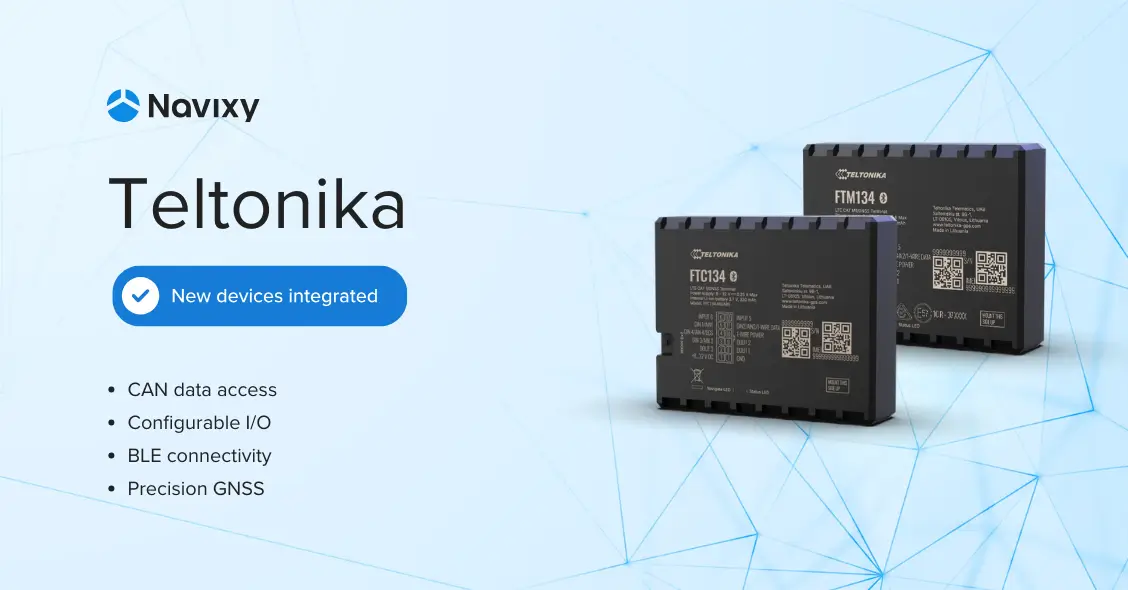
An excavator, a delivery truck, and a rental vehicle may serve completely different purposes, but telematics service providers are often expected to support all three using a single technology stack. That's easier said than done. Different industries bring different monitoring requirements, reporting needs, and operational workflows. Teltonika's FTC134 and FTM134 devices, now integrated with Navixy, are designed to make those deployments easier to adapt without constantly changing hardware or rebuilding solutions.
Read on to see how the combination helps service providers, fleet operators, and integrators support a broader range of telematics use cases with less complexity.
Why flexibility matters after installation
The work doesn't stop once a device is installed. In many cases, that's when the real complexity begins. A customer that initially needed basic vehicle tracking may later ask for fuel monitoring, maintenance alerts, driver identification, or integration with internal reporting tools. A construction company may want to track equipment utilization. A rental operator may need usage-based maintenance workflows. New customers bring entirely different requirements, often using the same vehicles, assets, and sensors in different ways.
For telematics service providers, every new requirement creates a choice. Build a custom solution and increase long-term support complexity, or find a way to adapt existing deployments without starting over. The same challenge affects integrators, who often need to connect telematics data to ERP systems, maintenance platforms, customer portals, or analytics tools without creating another layer of custom middleware.
The organizations that scale successfully are usually not the ones collecting the most data. They are the ones that can respond to new requirements without rebuilding hardware inventories, workflows, and integrations each time something changes.
Explore the full range of Navixy-supported devices and discover how different hardware platforms can support fleet tracking, IoT monitoring, automation, and analytics use cases.
FTC134 and FTM134 support more than one use case
The FTC134 and FTM134 are built around a practical reality: business requirements change faster than hardware replacement cycles. Both devices are based on Teltonika's FT platform and support software-configurable inputs and outputs. Instead of treating device functionality as something fixed at installation, businesses can modify how inputs and outputs behave as requirements change.
Why FTC134 and FTM134 can adapt to different use cases
Several hardware capabilities make the FTC134 and FTM134 particularly suitable for deployments that may evolve over time. The flexibility comes from a combination of connectivity, sensor support, and remotely configurable behavior. Software-configurable I/O allows inputs and outputs to be repurposed remotely as monitoring requirements change, reducing the need for hardware replacements and site visits.
- CAN bus data access provides visibility into vehicle diagnostics, fuel consumption, engine parameters, and other operational metrics without requiring additional sensors in many scenarios.
- BLE 5.4 support enables integration with wireless accessories such as driver identification tags, beacons, and environmental sensors.
- 1-Wire support expands monitoring possibilities through additional sensors, supporting use cases that require more than standard vehicle data.
- Multi-constellation GNSS with sub-1.5-meter accuracy improves positioning reliability for asset tracking, utilization monitoring, and geofence-based workflows.
- LTE connectivity Bold options allow organizations to balance coverage, throughput, and power efficiency according to deployment requirements.
Individually, these capabilities are valuable. Combined, they allow a single hardware platform to support very different operational scenarios across logistics fleets, construction equipment, rental assets, and other telematics applications. For telematics service providers, for example, this can reduce the number of device models that need to be stocked, supported, and certified across different customer projects.
Adapting deployments after installation
Hardware flexibility alone is not enough, however. The real value appears when those data points can be transformed into workflows, reports, alerts, and integrations. This is where Navixy becomes part of the story.
Consider a delivery fleet that deploys FTC134 devices primarily for tracking and vehicle diagnostics. Six months later, the customer wants to introduce driver identification and automated maintenance notifications. Because the hardware already supports the required data collection, the service provider can expand the solution through configuration rather than replacing devices across the fleet.
With Navixy, those new data points can immediately become part of dashboards, alerts, reports, and automated workflows. Instead of treating every new requirement as a separate project, providers can build on the same hardware foundation while adapting services to changing customer needs.
This creates opportunities to standardize hardware across different customer segments while maintaining the flexibility to support different operational scenarios. For service providers, that means fewer hardware variations to manage. For fleets, it means adapting deployments without additional installation work. For solution developers, it creates a stable foundation that can support new workflows and data sources over time.
Extending device capabilities with Navixy
Flexible hardware creates opportunities. The platform determines how effectively those opportunities can be turned into operational processes.
Many telematics deployments generate thousands of events every day. The challenge is not collecting them. It is determining which events deserve attention, who needs to know about them, and what should happen next.
Automating operational workflows
Navixy's IoT Logic allows organizations to build workflows around incoming telemetry without developing custom backend systems.
A construction company can automatically flag equipment activity outside approved working hours. A rental provider can trigger maintenance processes when operating-hour thresholds are reached. A logistics fleet can identify excessive idling patterns and notify managers before fuel waste becomes a larger issue.
For service providers, the value extends beyond automation itself. Workflows can be adapted and reused across customer accounts, reducing implementation effort while making advanced services easier to deliver and maintain.
At this point, the relationship between FTC134 and FTM134 and Navixy becomes particularly important. As customer requirements evolve, configurable device inputs can be paired with new IoT Logic workflows, allowing providers to introduce new services without changing hardware deployments.
Accessing and analyzing telematics data
Many organizations discover that collecting telematics data is easier than using it.
Operations teams need historical data. Analysts need reliable information for reporting and forecasting. External systems need access to operational records without relying on manual exports.
IoT Query addresses these needs by providing direct access to data stored in Navixy's Private Telematics Lakehouse. Instead of building separate data pipelines and maintaining export processes, organizations can query historical telematics data and combine it with broader business analysis.
For service providers, this creates opportunities to deliver analytics and reporting services. Enterprise fleets gain greater flexibility when building dashboards and operational reports. Integrators can work with query-ready data instead of spending months building supporting infrastructure.
Working with normalized data
One of the least visible challenges in telematics is that similar information often arrives in different formats depending on the device that generated it.
Mixed fleets may include hardware from multiple manufacturers, each using different protocols, event structures, and data models. Supporting those differences often requires custom transformation layers that become increasingly difficult to maintain over time.
Navixy addresses this challenge by normalizing incoming telemetry into a unified structure. Applications, reports, automations, and integrations can work with consistent data regardless of the original device source.
For solution developers, this reduces development effort and makes it easier to build products that can support diverse customer environments without introducing additional complexity.
Building deployments that can grow with the business
Ten years ago, telematics projects were largely defined by hardware selection. Today, they are increasingly defined by what happens after installation.
Businesses expect telematics systems to support new workflows, integrate with other operational systems, and adapt as priorities change. Service providers want to expand into new verticals without multiplying complexity. Integrators need data that can move easily between telematics platforms and business applications.
The FTC134 and FTM134 address this challenge by providing flexible hardware that can support a variety of monitoring scenarios. Navixy extends that flexibility through workflow automation, analytics, data accessibility, and integration capabilities.
Together, they help close one of the most persistent gaps in telematics: the gap between a successful deployment today and a deployment that still meets business requirements a year from now. For organizations looking to scale across customers, industries, and use cases, that ability to adapt may ultimately prove more valuable than any individual device feature.
Interested in using FTC134 and FTM134 in your own operation? Contact our team to discuss deployment scenarios, integration requirements, and the best fit for your business.