Building scalable personal monitoring solutions with ThinkRace devices and Navixy

AuthorBenjamin Hayes
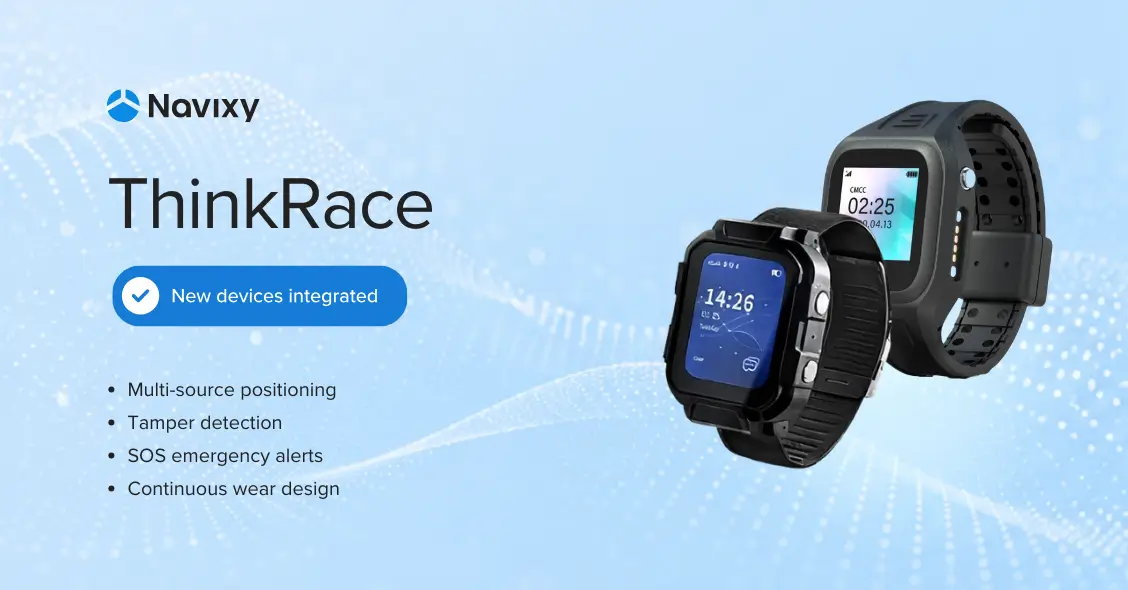
Personal monitoring comes in various forms. Whether in corrections, workforce safety, healthcare, assisted living, or other high-responsibility environments, organizations need safer and more efficient ways to protect people beyond traditional facilities. Reliable devices are the foundation of every monitoring program, but hardware alone cannot deliver operational success. The software layer ultimately determines how location updates, tamper alerts, SOS events, and other telemetry are transformed into timely decisions, automated workflows, and actionable insights.
In this article, we'll explore how ThinkRace's PT400HT, MT4, and TR40 devices, together with Navixy, help organizations build scalable personal monitoring solutions that can adapt to different operational models and grow alongside evolving organizational needs.
The operational challenges behind modern personal monitoring
Whether the objective is electronic monitoring, lone worker protection, healthcare, or assisted living, every personal monitoring program faces the same challenge: transforming a continuous stream of telemetry into timely, reliable decisions. As deployments grow, so does the volume of location updates, geofence events, battery warnings, tamper notifications, and emergency alerts. Processing that information manually quickly becomes impractical.
The challenge is not simply the amount of data, but its interpretation. Not every alert represents an incident. Temporary GPS degradation, brief connectivity loss, or a low battery may require no intervention, yet each demands context before an operator can decide what to do. Without intelligent event processing, routine notifications create alert fatigue, increasing operational workload and slowing responses to genuine emergencies.
At the same time, monitoring data must support far more than real-time visibility. Organizations need complete audit trails, reliable reporting, and seamless integration with case management, dispatch, workforce, or healthcare systems. Modern wearables have become highly capable of collecting telemetry. The real differentiator is the ability to transform that telemetry into consistent operational workflows that scale with the monitoring program.
Discover the whole range of devices integrated with Navixy and contact us should you need to know how to make the most of your hardware with Navixy.
Why ThinkRace PT400HT, MT4 and TR40 fit modern monitoring programs
Reliable monitoring starts with reliable field data. Regardless of the application, devices must remain comfortable to wear, communicate consistently, and continue reporting under changing environmental conditions. The ThinkRace PT400HT, MT4, and TR40 meet these requirements through different form factors designed for different monitoring scenarios while providing the dependable telemetry that monitoring platforms rely on.
Designed for continuous monitoring
A monitoring device provides value only while it remains on the wearer. The TR40 ankle bracelet and PT400HT tamper-proof watch support continuous supervision through secure wear and tamper detection, while the MT4 offers a wearable alternative for lone workers and mobile professionals who require protection throughout the working day.
Reliable positioning beyond GPS
People move between indoor and outdoor environments where GPS performance naturally varies. ThinkRace devices combine satellite positioning with Wi-Fi and cellular location services, helping maintain location visibility when satellite signals become unreliable and providing more consistent telemetry for monitoring applications.
Built for everyday operation
Long-term monitoring depends on devices that fit naturally into everyday life. Water-resistant construction supports continuous wear, while battery monitoring, connectivity reporting, and device health information help operators maintain uninterrupted monitoring with fewer manual interventions.
Emergency communication
Many monitoring scenarios require more than location tracking. The MT4 integrates SOS functionality into the wearable itself, allowing users to request assistance immediately while automatically providing responders with location and device context needed to coordinate an effective response.
The PT400HT, MT4, and TR40 provide the trusted telemetry that monitoring programs depend on. Turning that telemetry into operational workflows, however, requires a platform capable of validating events, automating processes, and connecting monitoring data with the rest of the organization.
How Navixy transforms ThinkRace telemetry into operational workflows
ThinkRace devices capture events in the field. Navixy turns those events into operational processes.
Instead of treating telemetry as a stream of independent messages, the platform receives, validates, enriches, and distributes incoming data so it can support day-to-day operations, business processes, and external systems. This enables organizations to focus on managing monitoring programs rather than managing devices.
Normalize telemetry across the device ecosystem
Monitoring environments rarely consist of a single device model. Organizations often deploy different hardware for different use cases while expecting the same operational experience across all of them.
Navixy normalizes telemetry from supported devices into a consistent data model. Location information, battery status, connectivity, and sensor events can therefore be processed using common rules, dashboards, reports, and APIs instead of device-specific implementations.
This simplifies long-term maintenance while allowing organizations to expand their hardware ecosystem without redesigning existing workflows.
Validate telemetry before it becomes an alert
Every event deserves interpretation before it demands attention.
A temporary loss of GPS coverage should not necessarily be treated as a supervision violation. A battery warning requires a different response than a tamper event. Indoor positioning may need to be interpreted differently from a high-confidence satellite fix.
Navixy allows organizations to evaluate telemetry within the context of predefined operational rules before generating alerts. By considering multiple data points together, the platform helps reduce unnecessary investigations while improving confidence in events that genuinely require operator attention.
Automate monitoring workflows
The efficiency of a monitoring program is often determined by how much routine work still depends on manual intervention.
As the number of monitored individuals grows, operators spend increasing amounts of time acknowledging alerts, checking device status, escalating incidents, and recording actions. While each task may take only a few moments, together they consume valuable time that could otherwise be spent responding to situations that require human judgment.
Navixy helps reduce this operational overhead by allowing organizations to automate routine processes through configurable rules and workflows. A geofence breach can notify the appropriate monitoring team automatically. A low battery event can trigger a reminder before communication is interrupted. A tamper alert can follow a different escalation path than a temporary loss of connectivity. Workflows can also be adapted to reflect different supervision policies, service-level agreements, or customer requirements without changing the device configuration itself.
The result is a monitoring environment that scales more efficiently while remaining flexible enough to support different operational models.
Monitor device health proactively
Reliable monitoring depends not only on where a device is, but also on whether it is functioning as expected.
Battery levels, charging status, network connectivity, and tamper conditions all influence the quality of monitoring. If these indicators are overlooked, organizations may only discover a problem after a device has stopped reporting or monitoring has already been interrupted.
Navixy provides continuous visibility into device health, helping operators identify potential issues before they become operational risks. Rather than reacting to equipment failures, monitoring teams can take preventive action to maintain service continuity and improve overall device availability.
For large deployments, this proactive approach can significantly reduce monitoring gaps while simplifying day-to-day fleet management.
Deliver actionable alerts instead of notification overload
One of the biggest challenges in personal monitoring is not collecting events. It is deciding which events deserve immediate attention.
Without prioritization, monitoring teams quickly become overwhelmed by routine notifications that require little or no action. Battery reminders, temporary connectivity loss, and routine status updates can easily obscure events that genuinely require an immediate response.
Navixy allows organizations to configure how different event types are evaluated and distributed. Notifications can follow predefined escalation paths based on event severity, device status, or operational policy, ensuring that the right information reaches the right people at the appropriate time.
This helps reduce alert fatigue while allowing operators to focus on incidents that affect safety, compliance, or service delivery.
Connect monitoring data with existing systems
Personal monitoring is rarely an isolated process.
Community supervision providers rely on case management platforms. Lone worker solutions often integrate with dispatch systems and workforce management software. Healthcare providers may need monitoring data to become part of broader patient management workflows. Service providers frequently expose monitoring information through customer portals or business intelligence platforms.
Navixy's APIs and integration capabilities allow telemetry, events, and operational data to move between these systems without creating duplicate workflows or disconnected data silos.
For organizations with more specialized requirements, Navixy IoT Logic provides an additional layer for transforming and routing telemetry before it reaches downstream applications. This makes it possible to implement organization-specific business logic without increasing complexity at the device level.
Instead of becoming another standalone application, the monitoring platform becomes part of the organization's wider operational ecosystem.
Simplify reporting and compliance
Monitoring programs generate more than real-time alerts. They also generate operational evidence.
Following an incident, organizations often need to reconstruct what happened, verify when events occurred, review operator actions, and demonstrate compliance with internal procedures or regulatory requirements.
Navixy centralizes location history, device status, event records, and notification history within a single platform, making it easier to generate reports and review incidents without collecting information from multiple systems.
For community supervision providers, this supports investigations and compliance reporting. For employers, it helps document lone worker incidents. For healthcare and assisted living providers, it contributes to care coordination and service documentation.
As monitoring programs expand, this ability to transform operational data into reliable records becomes just as valuable as real-time visibility itself.
Building monitoring operations that can scale
The evolution of personal monitoring has shifted the industry's focus. Reliable devices are no longer the primary differentiator. Today's challenge is building monitoring operations that remain effective as programs grow, requirements evolve, and technology ecosystems become more connected.
ThinkRace's PT400HT, MT4, and TR40 provide dependable field data through secure wear, resilient positioning, emergency communication, and continuous operation. Navixy builds on that foundation by transforming telemetry into configurable workflows, actionable insights, and integrated operational processes.
Together, they enable organizations to spend less time managing devices and more time delivering safer, more responsive, and more efficient monitoring services.
Contact the Navixy team to discuss how ThinkRace devices and the Navixy platform can support your operational, technical, and integration requirements.
Frequently asked questions
Which ThinkRace devices are supported by Navixy?
Navixy supports the ThinkRace PT400HT tamper-proof GPS watch, the MT4 smart GPS watch, and the TR40 electronic ankle bracelet.
Which monitoring applications are these devices suitable for?
The devices support a broad range of use cases, including electronic monitoring and community supervision, lone worker protection, healthcare, remote patient monitoring, assisted living, dementia care, and other personal monitoring applications.
Why is a monitoring platform important if the device already provides location data?
Devices collect telemetry, but organizations also need to validate events, automate responses, manage alerts, integrate with existing systems, and maintain reliable reporting. The monitoring platform provides the operational layer that connects these activities.
Can Navixy integrate monitoring data with existing software?
Yes. Navixy provides APIs and integration tools that allow telemetry and operational events to be exchanged with case management systems, dispatch software, workforce management platforms, healthcare applications, analytics environments, and other enterprise systems.
Can monitoring workflows be customized?
Yes. Configurable rules, automation capabilities, APIs, and IoT Logic allow organizations to adapt workflows to their own operational policies without modifying device firmware.