Vehicle data enrichment across business systems

AuthorRoman S, Product owner, Navixy integrations
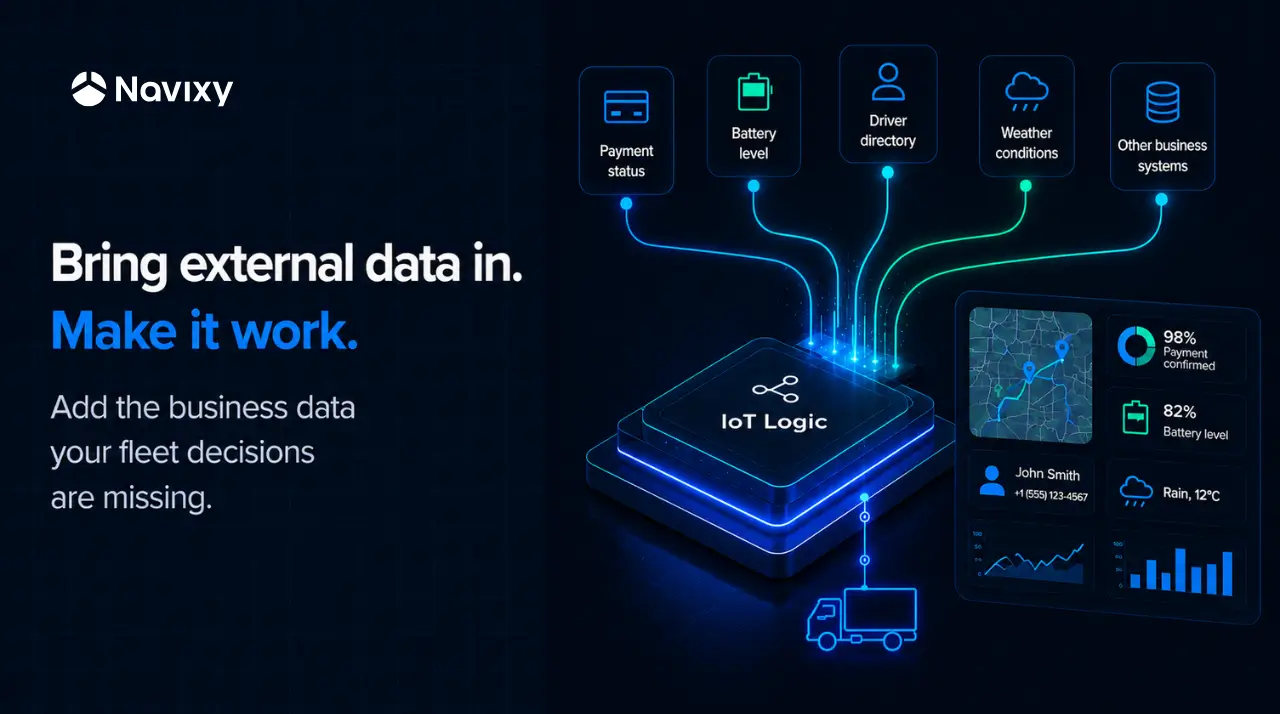
A fleet platform already knows a lot about the vehicle. A payment system, battery vendor's app, or driver directory knows something else that can be just as important. Often, these systems don't naturally share what they know, so decisions are made without the full context.
Connecting those missing pieces used to mean building another integration. With IoT Logic, many of them can simply become part of the vehicle's data flow.
A whole data integration project behind a few extra fields
And those missing pieces can be surprisingly small, such as an asset ID stored in an ERP, a service category assigned by an operations team, or a contract reference from a CRM. None is particularly interesting on its own, but each can become useful when it is available alongside the vehicle's data.
None of this sounds like a data integration project. Yet getting even a few such values from one system into another has traditionally required someone to scope the connection, build it, test it, and maintain it.
The business might need three extra fields. The technical answer can end up being another custom integration.
IoT Logic offers another route for vehicle data enrichment. An external system can push additional attributes to a device already tracked on the platform. The incoming data is mapped to the right device and joins its existing data flow, where it can be used in further processing and automation.
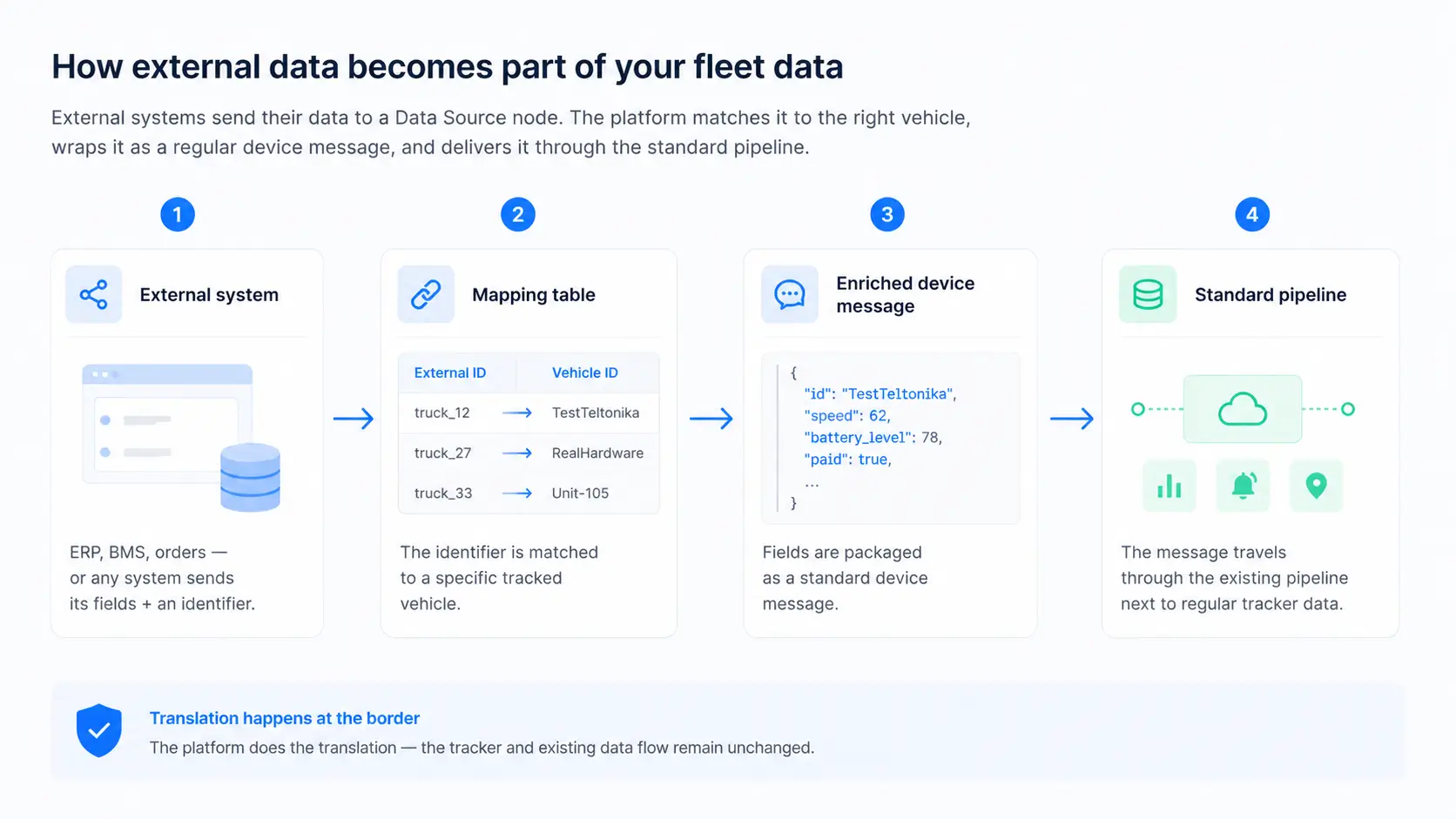
The request format and authentication details are covered in the technical documentation. Here, we'll follow what happens to the data once it reaches the platform.
How external data joins the vehicle data flow
The incoming data first needs to find the right vehicle. The external system sends it with an identifier, and IoT Logic uses the configured mapping to match that identifier to a device already registered on the platform. The new attributes then join the device's data stream alongside the telemetry it already reports.
Nothing changes on the device side. The tracker continues reporting as before, while IoT Logic can use the additional attributes in calculations, conditions, automation, and further processing.
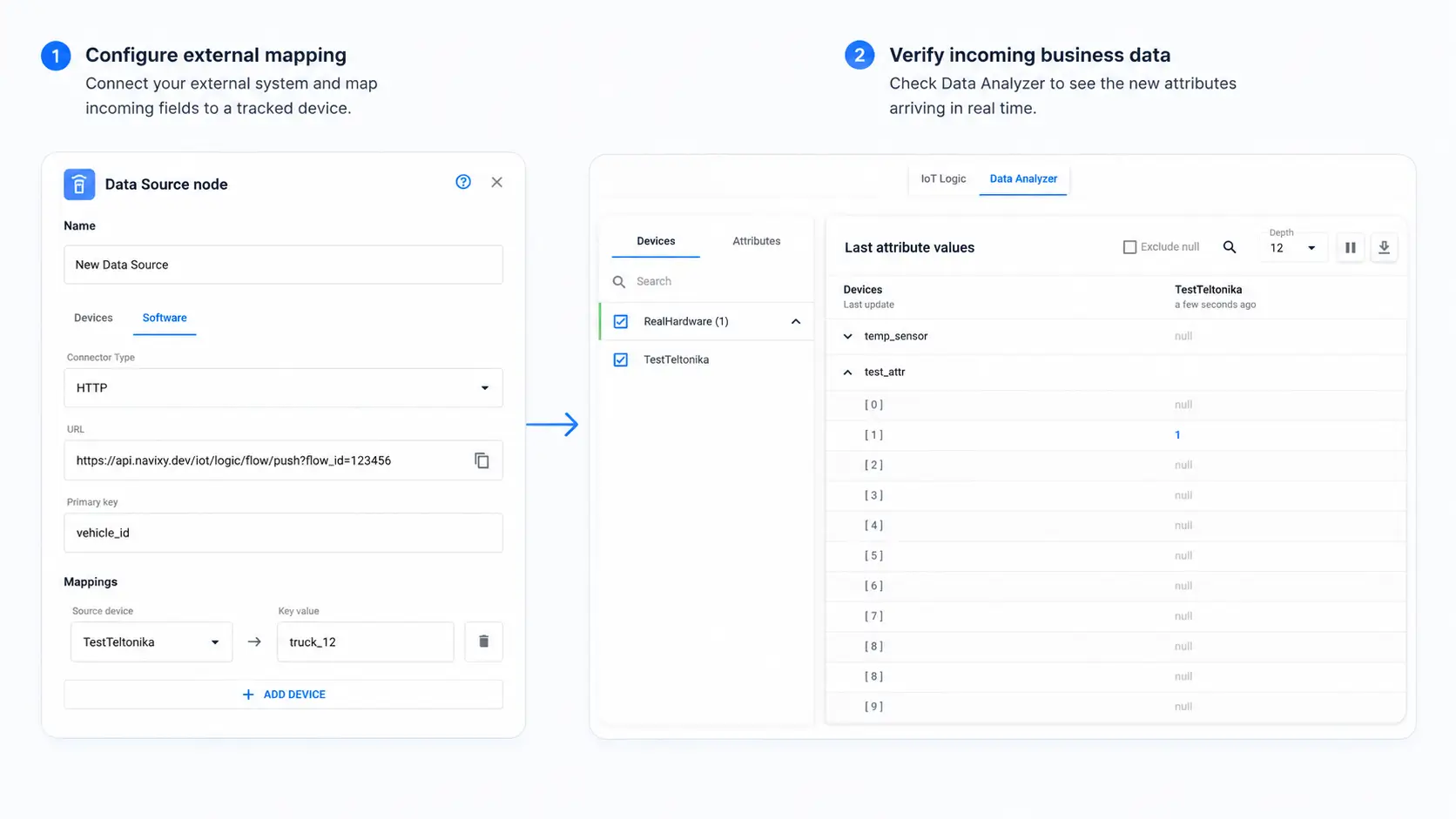
Normally, a telemetry flow starts with the device. The tracker sends a new message, and that message moves through IoT Logic for processing. Events in other systems don't necessarily follow that rhythm. A payment can be confirmed, a status can change, or an external service can produce a new value while the vehicle has nothing new to report.
HTTP Push allows that data to enter the flow when the external event happens, rather than waiting for the device's next message. A payment confirmation, for example, can arrive when the transaction is approved and become part of the logic that determines what happens next.
Vehicle data enrichment in real-world workflows
What happens next depends on what the fleet needs that additional data for. A payment status might determine whether a vehicle can be unlocked, weather conditions might change how its telemetry is evaluated, while data from an internal business system or an OEM platform can add context that the tracker doesn't provide.
The examples below follow those scenarios into IoT Logic. The flows are illustrative rather than prescribed configurations, since the exact attributes, conditions, and actions will depend on the external system, the devices involved, and the workflow being built.
Payment confirmation can become a vehicle action
Consider a shared mobility operator that needs payment and vehicle access to happen as one process. The payment provider knows when a transaction has been approved, while the fleet platform knows which vehicle the customer is trying to use. Without a connection between the two, payment and vehicle control remain separate workflows.
The payment provider can push the transaction status together with an identifier that maps it to the relevant vehicle. Once that status enters the vehicle's data flow, IoT Logic can use it as part of the logic that determines what happens next.
For example, a confirmed payment could allow an unlock command to be sent to the vehicle. A rejected or missing payment would leave the vehicle locked. The operator gets one automated flow instead of having to coordinate the payment system and vehicle control separately.
Example IoT Logic flow
One possible flow could look like this:
Payment provider → HTTP Push → Map transaction to vehicle → Check payment status → Send unlock command
The external system pushes an attribute such as payment_status for the mapped vehicle. IoT Logic evaluates the value and, when the required conditions are met, routes the message to the node responsible for sending the device command.
In a production flow, an operator would normally add its own safeguards around that logic, such as checking the transaction reference, vehicle state, or other conditions required by the service.
Weather data can make vehicle rules less rigid
Vehicle rules often operate with fixed thresholds. That works until the conditions around the vehicle change.
A fleet may tolerate one pattern of speed, braking, or movement on a dry road and want a different response during heavy rain, ice, or poor visibility. The weather service has that context, but the tracker itself does not need to measure it.
By enriching vehicle data with current conditions from an external weather source, IoT Logic can include that context when evaluating the vehicle's telemetry. The same vehicle behavior can then produce different outcomes depending on the conditions in which it occurs.
For an operator, this opens the door to more situational rules without requiring another source of telemetry from the vehicle itself.
Example IoT Logic flow
An illustrative flow could be:
Weather service → HTTP Push → Map conditions to vehicle → Combine with vehicle telemetry → Apply condition-specific logic → Alert or action
The external service might provide attributes describing precipitation, visibility, temperature, or road-related conditions. IoT Logic can use those values together with incoming vehicle telemetry in calculations or conditional logic.
For example, a rule could apply a different speed threshold when a mapped weather attribute indicates severe conditions. The exact thresholds and response would remain a business decision rather than something prescribed by the enrichment mechanism itself.
Business records can travel with the vehicle data
Not every enrichment use case needs to control the vehicle. Sometimes the useful information is already sitting in an internal business system, just too far away from the operational data.
A company might maintain vehicle assignments, service categories, contract references, responsible teams, or other operational attributes in its ERP, CRM, or internal application. Fleet staff may need some of that information when reviewing vehicle activity or running automated processes, even though it has nothing to do with what the tracker measures.
Instead of reproducing those records manually in the fleet platform, the relevant values can be pushed to the mapped vehicle. They then become available alongside its telemetry and can participate in processing, reporting, or downstream data delivery.
This is vehicle data enrichment in its quieter form. Nothing dramatic happens to the vehicle, but the telemetry becomes much more useful to the people and systems consuming it.
Example IoT Logic flow
A basic flow might look like:
ERP / CRM / internal system → HTTP Push → Map business attributes to vehicle → Enriched vehicle data → Processing or downstream destination
For example, an internal system could push a contract_id, service_type, or another operational attribute associated with the vehicle. IoT Logic can preserve that context as the vehicle data moves through the flow, allowing subsequent logic or downstream systems to work with both telemetry and business information.
Which attributes belong in the flow depends on the operation. The point is not to copy an entire CRM or ERP record into the fleet platform, but to bring across the few values that make the vehicle data more useful.
OEM battery data can fill gaps in tracker telemetry
Battery data is a slightly different case because many trackers already report battery-related parameters. The useful gap appears when an EV manufacturer or battery management system has information that the installed telematics device does not provide.
An OEM platform might expose additional state-of-charge information, battery health data, charging status, or another battery parameter through its own system. On its own, that information lives separately from the vehicle's GPS and operational telemetry.
Pushing the relevant values into the mapped vehicle brings the two sources together without changing how the tracker reports. Fleet operations can then work with location, movement, and the additional battery context in the same data flow.
For an EV fleet, that can be considerably more useful than treating the OEM portal and fleet platform as two separate places to check what is happening with the same vehicle.
Example IoT Logic flow
One possible flow is:
OEM / BMS platform → HTTP Push → Map data to vehicle → Add battery attributes → Combine with tracker telemetry → Processing, alert, or downstream system
Suppose the OEM system provides a battery parameter that the tracker does not. It can push that value as an additional attribute for the mapped vehicle. IoT Logic then has both the tracker's native telemetry and the externally supplied battery data available in the same flow.
From there, the fleet can apply its own logic. It might route the enriched data to another system, evaluate a battery-related condition together with vehicle activity, or use the additional parameter as context for an operational alert.
Across these examples, the external data plays different roles, but the vehicle remains the point that connects everything. Payment status can lead to an action, weather data can affect a rule, business attributes can add operational context, and OEM data can fill a gap in the telemetry available from the tracker.
In each case, the external data is mapped to a known device and added alongside the telemetry it already reports. It doesn't replace the device's native GPS or status data. This keeps vehicle data enrichment focused on adding the context a workflow needs, while the vehicle remains at the center of the data flow.
When another data source no longer means another integration
For partners and systems integrators, this changes a familiar conversation with a client. “Can we bring this data into Navixy too?” no longer has to lead immediately to “We'll need to build an integration.”
Sometimes a custom integration will still be the right answer. But when the external system can push the data IoT Logic needs, a request that once looked like a development project may be much closer to a configuration task.
That makes smaller enrichment ideas worth considering too. The question is no longer only whether a new data integration project can be justified, but whether bringing that extra context into the vehicle's data flow could make an existing workflow work better.
Want to see how vehicle data enrichment could work for your business? Get in touch with our team, and we'll help you explore your use case and answer your questions.