A three-degree window — where both directions are fatal.
Chilled fish and fresh meat hold in a sliver near 0 °C: dip below roughly −1 °C and ice crystals wreck the texture for good; drift above the ceiling and shelf-life burns by the hour while histamine and pathogens build — none of it reversible. The most expensive failure isn't a dramatic spike, it's the quiet drift that averages hide. Navixy evaluates every packet and its rate of change against a tight per-load corridor.
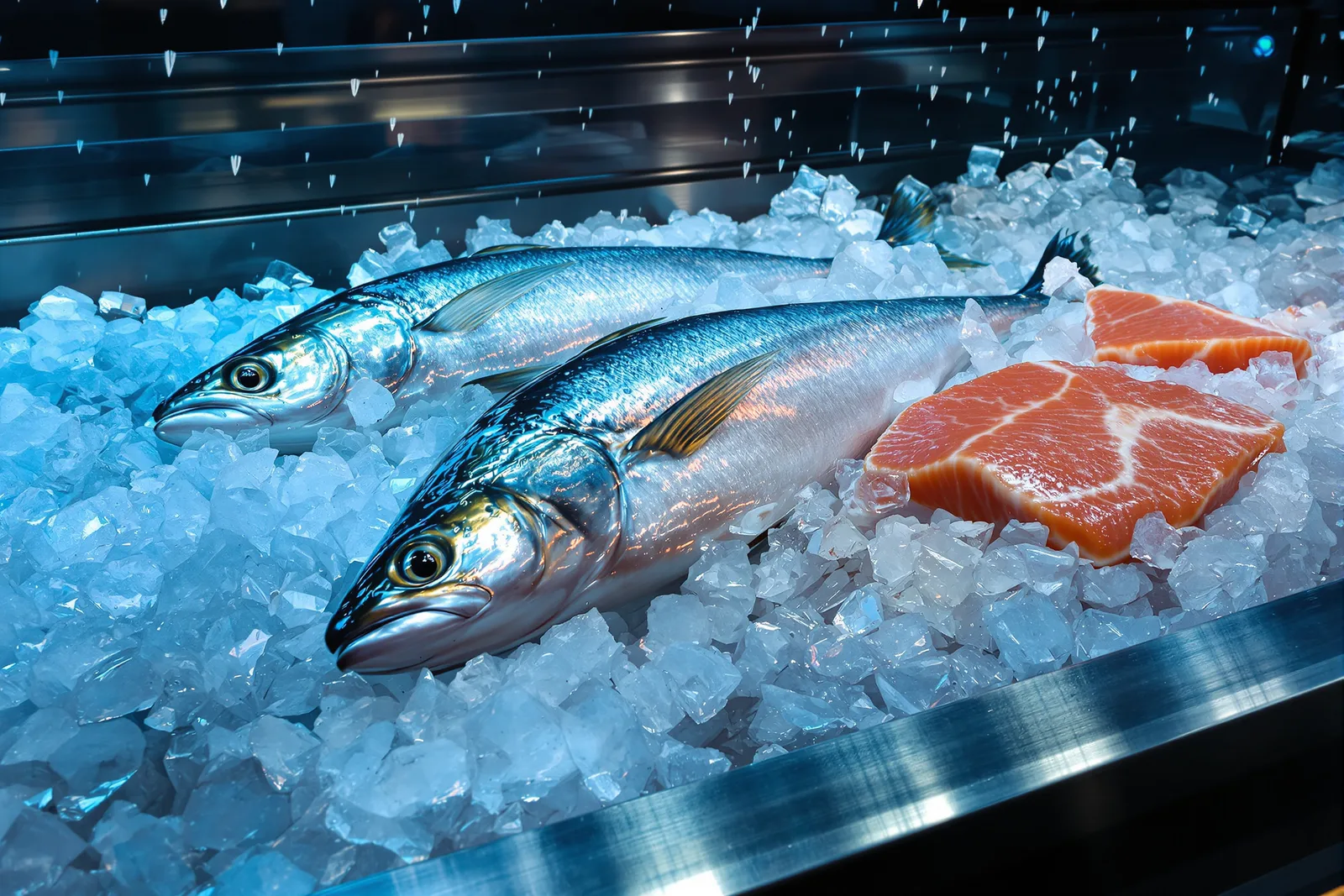
- Peak temp
- 5.4 °C
- Time above +2 °C
- 9 h
- Shelf-life spent
- ≈1.5 days
A load that never alarms can still be the load that fails
Here the harm is a cumulative function of time × temperature, not a single threshold crossing — three different biologies make the same point. So Navixy evaluates every packet and the delta between packets, not a sampled mean.
The slow drift spends shelf-life the alarm never sees
A load that rides at 5 °C instead of 0 °C for a day never trips an absolute limit — it just arrives looking fine with most of its sellable life gone. Per-packet rate-of-change rules catch the climb while it is minutes old; IoT Query reports the shelf-life spent, not a comfortable mean.
Raising fish from 0 → 4.4 °C roughly doubles the spoilage rate and halves remaining shelf-life (Oregon State Seafood) — and it never trips an absolute alarm.
Histamine (scombrotoxin) is heat-stable: once it forms, nothing downstream removes it. ≥200 ppm = adulterated (FDA).
Histamine is a permanent write-off
In tuna, mackerel and mahi-mahi, a warm hold builds scombrotoxin — heat-stable, so cooking, freezing or canning can't remove it, and it's a recall-grade adulteration. The only control is time-and-temperature, starting at harvest.
Listeria grows below 1 °C — RTE cold-smoked fish can gain +1.7 log at 4 °C before it even smells off.
Listeria grows in the 'safe' cold
Cold-smoked salmon is ready-to-eat and not cooked, and Listeria is cold-loving — it grows below 1 °C and invisibly. A small warm drift shortens the time to breach the legal limit on a load that still looks perfect.
Vibrio in oysters — the doubling time collapses as the meat warms; control is the cumulative integral, not a threshold.
Vibrio is a clock, not a threshold
In raw oysters, Vibrio growth accelerates exponentially as the meat warms — the doubling time collapses from ~36 h at 10 °C to ~1.6 h at 27 °C. Control plans grade lanes by time-to-cooling, so you must report the integral.
Live haul: warm water raises O₂ demand while lowering O₂ supply — one compound rule watches temp, dissolved oxygen and tank level together.
Live haul needs more than a thermostat
Live fish and shellfish travel in low-volume tanks where oxygen must be actively held. Warm water raises O₂ demand while cutting O₂ supply, so the alert has to be multi-parameter — temperature, dissolved oxygen and level on one rule.
No spike, no absolute alarm — and half the shelf-life gone
The classic seafood failure isn't a dramatic excursion; it's a quiet ride a few degrees too warm. A static limit may never trip, but spoilage is roughly linear with temperature, so the load arrives looking fine with its sellable life spent. A per-packet rate-of-change rule catches the climb while it is minutes old.
- Loaded on ice at 0 °C — squarely in band
- A tired door seal and a warm dock start a slow climb
- Rate-of-change alarm: +0.8 °C/h — still only 2.6 °C
- Rides at ~5 °C: no spike, but the spoilage rate has doubled
- Cumulative time-above-2 °C crosses the shelf-life budget
- Delivered — record shows ≈1.5 days of life already spent
- Peak temp
- 5.4 °C Peak temp
- Time above +2 °C
- 9 h Time above +2 °C
- Shelf-life spent
- ≈1.5 days Shelf-life spent
From a razor-thin band to an audit-ready record, in four moves
The same composable platform behind fleet and field operations, configured for the tightest corridor in the cold chain — on hardware you already approve.
- 01
Sense at the two diagnostic spots
High-resolution 1-Wire probes (~1/16 °C, no field calibration) at the door and the evaporator, streaming every packet, with reefer setpoint and door read over CAN / J1939 alongside the in-load probes.
- 02
Decide on a floor, a ceiling, and a slope
IoT Logic enforces a corridor with both bounds, evaluates every packet against the previous one for rate-of-change, and runs a compound temp + dissolved-oxygen + level rule for the live-haul edge case.
- 03
Act while the load is still saveable
The early rate-of-change alert means re-ice, fix the unit, or close the door before a quiet drift becomes spent shelf-life or an irreversible histamine build — not a post-trip discovery at the dock.
- 04
Prove the exact metric the auditor wants
IoT Query writes the cumulative figure this category needs — MKT, time-above-4.4 °C toward the histamine limit, equivalent-days-on-ice, or an NSSP-style Vibrio integral — exported for a Seafood HACCP / FSMA / NSSP audit and to settle a rejected-load dispute.
1-Wire at the two diagnostic spots — every packet, never averaged
A three-degree corridor is only observable with the right sensor in the right place, read at full resolution. Navixy normalizes high-resolution 1-Wire probes, reefer J1939, door and GPS into one data model across 2,500+ device models — and, for live haul, dissolved-oxygen and level on the same device.
- High-resolution 1-Wire (~1/16 °C, no field calibration) makes a 3-degree band and a slow drift observable — a ±0.5 °C-class tag can hide the entire window
- Two diagnostic placements: at the door (warm-air ingress on every open) and at the evaporator (unit fault + cold back-wall freeze risk); add front / mid / rear on a long trailer
- Per-packet evaluation, never sampled or averaged — the device streams every reading and the platform evaluates each one and its delta to the previous
- Analog / RS-485 dissolved-oxygen + water-level probes bind to the same device as the temperature probe, so one compound rule serves the live-haul tank
- Reefer CAN / J1939 and offline store-and-forward (no gaps) — because the time-temperature integral is meaningless with holes in the record; ships white-label over an open API
The two diagnostic spots earn their place: at the door catches warm-air ingress on every open, at the evaporator catches a unit fault and the cold back-wall freeze risk. For live haul, analog / RS-485 dissolved-oxygen and level probes ride the same device so one compound rule sees temp + O₂ + level; reefer CAN / J1939 is read alongside — never instead of — the in-load probes.
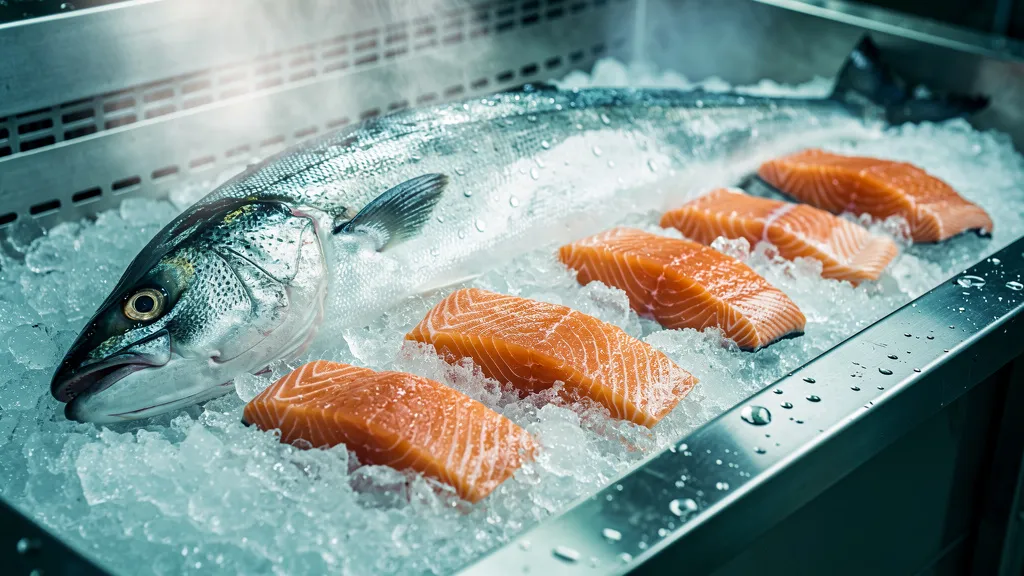
Air is not product — and the mean is not the trip
Spoilage, histamine and pathogen growth are all cumulative functions of time and temperature, realized days later as a texture complaint, a short code-life, or a recall. Reading the product itself at full resolution — and recording the integral — is what turns a tight, unforgiving band into a number you can act on and defend.
- Independent in-load probes at the door and evaporator, not just the reefer's return-air sensor
- A cumulative time-temperature record — MKT, time-out-of-range, equivalent-days-on-ice
- A gap-free, exportable log that supports Seafood HACCP / FSMA / NSSP and defends a claim
What seafood & meat teams ask
Why isn't a freezer 'safe' for fresh fish and meat?
If the load never set off an alarm, why did shelf-life arrive short?
Can spoiled-fish (histamine) poisoning be cooked or frozen out later?
Refrigerated oysters and smoked salmon are cold — why are they still risky?
Doesn't monitoring the reefer's own temperature cover it?
What does live seafood transport need beyond temperature?
How does Navixy turn this into something auditable?

Hold the three-degree line — and prove you held it
Tell us your species, lanes, and packaging. We'll map the high-resolution 1-Wire placements, the floor-and-ceiling corridor and rate-of-change rules, the compound live-haul logic, and the cumulative HACCP / FSMA / NSSP records — so a razor-thin, unforgiving band becomes an alert you can act on and a record you can defend.