Catch the freeze that quietly kills a vaccine.
Everyone guards the 8 °C ceiling — but distribution studies have found 14–35% of fridges and shipments exposed vaccines to freezing, and a few minutes below 0 °C against a cold-pack or reefer wall destroys potency with nothing for the receiver to see. Navixy puts calibrated logging inside the carrier, alerts on the freeze side and the rate of change, and turns the trip into a GDP-ready record.
- Min product temp
- −1.4 °C
- Time below 0 °C
- 6 min
- Disposition
- QA review
Guard both ends of the band — and prove it
A vaccine corridor has a floor as well as a ceiling. Navixy watches the freeze side most monitoring ignores, measures from inside the load, and assembles the qualified record a GDP audit actually asks for.
The record an auditor follows, not one you assemble the night before
Mean kinetic temperature, time above the ceiling, and time below freezing on one defensible record — built on a schedule with IoT Query and exported to your QA system, so a freeze event is logged, explained, and dispositioned instead of discovered.
- Mean kinetic temp
- Time above 8 °C
- Time below 0 °C
- Disposition
Alert on the freeze side, not just the ceiling
IoT Logic watches the lower 0 °C bound and the rate of change toward it, so a cold-pack or a stuck heater trips an alert before the vial is damaged — not at receiving.
Calibrated, certified, gap-free logging
Use BLE loggers certified to EN 12830 with ISO-17025-calibrated probes that hold ~345 days on-board, so a cellular dead zone never leaves a hole in the audit trail.
Measure the vial, not the airflow
The reefer's return-air sensor reads the air, not the product. Navixy ingests an independent probe placed in the carrier — where the freeze actually happens.
Weights heat exposure the way stability does — the number a GDP audit asks for.
Mean kinetic temperature, not a simple average
MKT weights exposure the way stability data does, so the number on the report reflects real potency risk — the metric GDP and stability budgets are written in.
The freeze usually happens on the way to the clinic
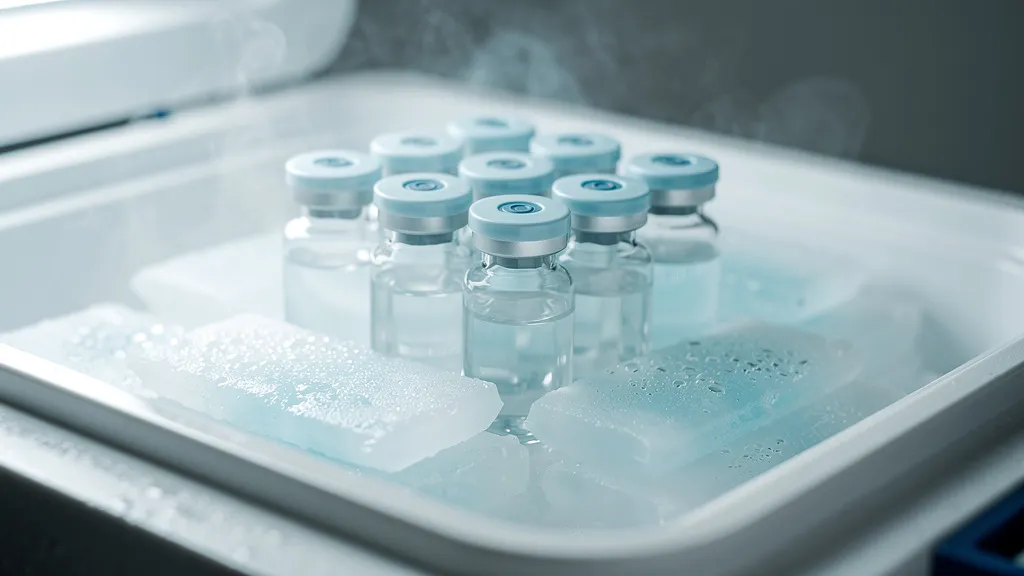
Frozen gel packs added for the last leg are the most common cause of an accidental freeze: a vial resting against a brick of −20 °C coolant drops below 0 °C while the box's air still reads 4 °C. A calibrated probe travelling with the product — not on the wall — is what turns that invisible event into an alert and a line on the record.
- Calibrated probe inside the carrier, beside the product
- Freeze-side and rate-of-change alerts before damage, not after
- Custody and condition handed to the clinic as one record
A 2–8 °C vaccine load brushes the cold wall — and is pulled back before potency is lost
The trace runs the GDP corridor until a cold-pack contact drives the product probe below freezing. Watch the rate-of-change alert fire on the dive, the handler reposition the load, and the trip resolve into a record that logs the time below 0 °C.
- Departure — box pre-conditioned to 4 °C, in range
- Gel pack added for the last mile; probe begins to dive
- Rate-of-change alert fires before 0 °C is crossed
- Freeze: −1.4 °C — handler repositions the vials off the pack
- Back in range; time below 0 °C logged automatically
- Condition record sealed and routed to QA
- Min product temp
- −1.4 °C Min product temp
- Time below 0 °C
- 6 min Time below 0 °C
- Disposition
- QA review Disposition
From a vial in a box to a released record, in four moves
The same composable platform that runs fleet and field operations, configured for a GDP cold chain — buildable on hardware you already approve.
- 01
Sense in the load
A BLE logger certified to EN 12830 with an ISO-17025-calibrated probe travels inside the carrier, sampling every 1–5 minutes and logging on-board so dead zones leave no gaps.
- 02
Decide on both bounds
IoT Logic evaluates each reading against the floor and the ceiling and the rate of change between readings — value('temperature',0,'valid') vs the previous index — so a freeze is caught on the way down.
- 03
Act before damage
The handler nearest the load is alerted to reposition or adjust, with an escalation ladder behind it, while the vials can still be saved.
- 04
Prove with the right metric
IoT Query rolls up MKT, time-above and time-below-freezing, excursions, and chain of custody into a qualified record, exported to your QA system over the API.
Calibrated sensors, certified logging, your QA system
Pharma needs traceable calibration and a record with no holes. Navixy normalizes EN 12830 / ISO-17025 BLE loggers, 1-Wire probes, door, and GPS into one data model on 2,500+ device models, then pushes the proof straight into the systems your quality team already runs.
- EN 12830-certified BLE loggers with ISO-17025-calibrated probes (±0.5 °C class) and on-board logging that survives dead zones
- No rip-and-replace: keep your GPS trackers and add the calibrated cargo probe your lanes need
- Freeze-side, ceiling, and rate-of-change rules run identically across mixed device fleets
- Push MKT, time-out-of-range, and chain of custody to your QMS / QA over an open API and webhooks — and ship it white-label
Every reading is calibratable and traceable end to end — the chain a Good Distribution Practice auditor follows from the vial to the released record.
What pharma teams ask about freeze and proof
Why focus on freezing when the limit everyone monitors is the upper one?
Isn't the reefer's temperature reading enough for a 2–8 °C load?
Can you produce the calibrated, traceable record GDP audits expect?
What happens to the record in a cellular dead zone?
Does this extend to ultra-cold and last-mile clinic delivery?
How does the proof reach our quality system?
Does pharma cold-chain monitoring pay for itself?
Prove your vaccines never froze — not just that they never cooked
Tell us your products, lanes, and GDP requirements. We'll map the calibrated sensors, the freeze-side and rate-of-change IoT Logic rules, and the MKT / time-out-of-range records for your pharma cold chain — and show you the proof your quality team and customers will trust.