Why a thermometer isn't a cold-chain record (and what is)
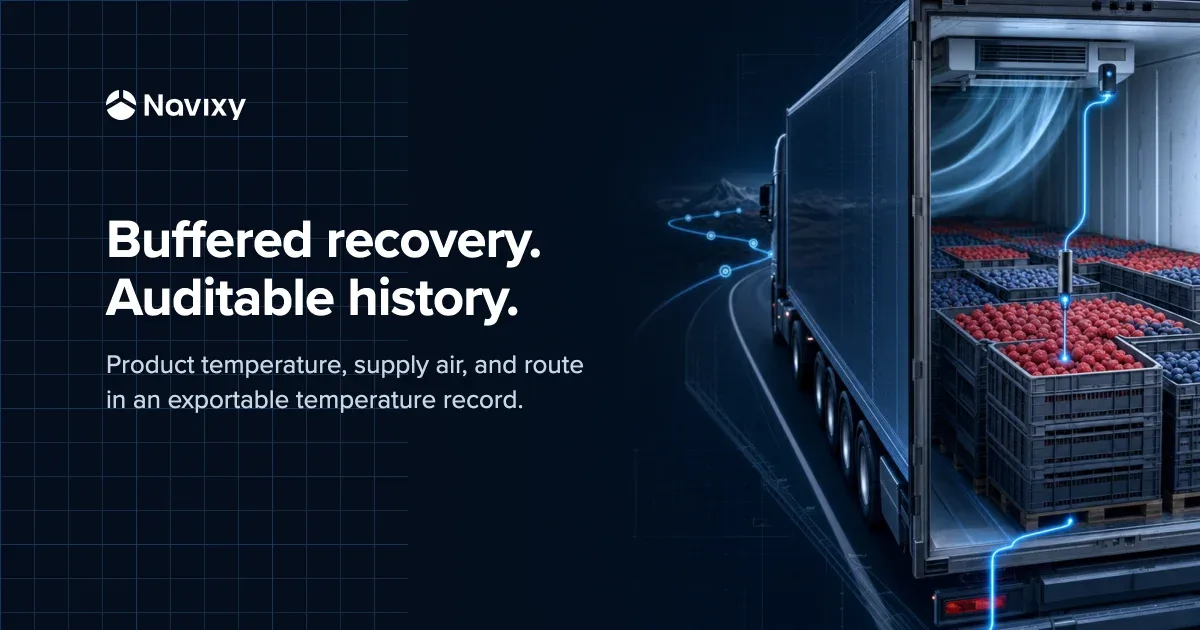
The truck left on time. The box thermograph read 4 °C the whole way. And the load still arrived soft, with juice at the bottom of the crate and a shelf life shorter than you promised. The buyer discounted the invoice. The air in the box was cold while the fruit at the center of the pallet was warmer.
A refrigerated trailer keeps produce cold — it does not prove the cold chain held. Those are two different jobs. A defensible record documents the product's temperature, location, and exposure duration for later review.
If you ship perishables across a border, a defensible record documents the temperature history behind a shelf-life or payment dispute. This post explains what makes that record defensible, and how to check yours before the next shipment.
How precooling, pulp, and supply air shape the record
Three physical facts shape every reliable temperature record, and a box-level thermograph captures only part of the picture.
A refrigerated trailer holds the temperature the produce enters with. Removing field heat from warm produce requires precooling before loading. UC ANR/UC Davis guidance for berries calls for forced-air cooling to 0 °C as quickly as possible, within 2 hours of harvest.
The return or supply sensor can read a comfortable 4 °C while the center of the pallet — the pulp temperature — runs several degrees warmer. An air reading can therefore support sign-off while the warmer pulp continues to consume shelf life.
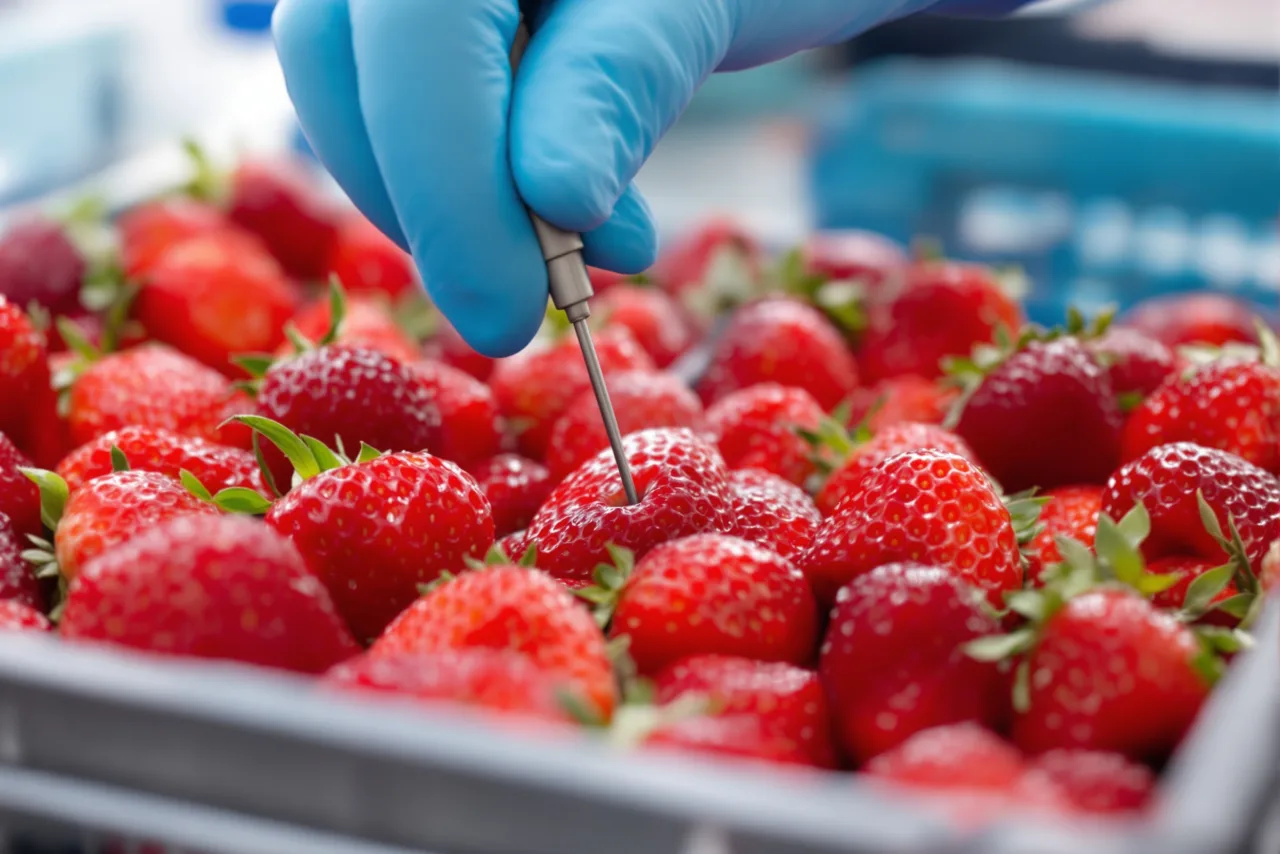
Under the Van't Hoff/Q10 rule in USDA Agriculture Handbook 66, respiration in fresh produce increases roughly two- to threefold for every +10 °C. A couple of hours at the wrong temperature increases cumulative respiration and reduces the remaining shelf life. That exposure remains after later cooling and can account for otherwise unexplained loss.
The four properties of a defensible record
A temperature log can support the temperature portion of a claim only if it has four properties. Treat them as your minimum checklist when you evaluate a supplier, a carrier, or your own operation.
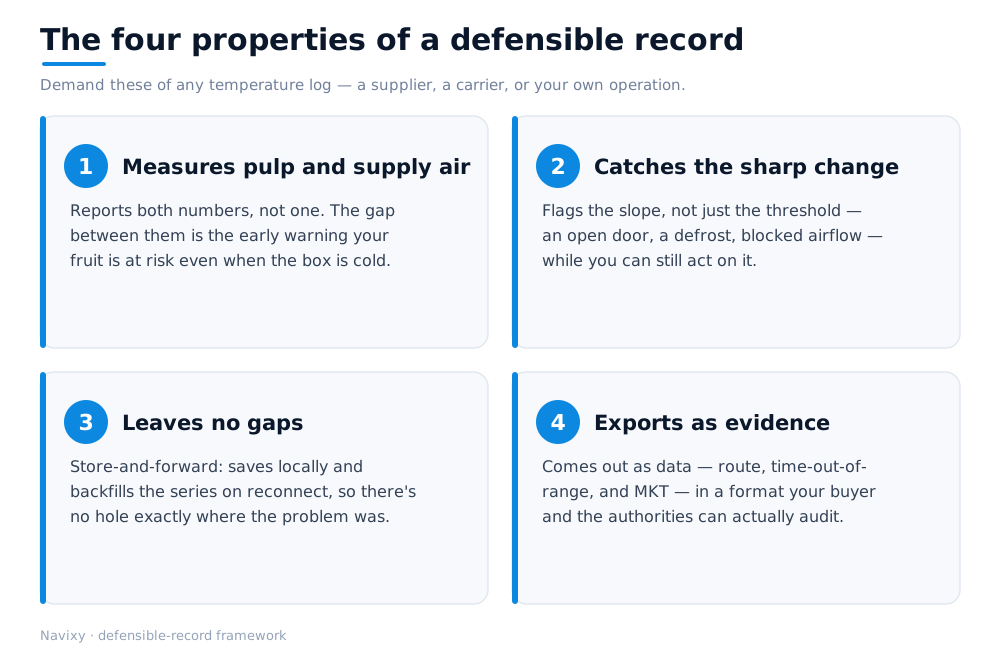
- It measures pulp and supply air. A defensible record reports both values, because the gap between them is the early signal that your fruit is at risk even when the box "is cold."
- It tracks rate of change. A threshold crossing records an excursion after it begins. The slope can expose a fast rise or drop associated with an open door, a defrost cycle, or a pallet blocking airflow.
- It recovers buffered readings. With store-and-forward, a compatible device saves readings locally during a connection loss and sends them after reconnection. Continuity still depends on each sensor and network path.
- It exports auditable data. The export includes route, time-out-of-range, and mean kinetic temperature (MKT) in a format your buyer and the authorities can read.
A defensible record isn't the one that says "it was cold." It's the one that still holds up months later, showing exactly what temperature your fruit lived at, where, and for how long.
What the data — and the border — actually reward
The numbers frame why this is worth the effort. A University of Guanajuato study of the strawberry trade counted 302,620 metric tons exported from Mexico to the US in 2024, worth about US$113 million, with 10 import alerts in the period studied. Against that flow, USDA Foreign Agricultural Service forecasts total Mexican berry exports of 715,000 metric tons in 2026, with around 80% expected to go to the US.
The same Guanajuato study identifies pesticide residues as the main documented cause of fresh-strawberry rejection. Temperature evidence is limited to temperature-related questions; pesticide-residue rejection remains separate. A temperature record can document temperature-related shelf-life questions when the relevant conditions were captured.
Under 21 CFR § 1.908, shippers of food requiring temperature control for safety must have written temperature-control procedures and provide written operating-temperature instructions, including the precooling phase when necessary. Before loading such food, loaders must verify that refrigerated compartments are prepared, including proper precooling if necessary. When a written agreement assigns temperature-control responsibility to a carrier, it must demonstrate the maintained temperature conditions upon request.
For persons subject to 21 CFR Part 1, Subpart S and foods on the Food Traceability List, § 1.1310 defines Key Data Elements as information associated with Critical Tracking Events. Sections 1.1325 and 1.1340 specify records for harvesting or cooling before initial packing and for shipping. These are recordkeeping requirements; certification remains separate.
SENASICA supervises and certifies avocado orchards in the export program, while APHIS continues documentary supervision to confirm their phytosanitary status. Telemetry records document temperature history. What a good record can do is shorten the dispute, not prevent it — when you can show pulp, air, recovered buffered readings, and MKT, that evidence can make the temperature portion of a buyer dispute faster to resolve.
A 7-point check for your next shipment
- Precool first. For berries, use forced-air cooling to bring pulp to 0 °C as quickly as possible, within 2 hours of harvest, following UC ANR/UC Davis guidance.
- Measure pulp and air. Put at least one sensor in the center of the pallet and compare it against supply air.
- Verify before you load. Confirm the unit arrived cold and the log is already capturing before loading.
- Confirm store-and-forward behavior. Verify which device buffers readings during a connection loss and sends them after reconnection. The cold-chain telematics reference covers how that mechanism works.
- Set the range and the slope alert. Configure both the threshold and rate-of-change condition.
- Agree the evidence format. Ask for the record to export with route, time-out-of-range, and MKT.
- Set the retention period. Identify the sanitary-transport, traceability, customer, or certification rule governing this shipment. Record that rule's retention period in the SOP, then configure and verify the archive against it.
How Navixy assembles the temperature record
These four properties are vendor-neutral requirements. Navixy implements them as follows.
IoT Logic compares pulp temperature against supply air and generates a notification when it detects the configured rate-of-change condition. IoT Query assembles mean kinetic temperature, time-out-of-range, and the route for export via API in an auditable format. The platform receives BLE sensor and logger readings alongside the reefer's J1939 data. For compatible sources that buffer readings during a connection loss, store-and-forward sends those buffered records after reconnection; end-to-end continuity still depends on each sensor and network path.
Navixy captures and exports the configured temperature and route history as evidence. The operator and its certified partners determine whether the resulting record satisfies applicable rules. Navixy does not certify compliance.
Your next step: audit your record
Apply the 7-point check to your next shipment. If your record already has the four properties, keep the process; if it lacks any of them, you now know what to ask for. Request the editable checklist and an evidence-record template, and start documenting the temperature history relevant to shelf life.