JC171 and Navixy integration for high-risk fleet operations

AuthorBenjamin Hayes
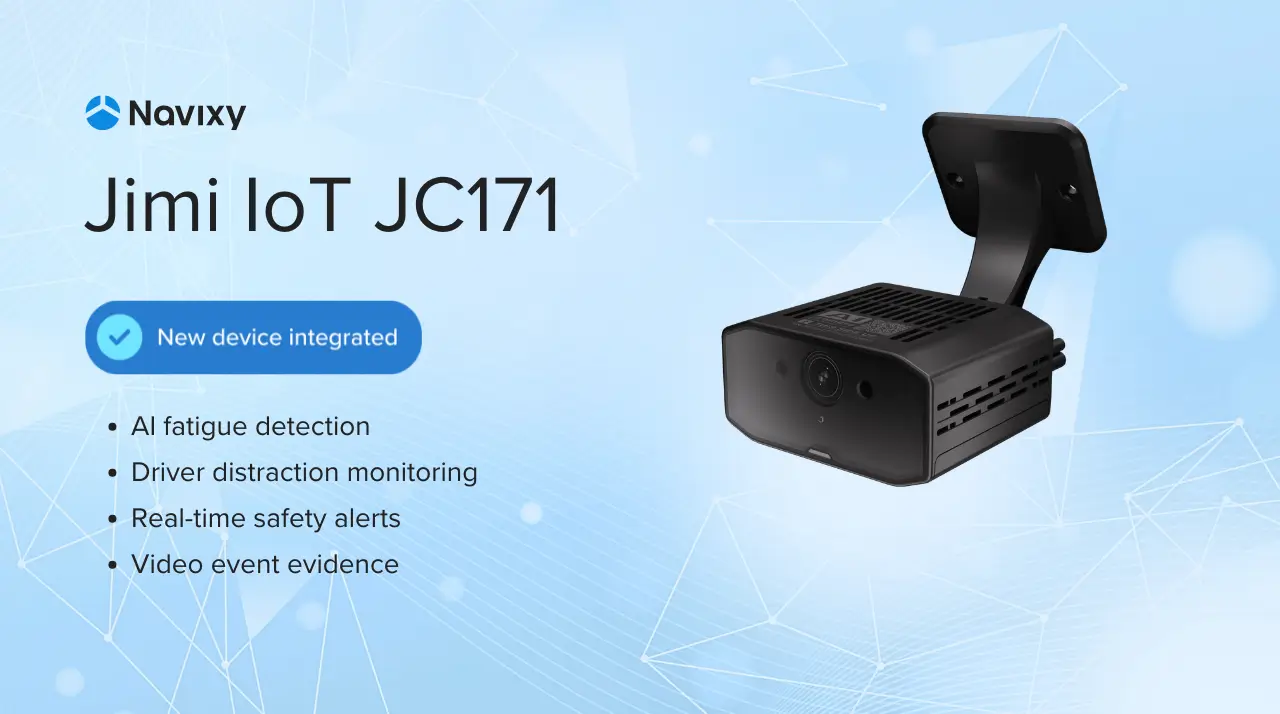
A single injury crash in long-haul trucking costs an average of $383,000 in direct losses. In mining, powered haulage accidents account for nearly 40% of fatalities and can shut down operations for days. For fleets operating under growing insurance and safety pressure, simply detecting fatigue and distraction is no longer enough. Driver behavior data needs to trigger operational response.
This article looks at how the Jimi IoT JC171 driver monitoring camera and Navixy IoT Logic help fleets respond to driver risk events in real time across trucking, transit, mining, and terminal operations.
The operational cost of fatigue and distraction
Fatigue and distraction remain some of the biggest causes of preventable incidents in commercial transportation. A momentary lapse in attention can quickly turn into a crash, followed by claims, downtime, operational disruption, and reputational damage. For fleet operators, the challenge is not identifying the risk. It’s responding before the incident happens.
The financial exposure is significant. FMCSA recorded more than 503,000 large truck crashes in 2022, with over 6,000 involving fatalities. A single injury crash averages $383,000 in direct costs before litigation. In mining, powered haulage remains one of the deadliest operational risks, accounting for nearly half of mining fatalities in some years. Public transit faces similar pressure, with Aon reporting liability claims frequency at 30.6% per bus-year.
Insurers have responded by treating driver monitoring as part of fleet risk evaluation, not just a safety add-on. But visibility alone is rarely enough. Many fleets already have video evidence showing warning signs before an incident. The real challenge is turning driver behavior data into operational response while there’s still time to intervene.
Why JC171: AI detection at the point of risk
The Jimi IoT JC171 addresses the detection layer with a compact, AI-powered camera designed for commercial vehicle environments. What distinguishes it from basic dash cameras is where the processing happens: on the device itself, eliminating the latency of cloud round-trips for critical safety decisions.
The device monitors the full spectrum of human-factor risks:
- Fatigue detection: Identifies yawning, prolonged eye closure, and head-nodding patterns that precede microsleep
- Distraction monitoring: Detects phone use, smoking, head lowering, and gaze deviation from the road
- Seatbelt compliance: Verifies driver restraint status
- Driver identification: Uses face recognition to confirm authorized operators
- Night vision: Infrared capability maintains detection accuracy in low-light conditions
When the JC171 detects a risk condition, it delivers immediate voice alerts to the driver cabin. This in-cab feedback creates the first intervention point, often sufficient for minor lapses. The driver hears an alert, adjusts behavior, and the potential incident never materializes.
But the device's value doesn't end at the cab. Every event generates structured data that flows to the telematics platform, where the more consequential decisions happen. Detection is necessary. It's not sufficient. What transforms a monitoring camera into an operational safety system is what happens to that data after it leaves the device.
Where the JC171 becomes operational intelligence
Navixy connects the JC171 to fleet operations through its IoT Logic automation engine. Rather than simply displaying events on a dashboard for human review, the integration enables rules that evaluate context and trigger responses in real time.
Here’s how the workflow operates.
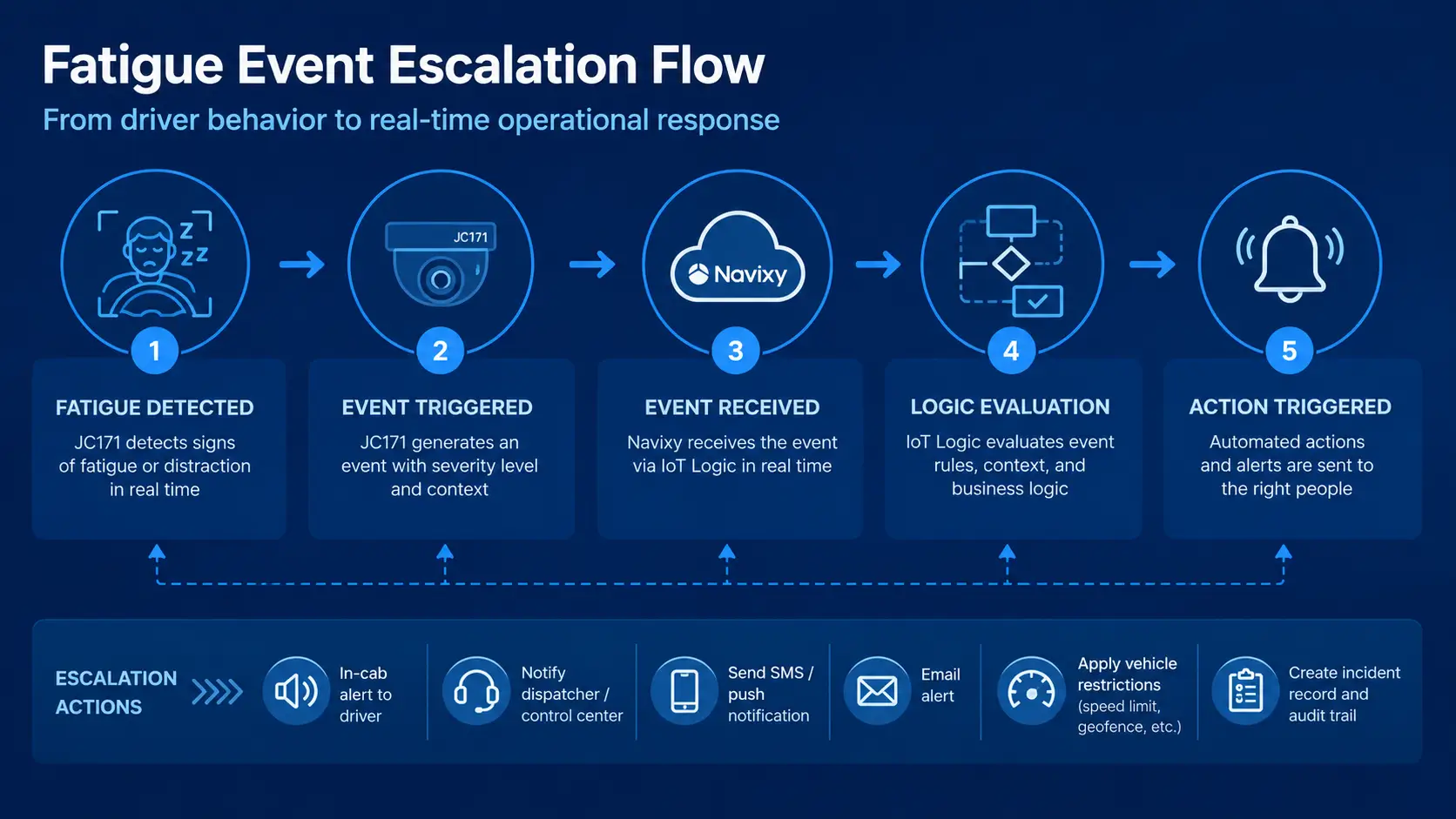
JC171 events arrive at Navixy alongside GPS position, route data, and driver assignment information. IoT Logic normalizes these signals into a consistent format and applies configurable rules. The rules can evaluate not just the event type, but its operational context, including shift duration, geofence location, driver history, and time of day.
This context matters. A yawning event from a driver two hours into a daytime urban route carries different implications than the same event from an operator eight hours into a night shift on a remote highway. IoT Logic automation enables TSPs and fleet managers to encode these distinctions without custom development.
The automation toolkit includes:
- Rule-based escalation – Define thresholds that trigger supervisor alerts, driver notifications, or both
- M2M commands – Send instructions directly to other connected devices, enabling coordinated responses without human delay
- Event enrichment – Attach operational context to every detection for downstream analysis and compliance documentation
- Multi-tenant governance – TSPs can configure industry-specific workflows for each customer fleet from a single platform
The result: when a fatigue event occurs, the system doesn't wait for a dispatcher to notice. The M2M command capability means the platform can trigger an audible alert in the cab, notify the dispatcher, log the event to the driver's risk profile, and document everything for compliance purposes, all within seconds of detection.
IoT Logic automations by industry
The same detection hardware and automation platform serve different operational realities depending on the industry. IoT Logic enables TSPs to configure workflows that match how each fleet actually operates.
Long-haul trucking
Fatigue risk concentrates in predictable patterns: night shifts, the final hours before a mandated rest break, and stretches of monotonous highway driving. Automation can target these windows.
- Fatigue escalation workflow When IoT Logic detects a fatigue event from a driver more than six hours into a shift, it triggers dispatcher notification and logs the event to the driver's coaching queue. Repeated events within the same shift escalate to supervisor alert and recommend routing to the nearest rest area.
- Distraction coaching trigger Phone use or head-lowering events generate an in-cab voice alert immediately, followed by a coaching flag that populates the driver's next check-in agenda.
- Evidence package generation Severe events automatically compile GPS track, video clip, and event metadata into a defensible record for insurance or compliance purposes.
Public transit and buses
Urban transit operates under intense public scrutiny and regulatory oversight. Passenger safety creates zero tolerance for incidents, and claims frequency makes every preventable event valuable.
- End-of-shift fatigue control The system monitors fatigue events by shift hour. Drivers showing elevated fatigue indicators in the final 90 minutes trigger a supervisor review before the next shift assignment.
- Intersection distraction escalation Geofenced high-risk intersections trigger enhanced monitoring. A distraction event within these zones generates immediate dispatcher alert and event documentation.
- Unauthorized operator detection Face recognition events that fail driver verification trigger vehicle immobilization commands and supervisor notification.
Mining operations
Mining combines heavy equipment, remote locations, and shift schedules that test human endurance. The consequences of impairment incidents extend beyond the individual operator to the entire work site.
- Haul-road fatigue shutdown A fatigue event on a designated haul road can trigger progressive responses: first an audible alert, then speed limiting via M2M command, then full equipment stop if the operator doesn't acknowledge.
- Repeat-risk operator automation Drivers with elevated fatigue event frequency over a rolling 30-day window are flagged for schedule review and mandatory rest protocol before next shift assignment.
- Near-miss learning workflow Events that occur without incident are tagged for safety review, enabling proactive intervention before a pattern produces an accident.
Ports and terminals
Container terminals operate 24/7 with a mix of yard tractors, reach stackers, and personnel on foot. Distraction in these environments creates risk not just for the operator but for surrounding workers.
- Yard distraction prevention Distraction events in active yard zones trigger immediate audio alert and supervisor ping. Repeated events within a shift can trigger reassignment to lower-risk duties.
- Shift-end fatigue reassignment Operators showing fatigue indicators in the final hours of overnight shifts are flagged for reassignment to non-critical equipment or early relief.
- Incident reconstruction support Every detection event retains GPS, timestamp, and operational context, enabling rapid incident reconstruction when near-misses or accidents occur.
Across industries, we can observe a certain pattern. Detection gains value when connected to context and automated response. The JC171 provides the eyes. Navixy's IoT Logic provides the judgment and the hands.
Just a camera? No, a control system
The JC171 and Navixy combination transforms driver monitoring from passive observation to active intervention. Detection happens at the device. Context evaluation happens at the platform. Response happens automatically, in seconds, not minutes.
For fleet operators, this means reduced incident frequency, stronger claims defense when incidents do occur, and documented compliance with insurer and regulatory expectations. For TSPs, it means configurable safety workflows that differentiate their offering without custom development.
The business case is straightforward: prevention costs less than response, and documented prevention costs less than litigation.
If this sounds relevant and you'd like to try the same setup to address your business needs, book a demo to see how the JC171 and Navixy integration can work for your fleet.