Waste management fleet software: how we rebuilt collection in the Balkans

AuthorNenad K., Technical Solutions Engineering Manager
The global waste management market is worth roughly $1.5 trillion this year. The slice of it running on sensors and real-time data instead of fixed schedules is far smaller, about $3.7 billion, but growing more than 16% a year. Most of that growth is not about adding more GPS coverage. It is about closing the gap between a sensor reading and a routing decision.
GPS tracking tells you where your trucks are. It does not tell you which stops to skip today. That is the real test for waste management fleet software: not whether it shows a dot on a map, but whether it can turn sensor data into a routing decision.
I lead technical support at Navixy. A few years ago, a waste management company in the Balkans asked us to help fix inefficient routes and get new drivers up to speed on unfamiliar terrain. By the time we finished, we had changed how the operation runs, not just where the trucks show up on a screen.
This is what we built, why we made each decision, and where we still have work to do.
Four problems before we started
When we first started working with this client, we sat down with their dispatch team to understand what was actually slowing the operation down, and four problems kept coming up:
- Planning accuracy. Route planning ran on a fixed schedule, so trucks visited every stop regardless of how full a container actually was.
- Container security. Nothing flagged if a container had been moved or taken without permission.
- Work verification. Dispatchers had no reliable way to confirm a truck had emptied a container rather than just driven past it.
- Human factor. New drivers who did not know the terrain needed weeks of shadowing before they could run a route alone.
The hardware on the ground
We decided the system needed an early warning: once a container reached 70% full, that had to register as a signal, not wait for a driver to find out on arrival. Everything else in this section follows from that one decision.
To act on it, we installed two sensors and built the logic around them. On each container, a laser fill-level sensor reports status. Containers do not move, so battery life was the deciding constraint: we set the reporting interval at six hours, letting a sensor run for years without a change. That interval is also why the threshold sits at 70% and not higher: a container crossing it at 5 am might not report again until 11 am, and we needed that headroom.
On each truck, we installed GPS and CAN bus devices that read engine data, plus a weight sensor on the cargo bed. At 90% of rated load, the driver needs to know before taking on three more stops.
Want the bigger picture first? See what waste management fleet software can do across the industry.
From sensor data to a dispatch decision
Two sensors and three rules created in Navixy's process automation tool IoT Logic turned those problems into an automated workflow. We built each rule on a simple canvas: input, condition, action.
The first two rules solve the container-security problem. Each container has a geofence around it, sized so a collecting truck sits inside the fence but passing traffic does not. If a container device crosses outside that boundary, meaning the container has been moved and not just driven past, the first rule fires: the device switches to reporting every 30 seconds, and a pop-up alert plus an email reach the dispatcher. High-frequency reporting continues until the container is back inside its fence.
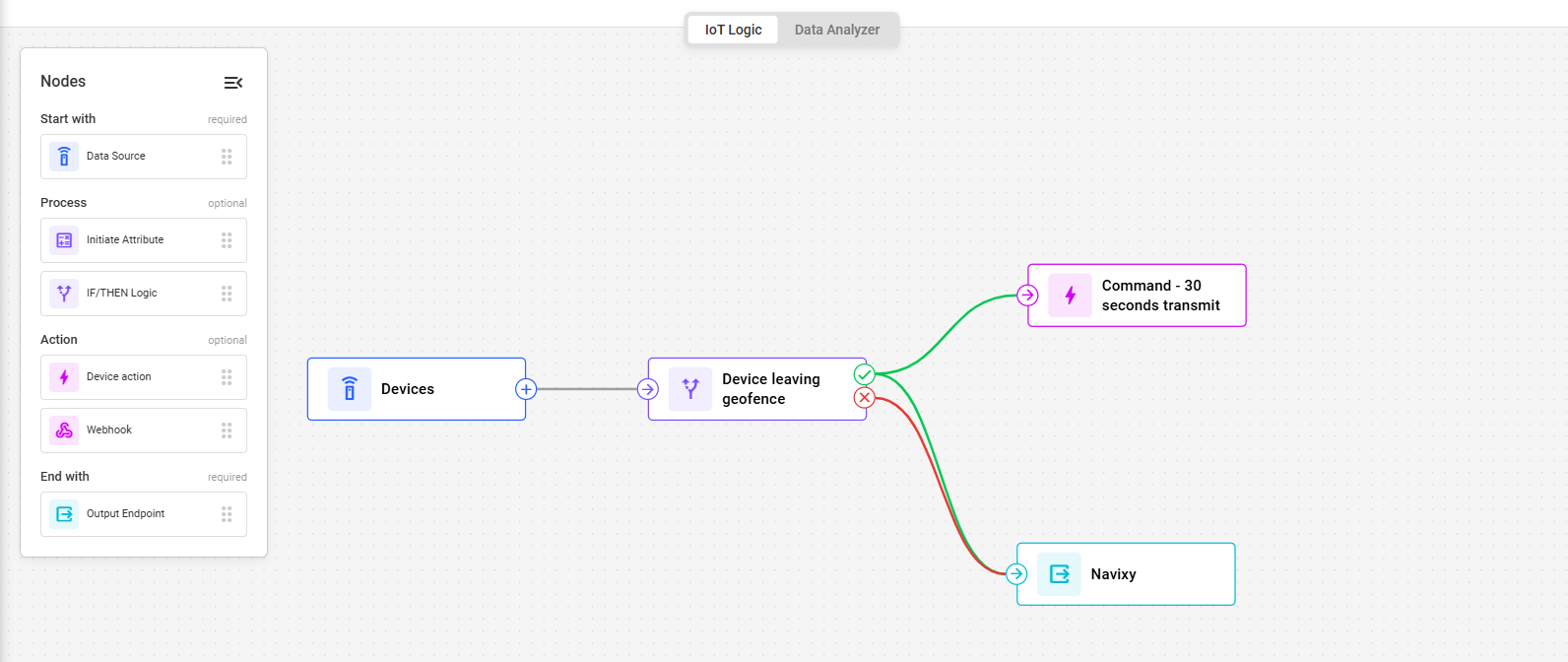
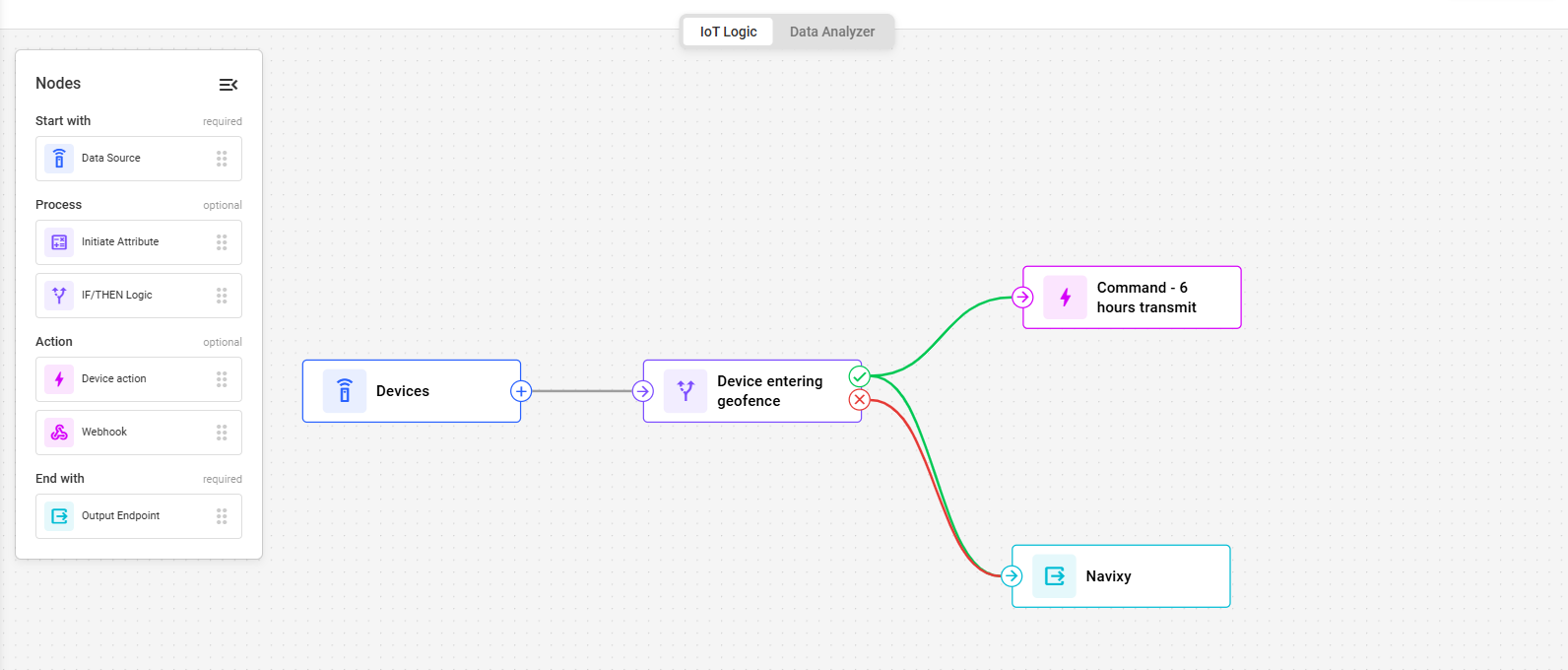
The second rule reverses this. Once the device re-enters its geofence, it drops back to the six-hour cycle automatically. No dispatcher action required.
The third rule solves the planning and overload problem from the truck side. When the weight sensor crosses 90% of rated capacity, the rule lights a warning lamp on the cab dashboard. The driver sees it, knows the truck is full, and heads to unload instead of taking on another stop it cannot hold.
All three rules live in the same drag-and-drop canvas. When a threshold needs adjusting, seasonally or because one location fills faster than the rest, the team changes it there without touching anything else.
Route planning that follows the fill level
Once the containers above 70% are identified, the system builds an optimized route from that list and sends it to the driver's tablet through X-GPS Tracker. Containers below the threshold stay off the day's list.
The terrain added a constraint the sensor data alone could not capture. Certain streets have steep sections that wear hard on a loaded truck, and those need to be avoided when a truck is full. The client mapped those roads manually, and we fed the list into the routing logic through the Navixy API.
A loaded truck now gets a route that skips those hills. The maintenance savings, fewer breakdowns and lower servicing costs, were one reason the project continued past the pilot.
For new drivers, this solved the problem we started with: someone who does not know the area can follow the tablet route from day one and cover the right stops without shadowing an experienced colleague for weeks.
Explore Navixy's Field service solution to gain real-time control over every driver and every stop.
Proving the waste collection happened
The third problem on our list was work verification: dispatchers had no reliable way to confirm a truck had actually emptied a container instead of just driving past it. We closed that gap with a native Navixy report: when a truck enters a container's geofence and its speed drops to zero, the event is logged with the truck, the container location, and the time.
Drivers also file field reports through X-GPS Tracker: photos of damaged containers, moved bins, blocked access points. Those reports reach the dispatcher directly and add context no sensor can provide.
In Navixy's fleet analytics platform IoT Query we built a mileage report that counts only kilometers driven while the truck was loaded, since loaded mileage is tracked separately for maintenance. That solves a problem no standard report handles: loaded and unloaded distance wear a truck differently, and the client needed the two tracked apart, built to their own specification.
Where we are now, and what we are still learning
This is a partial deployment; it covers selected recyclable waste streams, not the entire fleet. There are things we are still figuring out.
Sensor contamination is a real maintenance concern. Waste dust, moisture, and material buildup inside a container can block the laser sensor and produce inaccurate fill readings. Regular inspection and cleaning are now part of the operation, an ongoing cost the client did not fully anticipate.
Driver acceptance is uneven. Younger drivers and newly hired staff adopted the tablet routing immediately. Some experienced drivers were reluctant to change a system they had learned over years. Technology adoption and employee training turned out to matter as much as the technical build.
What I can say honestly: where the system is running, routes are shorter, trucks unload before they break down, and new drivers reach full productivity faster than before.
The bigger shift
Choosing the hardware came first, and everything else followed from that choice. The container sensors we picked run on battery only, which capped what they could report and set the six-hour interval behind the 70% threshold. A solar-powered sensor would have removed that constraint, but it also raises the price, so matching the hardware to what the client could pay came before any software decision.
Once the hardware was fixed, we built the rest on top of it in Navixy. Tracking, IoT Logic, and IoT Query together are what let us hand the client a full answer to their operational problem, not a partial one.
I talked about this project on our Navixy Telematic Talks podcast with Bodo Erken, CEO of Trackerando, who runs similar telematics projects for waste companies in Germany from a different hardware starting point: press containers with OEM sensors already built in. His framing of the shift matches what we built here:
"When I started in this business, telematic was just to get GPS coordinates. But these days we're collecting data in real time for clients, and that changes everything." — Bodo Erken, CEO of Trackerando, speaking on the Navixy podcast
That is what changed in this project too. The trucks already had GPS before we started. What we added is the set of rules that turn a sensor reading into a decision: for the containers, for the load, and for the route.
If you are working through a similar case or want to start project with waste collection company, contact us and we will help you build it.