From SQL to the agent: the five stages of fleet analytics maturity

AuthorAlex S., Senior Data Engineer
A dashboard still waits for someone to ask the right question. An analytics agent asks it first — here's where that shift stands today, and what has to be true before it can act on your fleet's data.
A fleet manager wants to know why maintenance costs rose this quarter, not which table holds the maintenance data. Moving directly from a business question to an actionable answer without SQL or analyst intervention defines the analytics agent. Today, fleet management is progressing along a five-stage maturity curve toward this very capability.
By 2027, Gartner expects augmented analytics capabilities to evolve into autonomous analytics platforms that fully manage and execute 20% of business processes — the industry-wide version of the same climb. This post names the five stages and shows the architecture Navixy is building toward the top of the maturity model. For the data layer underneath all five stages, see how raw telematics signals become a KPI in the first place.
The five stages of fleet analytics maturity
The five stages describe how a fleet team's relationship with its own data changes, not how much data it collects.
Manual SQL queries. Users query the database directly. Getting an answer requires SQL and a working knowledge of the schema — fast for the person who knows both, a bottleneck for everyone else.
BI dashboards and reporting. Pre-built reports and dashboards make analytics accessible to non-technical users, but a new view still means opening a ticket with an analyst or a developer.
Self-service BI. Non-technical users explore data and build their own visualizations without writing SQL. This is where most fleet analytics platforms sit today, Navixy's own Dashboards app included until recently.
Augmented analytics. Gartner coined this term in 2017 for tools that use machine learning and natural-language processing to automate data preparation and insight discovery inside a still human-driven workflow — AI assists the exploration, but a person still runs it.
Agentic analytics. Gartner's February 2025 Market Guide describes this stage as the evolution of augmented analytics: an AI agent plans, investigates, and acts across the data-to-insight workflow toward a stated goal, with human review built into the workflow.
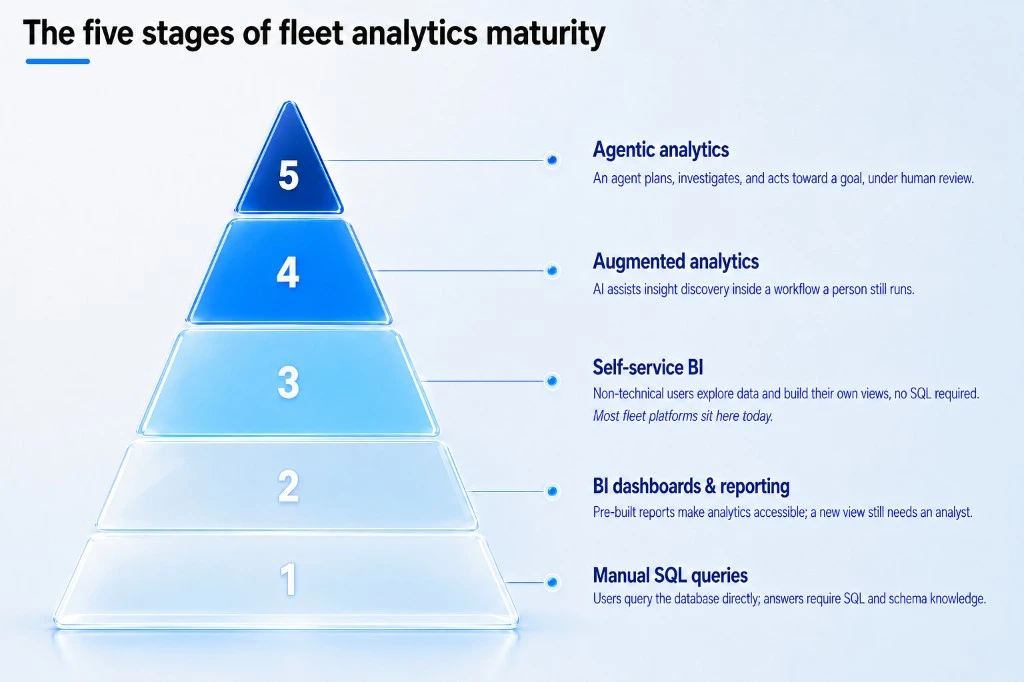
The jump from Stage 3 to Stage 5 is the one worth examining, because it changes who does the work of turning a question into an answer.
What an analytics agent actually changes
Self-service BI still asks a fleet manager to think like an analyst first: pick the table, choose the filter, build the chart, then interpret it. An analytics agent turns this model upside down. It plans the analysis autonomously, allowing fleet managers to ask practical everyday questions rather than thinking like a data analyst:
- Which vehicle models burn more fuel than the rest of the fleet?
- Why did maintenance costs rise this quarter?
- Which devices are due for replacement soon?
- Which regions show the most downtime?
None of those questions maps cleanly to one table or one chart type. Each one requires joining sources, comparing against a baseline, and explaining the result in words a non-analyst can act on. Self-service BI still leaves that joining and interpreting work to the person asking; an analytics agent does it and hands back an answer instead of a blank canvas.
Two paths to an analytics agent
Navixy is building toward an analytics agent along two connected paths. Navixy AI Assistant is the first: a chat interface built into the platform and website that answers documentation and how-to questions for anyone, and, once added as a User Application, can also query a signed-in account's live trackers, sensor readings, and trip history.
The second path runs through Dashboard Studio, the open-source, SQL-based dashboard builder that already sits on top of IoT Query's raw, transformation, and business-metrics layers. AI BI Specialist, embedded inside it, turns a plain-language business question into a proposed dashboard structure, then lets the user refine the result panel by panel instead of writing the SQL by hand.
The distinction from a stand-alone chatbot matters here: the agent isn't a separate window answering questions about the data, it's part of the same workflow a fleet manager already uses to build a dashboard.
An architecture built for what comes next
Underneath both surfaces is a deliberate architecture choice: Amazon Bedrock, whose multi-agent capabilities provide the structural foundation for the platform's future evolution. Today, Dashboard Studio operates with a single production agent — AI BI Specialist. The same architecture can support additional specialist agents as the platform evolves.
That future structure mirrors how a real fleet operation is staffed. A fleet manager owns utilization and dispatch decisions; a cost analyst owns maintenance and fuel budgets; a maintenance lead owns vehicle condition; a safety officer owns compliance and risk.
Specialist agents also need specialist knowledge. Maintenance procedures change, safety regulations update, and escalation policies evolve over time. As additional specialist agents are introduced, each can draw on its own curated knowledge base rather than sharing one monolithic source of information.
Amazon S3 Vectors, a native vector-storage bucket type integrated with Amazon Bedrock Knowledge Bases, provides a way to keep those knowledge bases current without operating a separate vector database. AWS states that it can reduce the cost of storing and querying embeddings by up to 90% compared with a specialized vector database, making it practical to refresh an agent's knowledge as procedures change rather than on a quarterly budget cycle.
No fleet operation runs on one universal expert, and an agent architecture that mirrors those roles makes it easier to scope access naturally than one that flattens them into a single assistant. Narrowing a maintenance-specialist agent's tools to work-order and sensor data is a smaller, more reviewable surface than narrowing one do-everything agent after the fact.
Security is part of the architecture, not an afterthought
While the broader architecture is designed for multiple specialist agents, today's implementation focuses on AI BI Specialist. The same least-privilege model that would govern future specialist agents already applies today: AI BI Specialist gets access only to the tools and data its job actually requires, nothing wider by default.
AI BI Specialist has no access to personal customer data. Its toolset is fixed to four operations: validating a SQL query before it runs, checking a dashboard request against what the data supports, pre-rendering a visualization before it reaches the screen, and generating the structure of an analytics object. That constraint is what makes an agent's behavior predictable enough to put in front of a live account — and it's also what has to extend, deliberately, before an agent can do more than answer a question.
What's next: from augmented to agentic
That extension already has a name, and in one form, a live implementation. Navixy MCP Server connects an external AI client (Claude Desktop, Cursor, ChatGPT) to a signed-in user's live account data through the User API today: ask Claude which trackers are online right now, and it queries the account directly, no custom integration required.
MCP itself isn't a Navixy-specific choice. Anthropic donated the Model Context Protocol to the Linux Foundation's Agentic AI Foundation in December 2025, and it's now described as the universal open standard for connecting AI models to tools and data, with more than 10,000 published MCP servers and adoption across Claude, Cursor, Microsoft Copilot, Gemini, and ChatGPT.
Today, the Navixy MCP Server lets external AI clients query live fleet data through the User API. The next evolution is exposing Dashboard Studio's widgets and analytics workflows as MCP Apps. Extending that interface to Dashboard Studio will allow those same clients not only to retrieve data but also to create and refine dashboards, validate queries, and eventually coordinate specialist analytics workflows.
That is the fifth stage of the ladder this piece opened with: not a person building a report, and not even a person asking an agent a question, but an agent running the workflow with a person reviewing the plan and the result. While Gartner's prediction of reaching 20% of business processes by 2027 reflects an industry-wide trend rather than a Navixy-specific roadmap, the architecture described above is built to be ready either way.
Fleet teams already connecting an AI client to their account through Navixy MCP Server can see today's version of this shift firsthand. Ask the in-app AI Assistant or Dashboard Studio's AI BI Specialist for the next KPI view instead of building it by hand.
Want to see an analytics agent working against your own fleet's data? Contact us to talk through what that looks like for your fleet.