The box was never the point: telematics after the factory modem
The box was never the point. For three decades telematics measured itself by the device — which tracker, which installer, which truck roll — but the value always lived one layer up, in whatever turned a raw signal into something a fleet could act on.
In 2024, 79% of new cars sold globally shipped already connected — up from 75% a year earlier, per Berg Insight. That shift has moved the edge in telematics from the device you install to whichever platform can take any source, an OEM's cloud feed or an aftermarket box, and turn it into one normalized stream you can act on. Call that source-agnostic. Ford's live integration is already running on it.
The fleet now controls its own data
For a while the worry was that automakers would hoard factory data behind their own apps. Regulation is pushing the other way. Since September 2025, the EU Data Act gives the user of a connected vehicle — the fleet that owns or leases it — the right to access the data it generates, and to direct the manufacturer to share that data with a platform of its choice, securely and in a machine-readable format.
The US is moving along the same line. The FTC's 2026 order involving GM and OnStar drew a bright line around consent: owner-consented, business-to-business fleet data is the clean lane forward.
The carmakers are reading those signals and opening the front door themselves. Ford frames its commercial data program as exactly that — "the power of choice," so a business can get manufacturer-grade vehicle data from the telematics provider it chooses. The fleet decides where its data goes. So the platform you choose matters more than it ever did.
There are two ways to lose when the modem ships from the factory
The first is to keep betting on the box. IndexBox estimates connected-vehicle dongles and modems shed a few percent of price every year, while the software and analytics layered on top roughly triple in value by 2035 in the EU. A business whose value is "we sell and install the device" is standing on an eroding floor.
The second way is subtler, and two companies spent over a billion dollars proving it. Wejo and Otonomo aggregated connected-car data to resell the raw feed, and neither model held up on its own: per TechCrunch and Automotive World, there weren't enough buyers for raw data to cover hundreds of millions in combined operating cost. Both changed hands in 2023–2024 — Wejo's technology went to Jacobs Solutions through bankruptcy proceedings, and Otonomo merged into the roadside-assistance provider Urgently, its shareholders left with a minority stake.
Put the two failure modes side by side and the lesson repeats: value collects in the layer that turns any source into something an operator can act on.
Source-agnostic, not device-agnostic
The industry has worn the "device-agnostic" badge for years — we support any tracker brand. It was a good badge, and it's quietly out of date, because it still assumes there's a device to choose.
The more useful question is whether a platform is source-agnostic. Four things define one, and each applies to any source — an OEM cloud feed as readily as a GPS box:
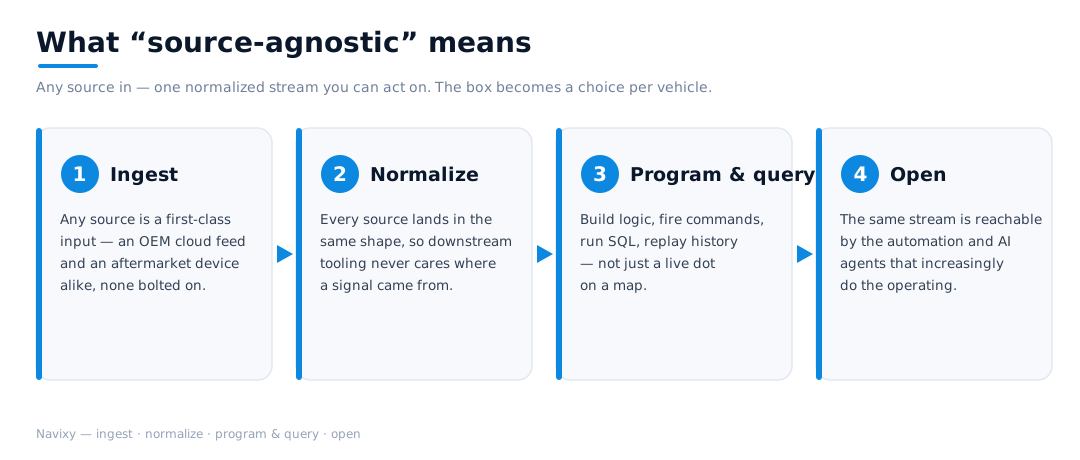
- Ingest any source. An OEM's cloud feed and an aftermarket device both enter as first-class inputs from day one.
- Normalize to one stream. Every source lands in the same shape, so downstream tooling treats it identically no matter where the signal originated.
- Program and query it. The stream is something you build logic on and run reports against, well beyond a live dot on a map.
- Open it to agents. The same stream is reachable by the automation and AI layers that increasingly do the operating.
Hardware still earns its place inside this picture. Most fleets already mix vehicles from several manufacturers — bought across different years, budgets, and leasing deals — and most still run a tail of older or specialized vehicles that need a physical device for deep telemetry, immobilization, or cold-chain duty. Hybrid is the steady state for the foreseeable future. The point of source-agnostic is that the box becomes a choice made per vehicle — and whichever source a given vehicle uses, it lands in the same place.
How Navixy makes any source one stream
Inside Navixy, an OEM cloud feed and a GPS tracker are treated as the same kind of citizen. Both enter through IoT Logic and are normalized into one shape — the Navixy Generic Protocol — and from that point on everything downstream simply works: live maps, automation, SQL, replay, alerts, a white-label app.
That last part turns showing data into operating on it. Once a signal is in the stream, you can program on it with IoT Logic (build a scenario, fire a command, immobilize a vehicle), query it in SQL with IoT Query, replay up to three years of it with Time Machine, and expose it to an AI agent over the MCP layer — the full lever set a composable platform hands an operator.
Navixy normalizes the signals the manufacturer's cloud exposes — odometer, coolant temperature, seatbelt status, whatever that specific feed actually publishes — and operates on them the same way it operates on a device feed. Every signal an automaker adds to its own cloud tomorrow shows up in Navixy the same way, on the same terms. Ford is a good place to see how rich that feed already is.
Ford: the proof already running
It's easy to claim "any source." Here is a concrete one, already built and in production.
Navixy ingests Ford vehicle data directly from Ford's connected-vehicle cloud — the Transportation Mobility Cloud, built on Autonomic — with no device installed in the truck. There is nothing to wire and no OBD dongle: the integration is a set of credentials and a data stream.
The feed itself runs deep: odometer, fuel, engine and coolant temperatures, door and hood state, seatbelt and parking-brake status, and VIN — plus, on electric Fords, battery state of charge and time-to-charge. Safety and behavior events arrive too: harsh braking, excessive idling, forward-collision warning, impact. They map onto the same native events any Navixy device would raise, so existing alerts and rules just fire.
The detail that matters most is structural: the Ford feed lands in exactly the same pipeline as a Teltonika or Queclink box, falling through the same funnel as everything else — and that is the whole point. Onboarding the next automaker is mostly a matter of pointing that same funnel at a new source.
Onboarding runs on credentials: point that same funnel at a new set of API keys, and a fleet already running connected Fords can turn on telematics from a configuration screen — no installer, no truck roll.
What it means — whether you run the fleet or supply it
The shift lands on two kinds of reader at once, and the answer is the same layer for both.
If you run connected vehicles, the real question is whether your platform can merge the factory feed with the devices you've already installed into one picture — a single screen and a single report spanning a multi-brand, mixed-generation fleet.
If your business is selling and installing hardware, the factory modem can feel like a countdown clock. Handled right, the OEM wave carries the channel forward. The value was always the data layer the box carried.
The value is the customer relationship, the vertical know-how, and the brand, and OEM data touches none of those; what it removes is cost and friction — truck rolls, RMAs, install scheduling. So ride the factory modem where it fits, keep the box where it earns its place, and move margin up-stack to the outcomes, automation, analytics, and white-label product that compound instead of commoditize.
Most OEM-data deals turn on data competency: a fleet that needs its data operationalized needs the expertise a small install partner often lacks, which is exactly the platform's job. The partner who brought the account keeps what was always theirs: supply, install, integration, service, sales, tenders. That's cooperation.
And the same substrate lets an enterprise team or a product company build its own niche offering with Navixy underneath — a new kind of builder alongside the reseller who serves a 50-mile radius.
The takeaway
The shift underneath telematics is structural and already locked in: the vehicle ships the sensor, the regulator hands the data to the fleet, and the average fleet is too multi-brand for any single box to matter. The advantage has moved up a layer — to whoever can make every source act as one.
OEM-ready by default, proven on Ford.
- If you run connected vehicles: you already have OEM data sitting in a handful of portals. Turn it into one programmable, queryable stream across every brand you run — with nothing to rip out. Book a data-architecture session.
- If you build telematics products — or want to: add OEM ingestion to your offer under your own brand. Talk to Navixy about partnership.