Unify OEM telematics and GPS monitoring in one platform
OEM telematics is the factory-installed hardware and cloud software that lets a vehicle report location, diagnostics, and usage data straight from the manufacturer – no aftermarket tracker required.
Navixy unifies that OEM data with your installed devices, giving mixed fleets a single source of truth for tracking, diagnostics, and automation.
- See every vehicle in one dashboard – OEM-equipped and aftermarket-equipped alike
- Stream OEM vehicle data (location, mileage, diagnostics, fuel, alerts) directly from the manufacturer's cloud
- Keep using your existing trackers and sensors – Navixy is source-agnostic, whether the data comes from a device or the manufacturer's cloud
- Automate responses to events with visual logic flows (e.g., temperature, engine codes, geofences)
- Own your data with full historical storage for analysis and reporting
Built for fleets, integrators, and mobility services operating mixed brands and mixed hardware.
What is OEM telematics?
OEM telematics is the factory-installed hardware and cloud software that lets a vehicle report location, diagnostics, and usage data straight from the manufacturer — no aftermarket tracker required. Ford Pro, GM OnStar, and similar manufacturer programs are common examples, and most mixed fleets end up running OEM data alongside traditional GPS trackers.
Each manufacturer ships its own data format, activation process, and portal – strong coverage for that one brand's new vehicles, but a separate system to log into for every OEM program a fleet runs. Older vehicles and any brand without a factory telematics program still depend on installed GPS trackers, CAN adapters, and sensors.
That's why most mixed fleets don't pick one over the other. They need a source-agnostic platform that reads OEM feeds and installed-device data side by side – which is exactly what Navixy is built to do. For a full side-by-side breakdown, see OEM telematics vs. aftermarket GPS tracking.
Use Cases
Explore real-world applications and success stories for OEM telematics integration

OEM Vehicle Brands
Learn about supported manufacturers: Ford, Volvo, Scania, and more

Roles
Solutions for Fleet Managers, System Integrators, and other key roles

Ford Pro Integration
How Navixy connects to Ford Pro's API and unifies it with the rest of your fleet
OEM vs. Aftermarket
Full factor-by-factor comparison to help you decide — or see why most fleets run both
When your vehicle data is scattered, your decisions are too
Your world today probably looks like this:
- New vehicles arrive with OEM telematics already built in
- Older units depend on GPS trackers, CAN adapters, or wired sensors
- Each brand pushes its own portal, data format, and login
- Your operations team still lives in spreadsheets to connect the dots
So every time you need an answer – "Where is this vehicle?", "Why did this asset fail?", "How much fuel did we really use?" – you end up jumping between:
- • Multiple OEM dashboards
- • Generic fleet platforms that only see some of your devices
- • Ad-hoc exports stitched together in Excel
Trigger events that expose the problem
- •Rolling out a new OEM-equipped fleet while still operating legacy vehicles
- •Expanding into a new region with different vehicle brands and regulations
- •Launching a new service (e.g., rental, subscription, or last-mile) that requires reliable, near real-time GPS monitoring and vehicle health data
- •Implementing safety or sustainability KPIs that depend on accurate, consolidated data
The cost of doing nothing
- •Delayed decisions because no one trusts a single source
- •Preventable breakdowns because diagnostic codes are missed or arrive too late
- •Inefficient fuel usage and under-utilized assets
- •Extra work for IT and operations teams to maintain brittle integrations
- •Career risk for decision-makers who are "responsible for the fleet" but don't really control the data
One vehicle data platform for OEM telematics and installed devices
Navixy is a source-agnostic telematics platform that ingests OEM vehicle data and aftermarket signals into a single, coherent layer. Instead of juggling separate systems, you get one place to:
Track new cars and existing vehicles
Read OEM diagnostics, CAN, and vehicle health metrics
Monitor GPS and sensor data from installed trackers
Build automated workflows and alerts that apply across your whole fleet
Four pillars of the Navixy OEM telematics approach
Unified data ingestion
Connect OEM APIs and third-party protocols into one normalized data model. Vehicle location, mileage, fuel, DTCs, temperature, inputs/outputs – processed consistently regardless of source.
Hybrid OEM + aftermarket model
Use OEM telematics where it's strong (plug-and-play on new vehicles) and complement it with hardware where you need extra sensors or specific behavior. Navixy doesn't force a choice; it orchestrates both.
Automation with IoT Logic
Define "if–then" rules visually: geofence events, harsh conditions, temperature thresholds, specific engine error codes, offline periods, and more. Trigger notifications, webhooks, or workflows automatically – across all sources.
Raw data and analytics-ready storage
Every data point is stored in its native detail, in a raw data lake. You retain ownership and can feed BI tools, data science pipelines, or custom dashboards on top of Navixy.
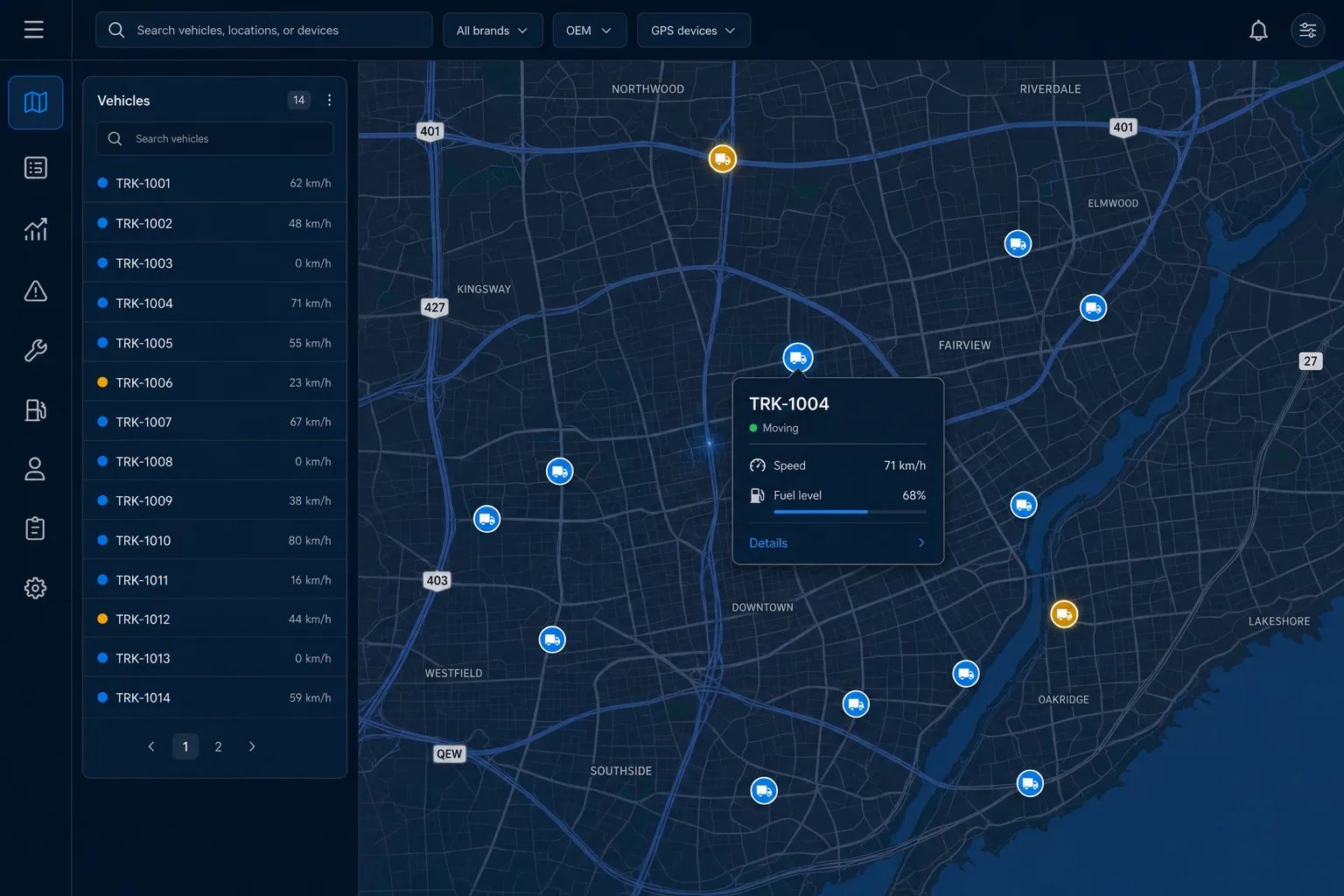
One live map, every data source
Once OEM accounts and installed devices are connected, the source distinction disappears from daily work. Dispatchers see one fleet, one map, one set of alerts.
Filter by source when it matters
Slice the fleet by brand, OEM program, or device type — then forget about it the rest of the time.
Same alerts, same automations
Geofences, speed rules, and maintenance triggers fire identically for OEM and tracker-equipped vehicles.
One history, one report layer
Trips, fuel, and diagnostics land in the same storage regardless of where the signal originated.
How Navixy connects your OEM and device data
Every source — manufacturer clouds and installed hardware alike — streams into one platform and out to the tools your team already uses.
- 1
Connect your OEM accounts
Authorize Navixy to access your OEM telematics data via secure APIs for supported brands (e.g., commercial vehicles, passenger cars, trucks). Vehicles appear automatically in the platform as soon as they're activated.
- 2
Add installed devices and sensors
Link your existing GPS trackers, CAN modules, and sensors. Navixy already speaks dozens of protocols and normalizes them using its generic telematics protocol.
- 3
Map vehicles and attributes
Match OEM vehicles and aftermarket units to your business entities (assets, drivers, projects, contracts). Choose which attributes matter: location, odometer, fuel, battery, temperatures, door status, etc.
- 4
Automate and analyze
Use IoT Logic and built-in reports to create alerts, workflows, and KPIs: maintenance triggers, SLA adherence, utilization, safety events. Export or sync data to your BI tools when needed.
OEM telematics vs. aftermarket GPS tracking
Neither one wins outright – the right choice depends on the vehicle, the brand, and how soon you need it online. Navixy is built to run both at once.
| Factor | OEM telematics | Aftermarket GPS tracking |
|---|---|---|
| Setup & activation | Built in at the factory – active as soon as the vehicle is delivered and the program is enabled | Requires purchasing and installing a device on every vehicle |
| Brand & vehicle coverage | Limited to that manufacturer's program – a mixed-brand fleet means multiple OEM portals | Works across any make, model, or age of vehicle |
| Data depth | Strong on factory diagnostics and vehicle health (DTCs, odometer, fuel, engine status) | Strong on location and custom I/O – extensible with extra sensors (temperature, fuel probes, cameras) |
| Ongoing cost | Manufacturer subscription fee per vehicle, set by the OEM | Hardware cost up front, plus a platform subscription you control |
| Best fit | New vehicles from a single manufacturer, factory diagnostics use cases | Older vehicles, mixed brands, or use cases needing extra sensors |
Most fleets end up needing both. Read the full OEM vs. aftermarket comparison or see how a rental fleet weighed the two in practice.
Where unified OEM telematics makes an immediate difference
Use case 1 – Mixed-brand corporate fleet
Context:
A regional logistics company runs 400 vehicles from multiple manufacturers. New trucks arrive with OEM telematics; older units depend on installed trackers.
What they do with Navixy:
- Connect OEM accounts and legacy devices in a single platform
- Use one map and one dashboard for all vehicles
- Configure maintenance alerts based on odometer and DTC codes
- Monitor GPS tracking and fuel levels across the entire fleet
Outcome:
Fewer missed services and breakdowns. Less time spent switching between OEM portals. A single reporting layer for management and finance.
Use case 2 – Telematics integrator launching OEM-based services
Context:
A telematics integrator wants to offer OEM-based solutions to clients, without rebuilding their stack for each new manufacturer.
What they do with Navixy:
- Use Navixy as the unified data layer for OEM and aftermarket signals
- White-label the interface and expose APIs to their customers
- Configure standardized packages (tracking, vehicle health, cold chain, etc.) regardless of vehicle brand
Outcome:
Faster time-to-market for new OEM programs. Less engineering spent on one-off integrations. Higher margin services built on a reusable, scalable platform.
Use case 3 – Rental / subscription fleet tracking new cars out of the factory
Context:
A rental or car subscription business regularly onboards brand-new vehicles. Devices are not always installed immediately, but accurate GPS monitoring and usage-based billing are needed from day one.
What they do with Navixy:
- Track new cars via OEM telematics as soon as they leave the dealer lot
- Use OEM fuel and mileage data to automate billing and refueling charges
- Gradually add extra devices (e.g., immobilizers, dashcams, temperature sensors) where needed, still using the same Navixy platform
Outcome:
No gap in visibility between purchase and device installation. Tighter control over vehicle usage and fuel costs. Ability to scale into new regions and brands without starting from scratch.
Proven telematics foundation you can build on
Designed as a global telematics ecosystem that integrates OEM modules, aftermarket trackers, and IoT sensors in one interface
Built to eliminate vendor lock-in and support long-term growth for fleets and integrators
Every event stored in a raw data lake for full traceability and advanced analytics
A typical mixed-brand rollout starts with five different portals and weekly CSV exports — and ends with one unified vehicle data platform. OEM telematics is used where it makes sense, existing devices stay in place, and management gets a single source of truth for the whole fleet.
Composite scenario · Regional logistics fleet, mixed-brand rollout
Security & trust themes
- Secure API integrations with OEM providers
- Role-based access control and audit trails
- Data residency and export options to align with internal policies
Why a unified OEM telematics platform beats piecemeal tools
| Feature | Spreadsheets & manual exports | Single-source portals or generic tools | Navixy unified OEM + device platform |
|---|---|---|---|
| Coverage across brands & devices | Depends on what you remember to export | Strong for one brand or device type, weak outside it | Designed for mixed fleets and mixed hardware from day one |
| Real-time visibility | Snapshots only, quickly obsolete | Real-time, but fragmented across portals | Real-time view spanning OEM vehicles and installed trackers |
| Automation & alerts | Manual checks, high risk of missed events | Limited to the scope of that OEM or device | Cross-fleet rules and IoT Logic flows that apply regardless of source |
| Data ownership & analytics | Difficult to ensure quality and lineage | Often bound to one vendor's ecosystem | Full raw data storage with direct access for BI and data teams |
| Scalability | Break under scale and complexity | Scale limited by that provider's roadmap | Built as a multi-tenant, global telematics platform designed to grow with fleets and integrators |
Invest once in a vehicle data foundation that keeps paying off
Rather than paying the hidden cost of fragmented tools and manual integrations, Navixy lets you:
- Start with a footprint that matches your current fleet size and grow as you add vehicles
- Mix OEM-only deployments with hardware-rich scenarios using the same platform
- Avoid re-platforming every time you change OEM partners or device vendors
Pricing scales with fleet size and how much of the platform you use — from basic tracking to full diagnostics, automation, and analytics, with room to add capacity as you grow.
For exact pricing, the best next step is to book a demo and align options with your fleet size and roadmap.
FAQ: OEM telematics and Navixy
Latest on OEM telematics
From our engineering and product team: deep dives on unifying OEM data with the rest of your fleet.
Stop fighting your data. Start using it.
Your vehicles are already generating rich OEM telematics and device data. The real question is whether that data is working for you – or making your life harder.
Navixy gives you a single, flexible vehicle data platform where OEM telematics and GPS monitoring finally come together. So you can make faster decisions, run safer and more efficient operations, and build services that keep you ahead of the curve.
Book a demo to see your mixed fleet in one dashboard.
Prefer a conversation first? Talk to an expert about your OEM and device landscape.