Ride the OEM wave, keep your brand
A reseller is building next year's renewal numbers when the hardware line disappears from the spreadsheet: the customer's next batch of vans will arrive already streaming odometer, location, fuel, and fault codes straight from the factory, with no device left to price. The line that used to start with hardware now starts with a question: so what do I sell?
You sell the layer above the box. For an eligible factory-connected vehicle, the factory modem can remove that install. It does not remove the customer relationship. The partner can build its offer around the outcomes, automation, analytics, and white-label service that use the vehicle's data.
The floor under "sell and install" is eroding
The market moved before any vendor pitched it, and it lands regardless of which platform a partner runs on. In 2024, 79% of new cars sold globally shipped already connected, up from 75% a year earlier, per Berg Insight. On the commercial side, Mordor Intelligence puts the OEM/factory channel at 58.71% of 2025 commercial-vehicle telematics revenue, now ahead of the aftermarket — though the aftermarket is forecast to grow faster, at a 15.14% CAGR.
The economics point the same way: IndexBox estimates that in the EU commercial-vehicle remote-diagnostics market, connected-vehicle dongles and modems shed roughly 3–5% of unit price every year, while the software and analytics layered on top grow several-fold through 2035. That trend puts pressure on an offer priced mainly around selling and installing the device.
Hardware stays part of the picture. Factory connectivity makes the vehicle signal available without an aftermarket device in more cases, so the partner's differentiation has to come from how that data is used.
Where the account's value actually lives
The customer relationship, vertical know-how, integration work, service, and brand remain work a factory modem does not perform. Where an OEM feed replaces a device, it can also remove truck rolls, RMAs, install scheduling, and spare-unit inventory from that vehicle.
When pricing anchors on the device, hardware price pressure reaches the whole offer. A partner can instead price the service it performs around the data: integration, operating workflows, reporting, support, and the branded customer experience.
The up-stack pivot
When the vehicle delivers its own signal, the value shifts to the layers the box was quietly subsidizing all along:
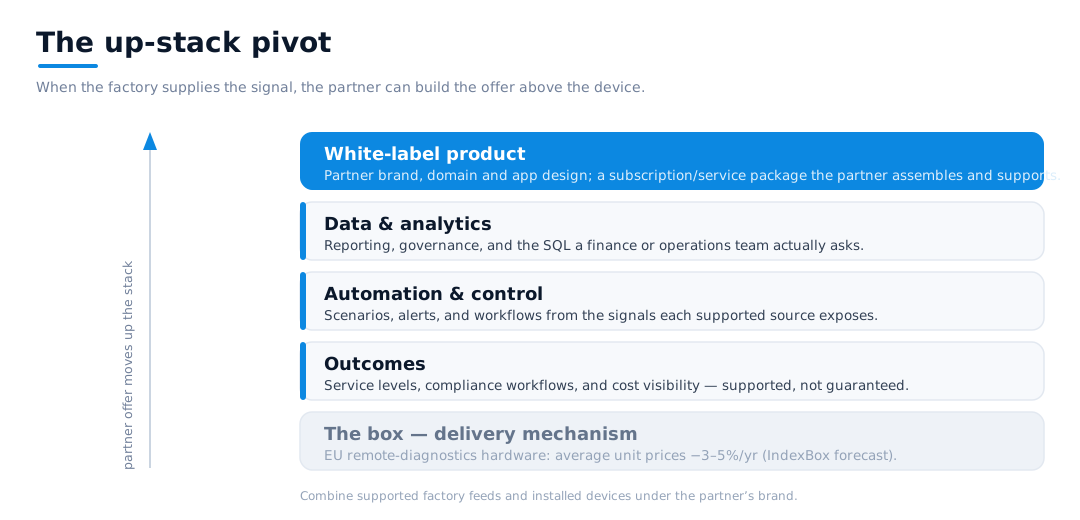
- Outcomes. Service levels, compliance workflows, and cost visibility — business goals the data service can support without guaranteeing the result.
- Automation and control. Turning supported signals into scenarios, alerts, and operating workflows; commands still depend on the source and installed hardware.
- Data and analytics. Reporting, governance, and the queries a finance or operations team actually asks.
- A white-label product. The partner's brand, domain, and app design, plus a subscription and service package the partner assembles and supports.
The box sits below all four, and the measured hardware category is under price pressure. The category-level piece describes the same shift as moving from device-agnostic to source-agnostic.
Mixed fleets keep hardware in the model
Riding the wave still keeps hardware in the mix. A fleet may run several manufacturers bought across different years, budgets, and leasing deals, with specialized vehicles that need a physical device for deep CAN access, immobilization, or cold-chain duty. Older or base-trim vehicles may also lack an available factory feed.
A partner can use the factory feed where it fits and an installed device where the job requires one, both under one roof and one brand.
The partner still owns customer-facing work
For an eligible vehicle, bringing an exposed OEM signal into the service does not require a tracker solely to collect that same signal. It does require ingestion, normalization, and data tooling behind the partner's operating and customer-facing work.
Across a mixed portfolio, the partner can continue to supply and install devices where needed and own integration, service, sales, and tender work. The platform normalizes the data underneath. That division is cooperation, not disintermediation.
That same division of labor widens who counts as a builder. A regional reseller is one kind. An enterprise team standardizing a mixed fleet or a software company embedding fleet data in its own product is another; each can put its own service and brand above the normalized source.
How Navixy does it
Under the hood, Navixy treats an OEM cloud feed and a GPS tracker as inputs to the same normalization layer. Both enter through IoT Logic and normalize into the Navixy Generic Protocol. Each OEM still needs its own authentication, connector, decoding, and field mapping; after that source-specific work, the normalized output uses the same platform model.
For the channel specifically, external sources are scoped per partner account: an OEM feed a partner provisions runs under that partner's own white-label brand.
On top of the normalized stream sit tools a partner can include in its service: IoT Logic for automation and alerts, IoT Query for SQL and reporting, and Time Machine for historical replay. Navixy has completed a SOC 2 Type II audit; the report is available to customers and qualified prospects under NDA for their security review.
The connector pattern is built OEM-agnostic; Ford is the first integration running on it, live today — size a deal on the Ford feed shipping now. Navixy normalizes the signals the manufacturer's cloud exposes, the same way it normalizes a wired tracker's feed.
The takeaway
For a supported factory-connected vehicle, the modem can take one installation out of the quote. The partner can still build and brand the service that turns that feed, alongside installed devices, into operating work.
- If you sell and service telematics: add OEM ingestion to your offer under your own brand and package the operations, automation, and reporting above the source. Explore Navixy white-label options.
- If you run the fleets partners serve: the same layer unifies your factory feeds and installed devices into one picture — worth a conversation with the partner who already knows your operation.